

SC Slams Meta: Why Chief Justice Warned WhatsApp Over its Privacy Policy & What it Means for Your Data
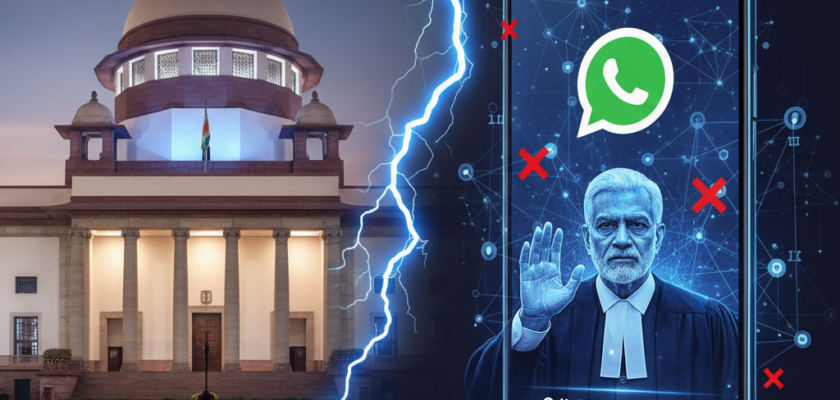
In a landmark hearing on Tuesday, February 3, 2026, the Supreme Court of India issued a stern warning to Meta (the parent company of WhatsApp) regarding its controversial 2021 privacy policy. The Chief Justice of India (CJI) personally intervened, emphasizing that citizens’ data cannot be compromised and that Meta must comply with Indian laws. This development has significant implications for user data protection, digital rights, and the ongoing push for a robust Data Protection Bill in India.
The hearing saw intense arguments from both sides, with the judiciary taking a strong stance against potential data exploitation.
1. The Core of the Controversy: 2021 Privacy Policy Revisit
The Supreme Court case, which has been ongoing since 2021, centers on WhatsApp’s updated privacy policy.
- The Issue: The policy mandates users to agree to share their data with Meta’s other services (like Facebook and Instagram) if they wish to continue using WhatsApp. This was seen as a violation of user choice and a potential monopolistic practice.
- Discrimination Allegation: Petitioners argued that WhatsApp applied this policy selectively, enforcing it strictly in India while offering more lenient options in Europe due to stricter GDPR laws. The CJI highlighted this disparity, questioning why Indian users should be treated differently.
2. CJI’s Stern Warning: “Your Data is Our Concern”
The Chief Justice minced no words, directly addressing Meta’s counsel.
- Key Statement: “Your data is our concern, and you cannot compromise the privacy of Indian citizens just because you have a global policy. You must align with Indian laws and ensure the highest standards of data protection for our people.”
- Implication: This warning signals that the judiciary is prepared to take decisive action if Meta fails to address these concerns, potentially leading to a stricter regulatory framework for tech giants operating in India.
3. The Role of the Competition Commission of India (CCI)
The Supreme Court’s observations also touched upon the ongoing investigation by the Competition Commission of India (CCI).
- Anti-Competitive Practices: The CCI has been probing WhatsApp’s privacy policy for potentially abusing its dominant market position to force users into accepting data-sharing terms.
- Legal Scrutiny: The CJI’s remarks will likely add weight to the CCI’s investigation, pushing for a quicker resolution and potentially stricter penalties or structural changes to Meta’s data practices in India.
4. Impact on the Data Protection Bill 2026
This Supreme Court intervention comes at a critical time as India is on the verge of enacting its Data Protection Bill 2026.
- Legislative Urgency: The judiciary’s strong stance will likely accelerate the parliamentary process for passing this bill, ensuring a comprehensive legal framework for data privacy.
- Future Safeguards: The new bill is expected to include robust provisions for data localization, user consent, data breach notifications, and the establishment of a powerful Data Protection Authority (DPA).
5. What This Means for Your Data
For WhatsApp users in India, this ruling brings a ray of hope for enhanced privacy.
- Potential for Opt-Out: In the short term, Meta might be compelled to offer Indian users a clear opt-out option for data sharing, similar to what’s available in Europe.
- Greater Transparency: Companies may have to be more transparent about how they collect, use, and share user data, empowering individuals to make informed choices.
- Strengthened Digital Rights: This case sets a precedent, reinforcing the idea that digital privacy is a fundamental right that cannot be overridden by corporate policies.
WhatsApp Privacy Case: Key Timeline & Impact (2026)
| Event | Date | Significance |
| WhatsApp Privacy Policy Update | Early 2021 | Sparked controversy over data sharing with Meta. |
| Petition Filed in SC | 2021 Onwards | Challenging the legality of the policy. |
| CCI Investigation Initiated | 2021 | Probing anti-competitive practices. |
| CJI’s Stern Warning | Feb 3, 2026 | Direct intervention, emphasizing citizen data protection. |
| Potential Outcomes | Near Future | Opt-out for data sharing, stronger Data Protection Bill. |
Conclusion
The Supreme Court’s unequivocal warning to Meta on WhatsApp’s privacy policy marks a watershed moment for data privacy in India. It underscores the judiciary’s commitment to safeguarding fundamental rights in the digital age and pushes both tech giants and the legislature to prioritize user protection. As the Data Protection Bill 2026 nears its final stages, Indian users can look forward to a more secure and transparent digital environment.
What are your thoughts on WhatsApp’s data sharing? Do you feel your privacy is adequately protected online? Share your views in the comments below!


