


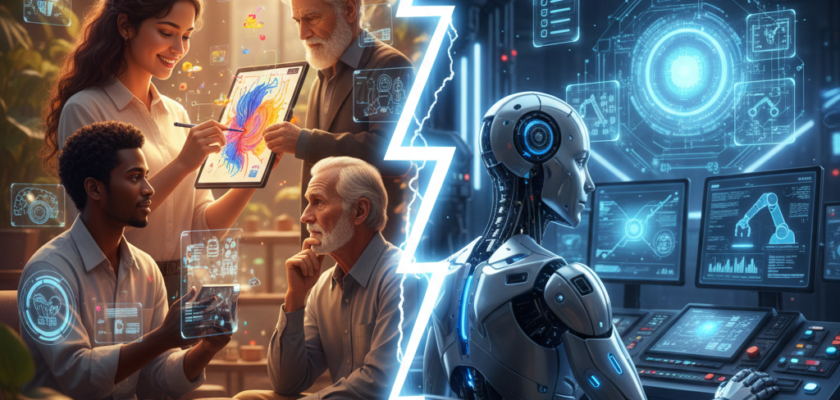
Humans vs. AI: Which Skills Will Remain Impossible to Automate?
As Artificial Intelligence continues its rapid ascent, integrating into every facet of our lives from self-driving cars to complex data analysis, a pertinent question arises: What’s left for humans? While AI excels at repetitive tasks, pattern recognition, and processing vast amounts of data, there are fundamental human skills that, even in 2026, remain largely beyond the reach of automation. These are the skills that will not only differentiate us in the job market but also define our unique value in an AI-powered future.
Here’s a look at the core human attributes that AI struggles to replicate, and why they will remain essential.
1. True Creativity & Original Intuition
While AI can generate art, music, and text based on existing patterns, it struggles with genuine, paradigm-shifting creativity that stems from original intuition, emotional depth, and a unique human perspective.
- Human Edge: The ability to conceptualize something truly novel, to make leaps of imagination without prior data, or to create art that profoundly moves the human spirit based on shared experience. AI combines; humans innovate from an empty canvas.
- Example: AI can write a song in the style of Beethoven, but it can’t compose a symphony that reflects its own profound personal suffering or joy, because it doesn’t feel.
2. Emotional Intelligence & Empathy
Understanding and navigating complex human emotions, offering genuine comfort, or building deep rapport is a uniquely human domain.
- Human Edge: Empathy, compassion, active listening that goes beyond processing words to understanding underlying feelings, and the ability to inspire or comfort another human being. AI can mimic emotional responses, but it lacks genuine subjective experience.
- Example: An AI therapist can analyze speech patterns and suggest solutions, but it cannot genuinely understand the nuances of grief or offer the same therapeutic presence as a human.
3. Complex, Unstructured Problem Solving
AI excels at solving problems within defined parameters and with clear data sets. However, real-world problems are often ambiguous, filled with ethical dilemmas, conflicting human interests, and incomplete information.
- Human Edge: The ability to synthesize disparate information, navigate ethical grey areas, make decisions with incomplete data based on intuition and experience, and adapt to entirely unforeseen circumstances. This requires contextual understanding, not just computational power.
- Example: AI can optimize supply chains, but it cannot negotiate a peace treaty between warring factions or ethically resolve a medical dilemma where there are no “right” answers.
4. Critical Thinking & Ethical Reasoning
While AI can analyze data for biases and inconsistencies, it cannot independently develop a moral framework or challenge its own programming with ethical insight.
- Human Edge: The capacity for independent judgment, questioning assumptions (even its own), understanding the societal implications of decisions, and upholding moral and ethical principles. This involves a subjective understanding of right and wrong.
- Example: AI can identify logical fallacies in an argument, but it cannot fundamentally decide whether a new technology is morally acceptable for society or design laws based on abstract concepts of justice.
5. Interpersonal Nuance & Influential Leadership
Leading people, motivating teams, understanding unspoken cues, and building strong, trusting relationships requires a level of human interaction that AI cannot replicate.
- Human Edge: Charisma, inspiration, mentorship, the ability to build culture, resolve interpersonal conflicts, and persuade through genuine connection and understanding of human psychology.
- Example: AI can manage projects efficiently, but it cannot inspire a team to go above and beyond during a crisis, build loyalty, or navigate complex political dynamics within an organization.
Humans vs. AI: The Unbridgeable Gap
| Skill Category | AI’s Capability (2026) | Human’s Unmatched Edge |
| Creativity | Pattern-based generation, remixing | Original intuition, profound emotional expression |
| Emotional Intel. | Mimicking, analyzing data | Genuine empathy, compassion, rapport building |
| Problem Solving | Defined, data-rich problems | Ambiguous, ethical, human-centric dilemmas |
| Critical Thinking | Logic, bias detection | Ethical reasoning, questioning assumptions, moral judgment |
| Leadership | Task management, optimization | Inspiration, motivation, culture building, interpersonal influence |
Conclusion
As AI continues to evolve, the future of work will undoubtedly be a collaborative one between humans and machines. However, the unique human capacity for creativity, emotional intelligence, complex ethical reasoning, and nuanced interpersonal skills will remain our indispensable advantage. To thrive in 2026 and beyond, the key is not to compete with AI on its terms, but to lean into and cultivate these inherently human attributes. These are the skills that define our humanity, and they will remain impossible to automate.
What human skill do you believe will always be irreplaceable by AI? Share your thoughts in the comments below!


