


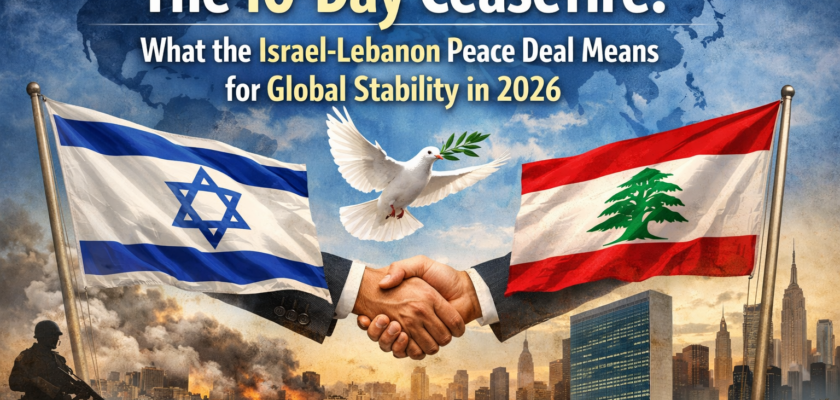
The 10-Day Ceasefire: What the Israel-Lebanon Peace Deal Means for Global Stability in 2026.
As of April 17, 2026, the world is watching the Middle East with a mix of cautious optimism and intense scrutiny. Following weeks of a devastating regional conflict that began on March 2nd, a 10-day Israel-Lebanon Ceasefire 2026 officially took effect at midnight in Beirut. Brokered by U.S. President Donald Trump, this truce represents the first direct diplomatic engagement between the two nations in over four decades.
While the ceasefire is a “gesture of goodwill,” its implications extend far beyond the border of Southern Lebanon. It is a critical test for Global Stability 2026, impacting everything from the Strait of Hormuz oil routes to the future of Sovereign AI security.
1. Key Terms of the 10-Day Truce
The Israel-Lebanon Ceasefire 2026 is not a permanent peace treaty, but a high-stakes “breathing room” deal. The core provisions include:
- Suspension of Offense: Both nations have agreed to halt all offensive military operations. This includes a stop to Israeli airstrikes and a cessation of Hezbollah’s cross-border rocket and drone attacks.
- Security Zone: Israeli forces will remain in a 10km-deep “security zone” in Southern Lebanon for the duration of the 10 days to ensure Minimized Risk of ground incursions.
- Sovereignty Recognition: For the first time, both sides have formally stated they are “not at war” and recognize each other’s territorial integrity.
- Direct Negotiations: The ceasefire is intended to lead to a historic meeting at the White House between Israeli PM Benjamin Netanyahu and Lebanese President Joseph Aoun.
2. Impact on Global Stability and Energy Markets
The Israel-Lebanon Ceasefire 2026 is the primary driver behind a potential “Cooling Effect” on global markets.
- The Hormuz Crisis: The conflict had effectively shut down the Strait of Hormuz, with daily traffic tanking from 100 ships to just 4. With the ceasefire in place, there is a coordinated international effort, led by the UK and France, to resume freedom of navigation.
- Oil Price Volatility: Following the announcement, crude oil prices—which had spiked to $115 per barrel—have begun to show signs of stabilizing. If the truce holds, analysts predict a significant “reload” of energy supplies.
- The Iran Connection: The Israel-Lebanon Ceasefire 2026 is being viewed as a precursor to a wider peace deal between the U.S. and Iran, potentially ending the 2026 Iran War.
3. Strategic Matrix: Conflict vs. Ceasefire 2026
| Feature | Active War (March – April 2026) | Israel-Lebanon Ceasefire 2026 |
| Military Action | Offensive strikes / Drone warfare | Self-Defense only / Offensive Halt |
| Global Energy | Hormuz Blockade / High Volatility | Reopening Routes / Price Stability |
| Diplomacy | Zero Contact / Proxy War | Direct Presidential Negotiations |
| Operational Risk | High (Global Disruption) | Minimized (Confidence Building) |
| Market Sentiment | Bloodbath (Fear-driven) | Cautious Optimism (Recovery) |
4. Challenges to a Lasting Peace
While the Israel-Lebanon Ceasefire 2026 is historic, several “Slowness & Liability” factors remain:
- Hezbollah’s Position: Hezbollah was excluded from the negotiations and remains a “volatile asset” that could violate the truce at any moment.
- Disarmament Clause: Israel’s core demand is the full disarmament of Hezbollah, a condition the militant group has historically rejected.
- Security Zone Friction: The presence of Israeli troops on Lebanese soil remains a major point of contention for Beirut’s sovereignty.
Conclusion
The Israel-Lebanon Ceasefire 2026 is a fragile but monumental step toward a new Middle Eastern architecture. By moving from the “Abacus Maze” of indirect proxy warfare to Autonomous Precision in direct diplomacy, the world has a 10-day window to prevent a full-scale global collapse.
Whether this leads to a “Historic Peace Agreement” or a return to the bloodbath depends entirely on the actions of the next 240 hours. In 2026, the most valuable currency is no longer just oil or AI—it is trust.


