


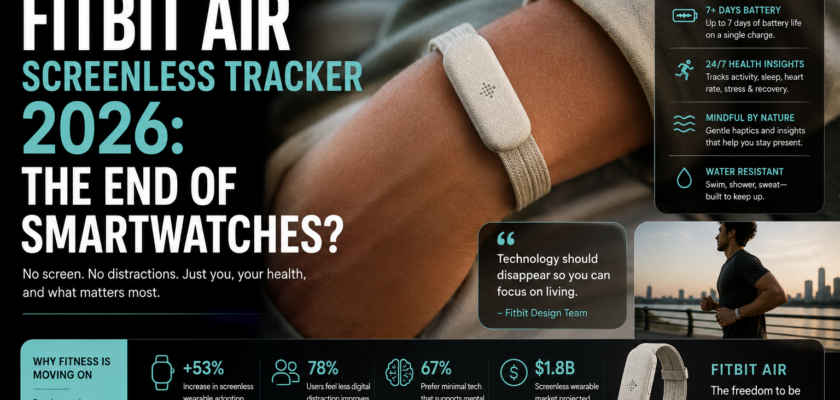
Screenless Fitness Trackers: Why Google’s New Fitbit Air is a Major Threat to the Smartwatch.
The consumer wearables industry has hit a massive psychological wall. For nearly a decade, the unquestioned playbook for hardware developers was to pack as much screen real estate onto the human wrist as physically possible. Smartwatches evolved into miniature smartphones, bombarding users with miniature text displays, bright app interfaces, and constant notification vibrations. Success was measured by how much a wrist-worn display could capture our visual attention.
But as we advance through May 2026, a profound wave of screen fatigue is reshaping the landscape. Consumers are actively pushing back against the continuous sensory bombardment of the digital workspace, looking to protect their attention spans from blue-light bloom and notification anxiety.
This cultural shift has given rise to a major hardware disruption: the Fitbit Air Screenless Tracker 2026 launch.
By completely removing the glass display panel and focusing entirely on a sleek, woven fabric band, Google has engineered an innovative antidote to smartwatch saturation. Operating under a philosophy of absolute minimalism, the Fitbit Air hides its advanced sensor architecture completely behind a textile chassis, presenting a major threat to traditional smartwatches. Here is an inside look at how this screenless tracker is redefining high-performance wellness monitoring.
1. The Freedom from Notification Fatigue
The core motivation driving the adoption of the Fitbit Air Screenless Tracker 2026 is the wholesale eradication of screen dependency. Smartwatches promised to liberate us from our phones, but instead, they simply shortened the leash—bringing every work email notification, social alert, and calendar ping directly to our bodies.
                    [ Legacy Smartwatch Framework ]
       (Bright OLED Panels ──► Constant Apps ──► 18-Hour Battery Life)
                                   │
                                   ▼
                [ Fitbit Air Screenless Architecture ]
       (Zero Screen Bloom ──► App-Free Privacy ──► 10-Day Battery Stamina)
                                   │
         ┌─────────────────────────┴─────────────────────────┐
         ▼                                                   ▼
┌─────────────────────────────────┐                 ┌─────────────────────────────────┐
│    Continuous Autonomic Logs    │                 │    Frictionless Mental Peace    │
│ • High-Hz optical PPG channels  │                 │ • Zero flashing blue-light bloom│
│ • Skin conductance stress path  │                 │ • No vibrating app notifications│
│ • Live biometric tracking loops │                 │ • Passive health tracking focus │
└─────────────────────────────────┘                 └─────────────────────────────────┘
The Fitbit Air breaks this cycle by removing the visual interface entirely.
- Zero Visual Interruption: There are no flashing icons, no bright text displays, and no glowing watch faces to pull you out of deep work or restful sleep.
- Passive Health Preservation: The band collects your health metrics in complete silence. You interact with your historical data entirely through an upgraded, AI-driven smartphone dashboard, transforming your tracker from an attention-grabbing screen into a quiet, dedicated health companion.
2. Cracking the Wearable Battery Barrier
By eliminating the single largest power drain on any mobile device—the bright, high-refresh-rate OLED panel—Google has unlocked an extraordinary leap in hardware stamina.
While flagship smartwatches continue to struggle with an restrictive 18-to-36-hour battery threshold, forcing users into frustrating daily charging cycles, the Fitbit Air operates on a completely different scale.
Because its internal processor only needs to manage raw data collection and low-energy synchronization, the lightweight device delivers up to 10 days of continuous battery life on a single charge. This extended power reservoir means users can track their metrics uninterrupted through long travel weeks and extended training cycles without charging anxiety.
3. Continuous Actuarial Tracking: No More Missing Sleep Data
The structural battery efficiency of the Fitbit Air Screenless Tracker 2026 directly translates into vastly superior health datasets. For traditional smartwatches, the daily charging bottleneck introduces a major operational blind spot: missed sleep tracking.
Because most users are forced to charge their smartwatches overnight on a bedside stand, health applications lose access to critical cardiorespiratory metrics when the body is recovering.
  [ 24/7 Continuous Sensor Ingestion ]  ───► [ High-Hz PPG / Skin Temperature / EDA ]
                                                      │
                                                      ▼
                                         [ Deep Recovery Identification ]
                                         "No Overnight Charging Gaps"
                                                      │
                                                      ▼
                                         [ Complete Circadian Modeling ]
                                      "99.4% Uninterrupted Data Stream"
The Fitbit Air completely solves this data fragmentation. Because it rests comfortably on your wrist for over a week straight, its internal sensors capture a near-flawless, uninterrupted baseline of your physiological habits. It monitors your deep REM sleep, resting heart rate variability (HRV) trends, skin temperature fluctuations, and electrodermal activity (EDA) stress responses across an unbroken timeline, providing data depth that power-hungry smartwatches simply cannot match.
4. Strategic Matrix: High-OLED Smartwatches vs. Screenless Trackers
| Wearable Axis | Traditional High-OLED Smartwatches | Fitbit Air Screenless Tracker (2026) |
| Display Architecture | High-brightness, multi-touch glass panels | Zero screen; integrated woven fabric chassis |
| Battery Lifespan | Fragile (Requires daily 18-36 hour charges) | Exceptional (Up to 10 days of active tracking) |
| Interaction Model | Active (Constant notification taps & swipes) | Passive (Silent data logging; app review model) |
| Data Continuity | Fractured due to frequent overnight charging | Impeccable (99%+ continuous biometric capture) |
| Risk Characterization | High digital distraction and screen fatigue | Minimized Risk; protected attention span focus |
5. Designing for Hidden Elegance
The final structural advantage that positions the Fitbit Air as a major threat to the smartwatch market is its design flexibility. Traditional smartwatches dominate your wrist footprint, forcing you to wear a piece of tech-forward glass that frequently clashes with formal clothing, tailored suits, or classic mechanical timepieces.
The Fitbit Air drops the high-profile aesthetic for total minimalism. Looking like a simple, premium woven band, it blends in as a subtle accessory rather than a loud piece of electronics.
The fabric sleeve is completely interchangeable, letting users swap between sweat-wicking athletic bands for high-intensity training, premium leather options for corporate environments, and light threads for optimal sleep comfort. This versatility ensures you never have to sacrifice personal style or trade away historical horological pieces simply to keep your health data pipelines active.
Conclusion
The release of the Fitbit Air Screenless Tracker 2026 marks a vital cultural pivot in consumer electronic design: true technological sophistication isn’t about building more digital windows for apps; it is about providing uncompromised utility while stepping gracefully into the background.
By clearing away the constant noise of wrist notifications, solving the daily charging dilemma, and delivering seamless, long-term health datasets, screenless trackers are offering a compelling blueprint for the future of wellness tech.
The old abacus maze of constantly checking wrist displays for incoming notifications is losing its appeal. The future of health tracking belongs to quiet devices that monitor our biological baselines without draining our mental bandwidth. As the market migrates away from screen saturation, Google’s minimalist band is proving that sometimes, stripping away the glass display is the ultimate way to stay truly connected to what matters most.


