


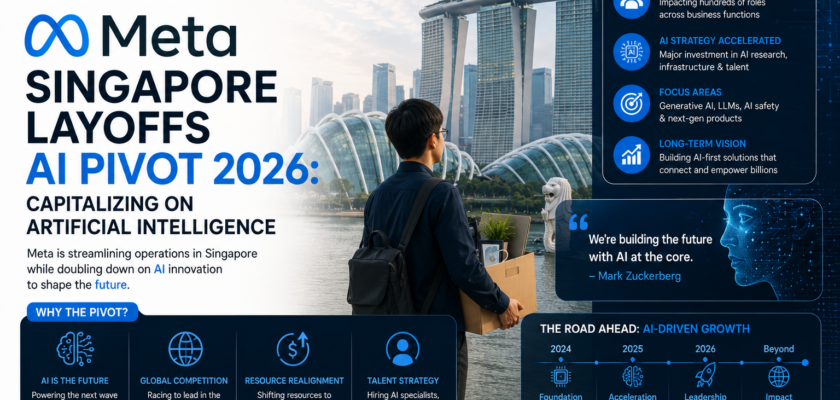
Meta’s Singapore Layoffs: Why Big Tech is Cutting Teams to Fund the 2026 AI Pivot.
The global technology sector is witnessing its most intense structural realignment since the post-pandemic correction. On Wednesday, May 20, 2026, the reality of an “AI-First” corporate economy materialized with brutal clarity.
In one of the largest single corporate restructuring events in Asia’s technology corridor this year, Meta Platforms initiated a sweeping global round of job eliminations.
The execution was swift and tightly managed. At exactly 4:00 a.m. Singapore time, automated termination notices landed in the inbox queues of affected regional employees. To minimize friction, the enterprise instructed its remaining global and North American workforces to work from home before the axe fell.
The Meta Singapore Layoffs AI Pivot 2026 represents an approximately 10% workforce reduction, eliminating roughly 8,000 active roles globally alongside the cancellation of 6,000 unfilled open listings.
This is not a response to weak financial performance; it is a calculated capital reallocation. Despite booking record quarterly revenues of $56.31 billion, Meta is flattening its organizational structure to divert massive capital streams directly into bleeding-edge AI computing power.
1. The $145 Billion Infrastructure Trade-Off
The core motivation behind the Meta Singapore Layoffs AI Pivot 2026 boils down to a stark balance-sheet reality: computing infrastructure is exponentially more expensive than human headcount.
                    [ Meta's Financial Realignment: 2026 ]
                                      │
         ┌────────────────────────────┴────────────────────────────┐
         ▼                                                         ▼
┌─────────────────────────────────┐               ┌─────────────────────────────────┐
│     Human Headcount Reduction   │               │   AI Capital Infrastructure     │
│ • 8,000 active roles cut (10%)  │               │ • CapEx guidance up to $145B    │
│ • 6,000 vacant listings closed │               │ • Massive GPU cluster arrays    │
│ • Flatter management layer structures│          │ • Custom silicon fab expansion  │
└─────────────────────────────────┘               └─────────────────────────────────┘
         │                                                         │
         └────────────────────────────┬────────────────────────────┘
                                      ▼
                        [ Target: Protect Net Operating Margins ]
Meta adjusted its capital expenditure guidance for 2026 to an unprecedented $125 billion to $145 billion—more than doubling its infrastructure investment footprint compared to 2025.
To build out state-of-the-art data centers, secure specialized high-performance chips, and expand its custom silicon manufacturing pipelines, the enterprise is forced to maintain strict control over structural operating expenses.
The math is uncompromised: to prevent heavy infrastructure investments from eroding net operating margins, traditional engineering, product design, and middle-management teams must be systematically streamlined.
2. Inside the “AI Native Design” Architecture
The structural cuts are paired with an internal draft that re-engineers how the enterprise functions. In the days leading up to the layoff announcement, Meta aggressively reassigned roughly 7,000 remaining staff members into newly structured, agile AI pods.
According to internal communications, senior leaders built these fresh layouts using “AI native design principles.” This model eliminates multi-tiered human approval chains in favor of ultra-flat hierarchies where up to 50 individual contributors report to a single director.
The Core AI Units Receiving Talent Transfers Include:
- Applied AI Engineering (AAI): Tasked with integrating frontier models into commercial facing products.
- Agent Transformation Accelerator (ATA) XFN: A cross-functional group focused entirely on deploying specialized AI agents capable of handling complex programming, content moderation, data analytics, and corporate workloads.
- Central Analytics: Transitioned to measure workforce productivity gains achieved by automated internal tooling.
3. Strategic Matrix: 2023 Efficiency vs. 2026 AI Restructuring
| Structural Axis | The 2022–2023 “Year of Efficiency” | The May 2026 AI Native Restructuring |
| Primary Driver | Macroeconomic cooling, post-pandemic over-hiring | Funding massive $145B AI infrastructure CapEx |
| Total Global Cut | ~21,000 roles eliminated across multiple waves | ~8,000 roles cut (10% global workforce) |
| Organizational Philosophy | Standard corporate down-sizing & project trimming | Flatter models using AI native design frameworks |
| Redeployment Metric | Minimal; heavy emphasis on simple offboarding | 7,000 employees shifted into Applied AI teams |
| Risk Characterization | Strategic belt-tightening to appease Wall Street | Minimized Risk; protecting core operating margins |
4. Human Capital Management and Regional Realities
Managing a mass layoff of this scale introduces intense internal friction and reputational challenges. Severance frameworks for affected workers include a base of 16 weeks of standard salary plus an additional two weeks of compensation for every year of continuous service at the firm.
In a personal memo to staff, CEO Mark Zuckerberg acknowledged that the company fell short in its communication strategy during the lead-up to the cuts, writing that he felt the immense weight of the responsibility.
In an attempt to stabilize sinking workplace morale, Zuckerberg stated that the company does not anticipate any further company-wide layoffs for the remainder of 2026.
However, field experts caution that the broader hiring environment inside Big Tech has changed permanently. As tech companies continue to reallocate resources toward automated workflows, the traditional safety net of immediately leaping from one tech giant to another has weakened.
The skill requirements have pivoted overnight: tech organizations are no longer paying premiums for generalist managers or redundant administrative layers. They are looking strictly for lean, technical contributors who can comfortably direct, audit, and scale automated AI systems.
Conclusion
The Meta Singapore Layoffs AI Pivot 2026 is a definitive case study in how modern tech leverage works. It breaks the old corporate myth that a company must scale its headcount to expand its operational footprint.
By replacing human organizational layers with ultra-flat, AI-driven pods, Meta is attempting to establish a highly efficient corporate engine capable of sustaining immense technological growth with a fraction of the historical human capital.
While this aggressive migration toward automated workflows creates massive anxiety across the tech labor market, it underscores the structural realities of the current tech ecosystem.
In 2026, corporate dominance is no longer measured by the size of an international campus or total employee registries. It is determined by the raw computational capacity of your data centers and the efficiency of your automated models. Big Tech isn’t just trimming costs—it is fundamentally clearing the field to ensure it owns the structural foundations of the artificial intelligence era.


