


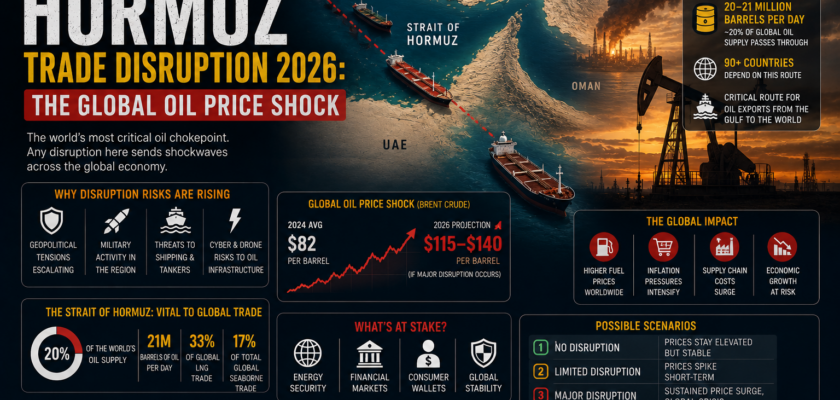
What if the Strait of Hormuz Stays Closed? Preparing for the Next Big Global Oil Price Shock.
The global financial system is currently staring directly down the barrel of the most severe energy security challenge in modern economic history. For decades, macroeconomists treated the complete, multi-month closure of the world’s most vital maritime chokepoints as a theoretical “black swan” risk—the kind of extreme crisis reserved exclusively for hypothetical simulation models and worst-case defense briefs. Markets generally operated under the assumption that international naval task forces and shared economic interests would always keep vital trade lanes open.
But as we advance through May 2026, that structural safety net has entirely evaporated.
Driven by the explosive fallout of the 2026 West Asia war, shipping traffic through the Persian Gulf has faced catastrophic restrictions. The International Energy Agency (IEA) recently characterized the current bottleneck as the single largest supply disruption in the entire history of the global oil market.
With the ongoing Strait of Hormuz Trade Disruption 2026 throttling the daily transit of more than 14 million barrels of oil and massive volumes of liquefied natural gas (LNG), the global energy sector is fast approaching a perilous “red zone”.
For retail investors and wealth managers, navigating this inflationary storm requires looking past the daily noise of geopolitical headlines. It demands a cold, hard evaluation of structural supply constraints, economic scenarios, and high-trust capital allocation strategies.
                    [ The 2026 Global Supply Deficit ]
     (14 Million Barrels/Day Missing ──► Dwindling Global Reserves ──► Core Inflation Surge)
                                     │
                                     ▼
                [ The Strategic Financial Defense Playbook ]
     (Commodity Assets ──► Infrastructure Equity ──► Sovereign Short-Duration Notes)
                                     │
         ┌───────────────────────────┴────────────────___________┐
         ▼                                                       ▼
┌─────────────────────────────────┐                     ┌─────────────────────────────────┐
│     Hard Asset Allocation       │                     │    Domestic Self-Reliance       │
│ • Gold and silver capital havens│                     │ • Domestic oil and gas drillers │
│ • Tangible real estate hedges   │                     │ • Renewable energy platforms    │
│ • Direct resource ownership     │                     │ • Localized supply insulation   │
└─────────────────────────────────┘                     └─────────────────────────────────┘
1. The Three Paths Forward: Wood Mackenzie’s Asymmetric Scenarios
The forward trajectory of global inflation and stock market stability rests entirely on how long the maritime blockade persists. Energy analytics firm Wood Mackenzie has laid out three specific structural scenarios tracking the potential paths forward:
Scenario A: The “Quick Peace” (The Baseline Target)
Under this optimistic path, international mediators achieve a breakthrough, resulting in a workable peace agreement and a complete reopening of the shipping lanes. Global energy flows begin to recover, causing Brent crude oil prices to settle down toward a manageable $80 per barrel by the end of 2026. In this framework, global GDP growth slows slightly to 2.3%, and the threat of a deep, long-lasting recession is safely avoided.
Scenario B: The “Summer Settlement” (Shallow Global Recession)
This path assumes a fragile ceasefire holds, but diplomatic talks drag out through the summer, keeping the strait heavily restricted until September. Acute oil and LNG shortages persist through the third quarter, driving global GDP growth below 2% and triggering a shallow, synchronized global recession in the second half of 2026.
Scenario C: The “Extended Disruption” (The $200 Nightmare)
Under the most severe scenario, the chokepoint remains largely blocked through the end of the year. Even with global energy demand falling by 6 million barrels per day as economies contract, the absolute lack of Middle Eastern exports forces a systemic global crisis. Wood Mackenzie warns that under this scenario, Brent crude oil could skyrocket to $200 per barrel, while refined products like diesel and jet fuel blast toward $300 per barrel, triggering a brutal global economic contraction of 0.4%.
2. The Domino Effect: Fuel Shortages, Fertilizer Crises, and Sovereign Re-Wiring
The real-world impact of a prolonged Strait of Hormuz Trade Disruption 2026 shock extends far beyond the price at the local gas pump; it acts as a massive tax on global industrial productivity.
  [ Massive Crude Cargo Drops ] ───► [ Record High Fuel and Power Costs ]
                                                 │
                                                 ▼
                                  [ Global Fertilizer Halts ]
                             "Natural Gas Outages Spike Farm Overheads"
                                                 │
                                                 ▼
                                  [ Systemic Cost-of-Living Shock ]
                              "Double-Digit Food Inflation Hits Markets"
The Persian Gulf is not just an oil hub; it is the central nerve center for the global fertilizer and petrochemical trade.
With Qatari gas facilities forced into unprecedented shutdowns because LNG tankers cannot safely exit the Gulf, world spot gas prices have experienced massive, triple-digit surges.
This energy crunch directly cripples fertilizer manufacturing plants worldwide, raising the risk of severe global food shortages and structural food inflation heading into 2027.
In response to this strategic vulnerability, nations are radically altering their long-term economic policies. For instance, in India, Prime Minister Narendra Modi has ordered multiple government departments to aggressively cut down on fossil fuel import dependence. The country is rapidly accelerating its push toward energy self-reliance—pouring massive state funding into solar power installations, green hydrogen networks, ethanol blending, and accelerated nuclear energy developments to insulate the domestic economy from international shocks.
3. Strategic Matrix: Portfolio Performance Under an Extended Oil Shock
| Asset Classification | Performance Realities Under $200 Crude Oil | Strategic Capital Allocation Actions |
| Traditional Equities | Heavy losses; corporate margins crushed by high input costs | Short/Underweight consumer discretionary and transport |
| Energy & Exploration | High growth; domestic producers capture immense pricing power | Overweight independent upstream domestic drillers |
| Precious Metals (Gold) | Exceptional strength; acts as the primary global inflation hedge | Maintain a 10% to 15% core portfolio safe-haven anchor |
| Fixed Income/Bonds | Volatile; long-duration bonds hammered by rising interest rates | Migrate capital allocations into short-duration cash notes |
| Risk Characterization | High vulnerability to systemic stagflation and margin drops | Minimized Risk via defensive diversification out of oil dependence |
4. Building the Shield: Financial Hedges Against Stagflation
When global energy supply shocks mirror the structural crises of the 1970s, standard buy-and-hold index strategies become an operational liability. To protect your capital from currency volatility and rising inflation, your investment framework must pivot toward tangible value preservation.
- Upstream Energy and Infrastructure Realignment: Avoid high-overhead multinational refining networks that are exposed to Middle Eastern supply lines. Instead, shift your equity allocations toward independent domestic oil and gas drillers, pipeline infrastructure operators, and alternative energy developers that stand to capture immediate market share as importing countries accelerate their domestic production pushes.
- The Hard Asset Allocation Anchor: In an environment marked by double-digit wholesale price inflation and rising interest rates, physical commodities serve as an un-falsifiable store of value. Maintaining a disciplined position in gold, industrial silver, and tangible real estate structures insulates your net worth from paper currency degradation.
- Cash Preservation in Short-Duration Notes: Long-term corporate and government bonds are highly exposed to rising interest rates driven by sticky inflation. Protect your liquidity by parking capital in short-duration Treasury bills or high-yield money market funds, ensuring you keep your powder dry to snap up high-quality equities at steep discounts when the broader stock market bottoms out.
Conclusion
The ongoing tension surrounding the Strait of Hormuz Trade Disruption 2026 wave serves as a harsh reminder for the modern global investor: true economic stability is a fragile illusion when your foundational supply chains depend on volatile geopolitical corridors. The old abacus maze of blindly trusting international trade networks to run smoothly without interruption is officially dead.
By clearing away speculative bets on high-debt growth companies and replacing them with disciplined allocations into hard assets, independent energy producers, and short-duration cash reserves, you can successfully de-risk your wealth from international shocks.
True financial resilience isn’t about perfectly predicting when a geopolitical conflict will end; it is about building a portfolio strong enough to withstand the worst-case scenario. As energy markets march toward a critical summer crossroads, the investors who take proactive steps to hedge their portfolios today will be the ones who emerge from this global energy shock with their capital, security, and purchasing power completely intact.


