


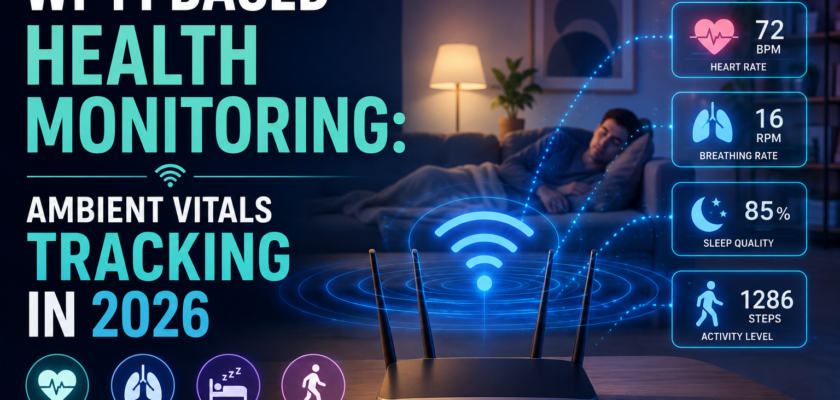
Ambient Health Tracking: How Ordinary Home Wi-Fi Signals Are Monitoring Sleep and Vital Signs.
The concept of the connected smart home has officially transitioned out of its legacy utility phase. For years, domestic smart technology was measured entirely by automated conveniences: programming a smart thermostat to adjust temperatures before you wake up, using voice commands to dim ambient lighting, or viewing automated front-door camera feeds from a smartphone. When early health tracking did enter the home, it was completely dependent on physical wearables. Users had to remember to charge smartwatches every night, strap on high-friction chest bands, or sleep on top of rigid mattress sensor strips to capture basic biometric trends.
But as we advance through 2026, healthcare is undergoing a profound structural transformation. We are moving past the limitations of body-worn devices into the era of true ambient intelligence.
Instead of asking vulnerable patients or tired professionals to strap on sensors, pioneering software is utilizing the invisible radio waves already filling our living spaces.
Through the rapid deployment of Wi-Fi based health monitoring, ordinary home routers are being transformed into active, medical-grade diagnostic radar networks.
By analyzing how standard wireless communication bursts bounce off the human body, these contactless systems track respiration waveforms, evaluate sleep cycles, and detect sudden falls with clinical-grade accuracy—all while protecting personal privacy and requiring zero active user behavior.
1. The Physics of Wireless Sensing: Demystifying CSI Data Streams
To understand how a standard wireless router can track biological micro-movements without a single camera lens, we must step look past basic network connection metrics. Traditional smart home motion tools relied on Received Signal Strength Indicator (RSSI) data—a simple scalar value tracking overall signal power that can tell if a large object entered a room, but lacks the sensitivity to read fine-grained movements.
True ambient health intelligence instead taps into the raw physical layer of wireless transmissions: Channel State Information (CSI).
                     [ The Ambient CSI Tracking Loop ]
                                     │
         ┌───────────────────────────┴────────────────___________┐
         ▼                                                       ▼
┌─────────────────────────────────┐                     ┌─────────────────────────────────┐
│     The Static Baseline Map     │                     │     The Dynamic Human Ripple    │
│ • Signals bounce off hard walls │                     │ • Chest walls shift 4 to 12 mm  │
│ • Furniture locks in fixed lines│                     │ • Micro-movements alter waves   │
│ • Establishes room room matrix  │                     │ • Rhythmic CSI phase shifts show│
└─────────────────────────────────┘                     └─────────────────────────────────┘
         │                                                       │
         └───────────────────────────┬────────────────___________┘
                                     ▼
                     [ Real-Time AI Signal Translation ]
       (Extracts Respiratory Waveforms ──► 24/7 Remote Patient Safety)
Modern Wi-Fi routers transmit data using Orthogonal Frequency-Division Multiplexing (OFDM), splitting a single wireless channel into multiple individual subcarrier frequencies.
As these subcarrier waves travel through a room, they bounce off walls, furniture, and human bodies before hitting a receiver.
- The Phase Shift Sensitivity: For a standard 5 GHz Wi-Fi link, the signal’s physical wavelength ($\lambda$) spans roughly 6 centimeters. A movement of just 3 centimeters is enough to shift the radio wave from constructive to destructive interference.
- The Respiratory Waveform: During respiration, the adult human chest wall expands and contracts by approximately 4 to 12 millimeters. While invisible to the naked eye from across a dark room, this rhythmic shift alters the path of the Wi-Fi signal.
- Extracting the Vitals: As the chest moves through these wireless zones, it causes tiny, periodic ripples in both the amplitude and phase metrics of the CSI data stream. Advanced edge AI algorithms filter out background ambient noise to isolate these micro-fluctuations, reconstructing a clean respiratory waveform with clinical precision.
2. Reclaiming the Night: Contactless Sleep and Fall Management
The immediate commercial application for Wi-Fi based health monitoring architectures centers squarely on vulnerable demographics, such as independent seniors aging-in-place and patients navigating chronic respiratory diseases.
A. Frictionless Sleep Diagnostics
Traditional sleep studies require patients to spend the night covered in wired sensors inside an unfamiliar clinic room, a stressful setup that often alters natural sleep architecture.
Ambient Wi-Fi sensing operates continuously in the background of the user’s actual bedroom.
By analyzing changing Doppler signatures and body movement metrics throughout the night, the platform maps out light, deep, and REM sleep cycles without requiring the user to wear a charging smartwatch or touch a single interface.
B. Context-Aware Fall Management
Traditional wearable fall detectors fail if a senior leaves their device charging on a nightstand or forgets to strap it on in the morning. Wi-Fi sensing solves this safety loop through continuous coverage.
  [ Sudden Doppler Velocity Spike ] ───► [ Macro Signal Drop to Floor Level ]
                                                      │
                                                      ▼
                                       [ Post-Fall Micro-Motion Audit ]
                                     "Is the CSI Reading Micro-Vitals?"
                                                      │
                                                      ▼
                                       [ Context-Rich Emergency Alert ]
                                 "Confirmed Fall with Inability to Rise"
The system uses specific Doppler signatures to distinguish between a fast, accidental fall and someone simply lying down on a couch.
Crucially, the system checks for post-fall micro-motions. If the software registers a fall followed by a complete lack of gross motor movement, but detects a steady breathing rhythm at floor level, it flags a “fall with inability to rise”. This context-rich alert is routed straight to medical care teams, minimizing false alarms while ensuring rapid emergency dispatch.
3. Strategic Matrix: Wearable Trackers vs. Ambient Wi-Fi Sensing Platforms
| Health Monitoring Vector | Traditional Body-Worn Devices (Smartwatches) | Ambient Wi-Fi Sensing Networks (2026) |
| User Compliance Burden | High (Requires manual charging and daily wear) | Zero; works 100% passively in the background |
| Physical Contact Layer | Direct skin contact required; can cause irritation | 100% Contact-free; senses right through clothing |
| Visual Privacy Integrity | High; collects data via hidden accelerometer lines | Absolute; processes radio waves with zero cameras |
| Monitoring Window | Intermittent; breaks down during charging cycles | Continuous 24/7 protection across living zones |
| Risk Characterization | High risk of data gaps if user forgets device | Minimized Risk; infrastructure is always on |
4. The Privacy Shield: Why Radio Waves Trump Video Cameras
As remote patient monitoring scales internationally to support overextended healthcare workforces, a major social barrier has emerged: consumer privacy.
While installing connected smart cameras throughout a home offers a direct way to watch over an elderly parent or convalescing patient, the thought of constant video tracking inside private spaces like bedrooms and bathrooms is an intrusive non-starter for most families.
Ambient Wi-Fi monitoring resolves this core ethical dilemma by providing an absolute privacy shield. Because the software reads abstract, numeric radio signal reflections rather than raw optical pixels, it generates zero images, records zero video streams, and collects no personally identifiable facial details.
The system treats the human body as an anonymous, moving radio wave reflector. This mathematical abstraction delivers the ultimate combination of data rich visibility for physicians and complete, uncompromised dignity for patients—proving that the path to sustainable home care lies in making technology highly insightful without being invasive.


