


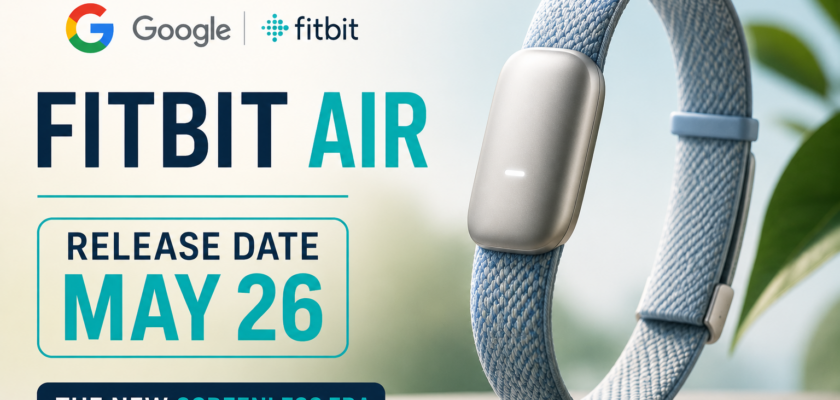
Screenless Wellness: Why Google’s Fitbit Air Launch Today Signifies the Shift Away from Smartwatches.
The consumer technology landscape has officially entered an era of aggressive sensory decompression. For the past decade, the engineering roadmap for wearable fitness trackers followed a predictable, display-heavy path. Manufacturers rushed to pack larger, brighter, and more power-hungry AMOLED touchscreens onto users’ wrists. Fitness trackers slowly morphed into mini-smartphones, continuously blasting users with email alerts, social media pings, text messages, and app notifications. Instead of serving as tools for health and recovery, these high-refresh-rate smartwatches became a primary source of continuous digital distraction and notification fatigue.
But today, Tuesday, May 26, 2026, Google has officially drawn a line in the sand against screen obsession.
Marking the official Google Fitbit Air release date May 26, the tech giant has launched a radically minimalist device that completely redefines the wearable tech category.
By completely removing the glass display screen and stripping away non-essential communication features, this new launch leads a major industry movement toward screenless wellness.
The Fitbit Air is engineered to operate quietly in the background of your life, capturing medical-grade biometric data without demanding a single glance—proving that the ultimate luxury in a loud world is digital peace.
1. The Biological Cost of Screen Overload: Why Wearables Needed a Reset
To understand why Google is stepping away from traditional smartwatch designs, we must analyze the psychological and neurological impact of constant screen interaction. When a fitness tracker continuously flashes notification badges throughout the workday, it keeps the user’s nervous system trapped in a high-alert state.
                    [ The Smartwatch Distraction Loop ]
     (Continuous Screen Pings ──► Cortisol Spikes ──► Fragmented Workout Focus)
                                     │
                                     ▼
                [ The Fitbit Air Screenless Architecture ]
     (Passively Hidden Sensors ──► Zero Visual Grids ──► Immersive Physical Flow)
                                     │
         ┌───────────────────────────┴────────────────___________┐
         ▼                                                       ▼
┌─────────────────────────────────┐                     ┌─────────────────────────────────┐
│    Dopamine Baseline Reset      │                     │     True Continuous Tracking    │
│ • Ends toxic notification cycles│                     │ • Low-profile fabric wristband  │
│ • Restores raw mind-body focus  │                     │ • 7-Day uninterrupted battery run│
│ • Lowers baseline everyday anxiety│                     │ • Eliminates charging anxieties │
└─────────────────────────────────┘                     └─────────────────────────────────┘
This constant digital noise fractures our attention spans, interrupts deep workout sessions, and increases daily stress levels.
- The Interruption Matrix: Checking a wrist notification disrupts your creative focus, requiring up to 20 minutes for your brain to regain its deep state of concentration.
- The Visual Strain: Staring at bright wrist displays late at night suppresses natural melatonin production, directly ruining your REM sleep recovery cycles.
- The Solution: Removing the display screen breaks this unhealthy dependency at the source, allowing users to reconnect with their physical bodies without checking an app feed.
2. Inside the Hardware: A Deep Fitbit Air Review
The design philosophy behind the Fitbit Air centers entirely on high-performance material engineering and invisible biometric monitoring.
A. The Seamless Fabric Aesthetic
The device features an ultra-slim, lightweight chassis wrapped in a premium, stain-resistant recycled yarn band.
Because it has zero glass screens to scratch or crack, the tracker weighs less than 11 grams, making it incredibly comfortable to wear all day and night.
The interface completely drops physical buttons and glowing light panels. It interacts with the user exclusively through soft, highly customized haptic vibrations that signal major workout milestones or heart-rate thresholds.
B. Medical-Grade Sensor Arrays
Do not let the minimalist exterior fool you; the hardware packed beneath the fabric loop ranks among the most sophisticated diagnostic tech Google has ever engineered:
  [ Advanced Skin Contact Sensor ] ───► [ Real-Time Micro-Vitals Analysis ]
                                                    │
                                                    ▼
                                     [ High-Velocity Processing Engine ]
                                "Tracks Heart Variability & Hydration Metrics"
                                                    │
                                                    ▼
                                     [ Background App Synchronization ]
                               "Updates Your Personal Health Logs via Bluetooth"
The tracker features an advanced optical heart-rate sensor array, a continuous skin-temperature monitor, and a highly responsive electrodermal activity (EDA) sensor to track daily stress.
The device runs an intelligent background loop that measures heart rate variability (HRV) and breath wave rhythms every second.
The captured biometric data syncs smoothly via low-energy Bluetooth straight to the redesigned Fitbit App on your phone—giving you deep, data-rich wellness logs whenever you choose to open them, without interrupting your day.
3. Strategic Matrix: High-Screen Smartwatches vs. Screenless Wellness Trackers
| Operational Vector | Standard Touchscreen Smartwatch Models | Next-Gen Screenless Fitbit Air Systems |
| Display Infrastructure | High-brightness AMOLED glass touchscreens | Zero screens; wrapped in minimalist premium fabric |
| Battery Performance | Short; requires daily charging connection loops | Exceptional; 7-day continuous battery life runtime |
| User Attention Drain | High; continuous app pings and message alerts | Zero; works 100% passively in the background |
| Material Weight Footprint | Heavy and bulky; prone to skin irritation traits | Ultra-lightweight; comfortable 11-gram design |
| Risk Characterization | High risk of screen addiction and data distraction | Minimized Risk; tech-backed mental peace |
4. Reclaiming the Flow: Rebuilding Mind-Body Focus
The ultimate behavioral benefit of integrating screenless tech into your life is the complete restoration of raw, undistracted workout focus. When you engage in a run, weight session, or meditation loop without a screen constantly flashing performance numbers at your wrist, your brain experiences a profound shift in awareness.
You stop gamifying your fitness through artificial digital badges and start listening to your body’s natural physical signals.
  [ Step Into Workout Session ] ───► [ Passive Background Sensor Tracking ]
                                                   │
                                                   ▼
                                    [ Deep Mind-Body Reconnection ]
                              "Focus on Natural Breath & Muscle Movement"
                                                   │
                                                   ▼
                                    [ Post-Workout Digital Digest ]
                               "Review Clean Data Logs on Your Phone Screen"
The Fitbit Air manages the tracking chores entirely behind the scenes, leaving you free to immerse yourself in the immediate moment.
You no longer look down mid-stride to check artificial calorie counts or heart zones.
Instead, you focus your mental energy on perfecting your physical form, managing your breathing rhythms, and building deep structural stamina. Once your session wraps up, you can review your highly accurate data logs, workout routes, and recovery metrics inside your phone app—proving that the most effective way to optimize your personal health is to stay fully present in the real world.
Conclusion
The official launch celebrated across the Google Fitbit Air release date May 26 timeline signals a permanent milestone in the design of consumer health tech: true innovation isn’t about finding new ways to capture your visual attention, but about building technology that fades beautifully into the background of your life. The old abacus maze of treating your fitness tracker as a secondary smartphone screen is officially obsolete.
By replacing bright, stressful glass displays with an ultra-lightweight fabric band and high-performance sensors, Google is demonstrating how to balance advanced biometrics with mental peace.
This sophisticated screenless approach gives you the data insights you need to improve your life without the constant digital noise that causes daily burnout. As these screenless tracking platforms continue to expand their footprint across the health landscape, they offer a brilliant truth for modern lifestyle design: your technology should work tirelessly for you in the background, leaving you completely free to experience your life to the absolute fullest.


