


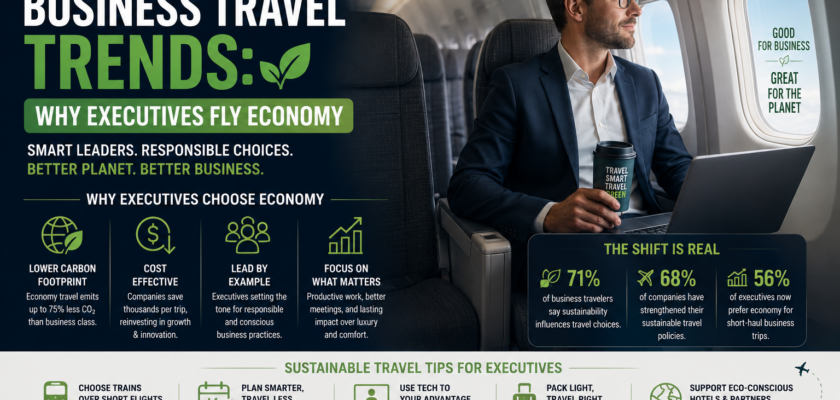
The First-Class Class Cut: Why Major Institutions are Urging Senior Executives to Fly Economy.
The architectural framework of corporate mobility is undergoing an aggressive fiscal and environmental overhaul. For decades, the standard blueprint for multinational corporate travel associated professional status with premium cabin placement. Top-tier executives, senior partners, and institutional directors automatically booked first-class or business-class tickets for long-haul international flights. This calculation assumed that premium seating was an unyielding operational requirement to preserve executive productivity, ensure rest, and project corporate prestige to global clients.
However, a sudden convergence of economic austerity and intense climate scrutiny has turned that old travel playbook on its head.
We have officially entered a new era characterized by the rapid expansion of sustainable business travel trends across public and private sectors.
Driven by strict greenhouse gas reduction targets and tightening operating budgets, major global institutions are stripping away luxury transit privileges.
By systematically overhauling corporate flight policies, organizations are mandating that even senior executives transition to premium economy or standard coach options for non-continental flights—proving that in the modern economy, environmental accountability outweighs traditional corporate vanity.
1. The Carbon Multiplier: Why Premium Cabins Damage Green Portfolios
The primary catalyst driving the sudden institutional restriction on first-class transit is the lopsided carbon footprint generated by premium cabin designs. A standard passenger seat in economy class takes up a highly optimized, compact physical space, allowing airlines to distribute the flight’s total fuel burn across a massive number of travelers.
In contrast, luxury seating arrangements create a massive, highly inefficient spatial drain inside the aircraft.
                    [ The Luxury Cabin Footprint Loop ]
     (Sprawling Flatbed Suites ──► Low Passenger Density ──► High Per-Capita Carbon)
                                     │
                                     ▼
                [ The Sustainable Flight Correction ]
     (High-Density Premium Economy ──► Shared Spatial Burdens ──► Drops Portfolio Emissions)
These spacious, heavy physical layouts directly inflate an executive’s personal environmental impact:
- The Spatial Allocation Trap: Because a typical first-class suite or business-class flatbed seat takes up to three to four times the physical floor area of a standard economy seat, the carbon emissions assigned to that individual passenger are multiplied by that exact same ratio.
- The Weight Overhead: Furthermore, the heavy mechanical components of premium seating arrays—including motorized recliners, massive personal entertainment monitors, and private partition walls—significantly increase the aircraft’s total weight, requiring more fuel burn per mile.
- The Result: Consequently, public institutions looking to hit aggressive carbon reduction targets are realizing that a handful of executive flights can completely wipe out the emissions progress achieved by whole office recycling and energy conservation systems.
2. Inside the Directives: The Corporate Flight Policy Overhaul
The widespread adoption of these green transit adjustments is being led by massive international regulatory changes and strict institutional policy changes.
A. The UN Travel Budget Interventions
The United Nations has set a powerful global example by aggressively tightening its internal travel budget guidelines.
Under the revised sustainability frameworks, the organization has systematically removed business-class funding for a wide array of diplomatic trips and committee missions.
This strict policy change forces senior staff members and regional directors to utilize premium economy or standard coach options unless a trip exceeds a grueling 11-hour non-stop flight loop.
This single adjustment saves millions of dollars in taxpayer funding while preventing thousands of tons of unnecessary carbon emissions annually.
B. The Rise of the Corporate Carbon Fee
Parallel to public sector reforms, forward-thinking multi-national corporations are deploying advanced internal tracking systems to enforce sustainable choices:
| Institution Segment | Legacy Executive Travel Rules | Next-Gen Sustainable Flight Policies |
| Corporate Flight Booking | Automatic first-class or business approval loops | Mandatory premium economy caps for non-continental legs |
| Carbon Accounting | Unmonitored emissions; flat annual reporting | Strict internal carbon pricing fees billed directly to teams |
| Approval Infrastructure | Managed by administrative assistants manually | Automated AI software blocks non-compliant routes instantly |
| Secondary Transit Link | Private premium taxi queues and premium cars | Mandatory public transit rail integration from airports |
| Risk Characterization | High vulnerability to public environmental call-outs | Withdrawn Risk; tech-backed climate compliance |
Companies are applying a direct internal carbon fee to every single business flight booked across their organizations.
If an executive insists on bypassing standard economy guidelines to secure a business-class seat, the additional carbon emissions are translated directly into a harsh financial penalty billed straight to their specific department’s quarterly budget.
Thus, technology is changing behavior at the source. This financial mechanism forces managers to carefully balance the real necessity of an in-person meeting against the true ecological and financial cost of the flight.
3. Optimizing the Alternative: Maximizing Value in the Main Cabin
The ultimate success of these sweeping sustainable business travel trends relies on changing the focus of business travel from luxury to pure travel efficiency. By utilizing high-performance mobile devices, noise-canceling headphones, and dedicated airport transit lounges, modern executives are proving that professional output can be sustained smoothly anywhere in the aircraft.
  [ Executive Enters Main Cabin ] ───► [ Passive On-Board Work Sessions ]
                                                   │
                                                   ▼
                                    [ Reclaiming Flight Downtime ]
                              "Focus Shifts to Offline Strategic Audits"
                                                   │
                                                   ▼
                                    [ Cost-Effective Landing Prep ]
                               "Arrive Focused with Zero Corporate Waste"
Traveling teams no longer view flight hours as lost working time.
Instead, they treat the quiet hours of a long flight as a perfect opportunity to run deep, uninterrupted strategic audits, review code libraries, or draft policy documents away from office slack feeds.
By checking in early, securing extra-legroom seats, and utilizing local airport express trains instead of premium private car rentals, traveling professionals arrive at their destinations completely organized. This disciplined execution proves that the ultimate measure of professional value isn’t the premium label printed on your boarding pass, but the efficiency and purpose of the work you deliver to the world.
Conclusion
The dramatic paradigm shift unfolding across corporate travel guidelines highlights a permanent evolution in modern global management: true leadership is no longer demonstrated by collecting exclusive corporate perks, but by taking personal responsibility for our shared climate future. The old abacus maze of allowing senior management to consume massive amounts of resource overhead purely to project corporate prestige is rapidly being replaced by sustainable, realistic travel design.
By combining strict carbon accounting with practical premium economy mandates, modern institutions are building a highly responsible corporate travel culture.
These proactive policy updates don’t stop essential human collaboration; they ensure that cross-border partnerships are built on a fair, sustainable foundation. As these green corporate flight rules continue to expand across global logistics and business networks, they deliver an undeniable truth for our connected world: the ultimate unfair advantage in a competitive market isn’t flying in a luxury first-class cabin, but leading an organization that knows how to run lean, respect the planet, and deliver maximum real-world value.


