


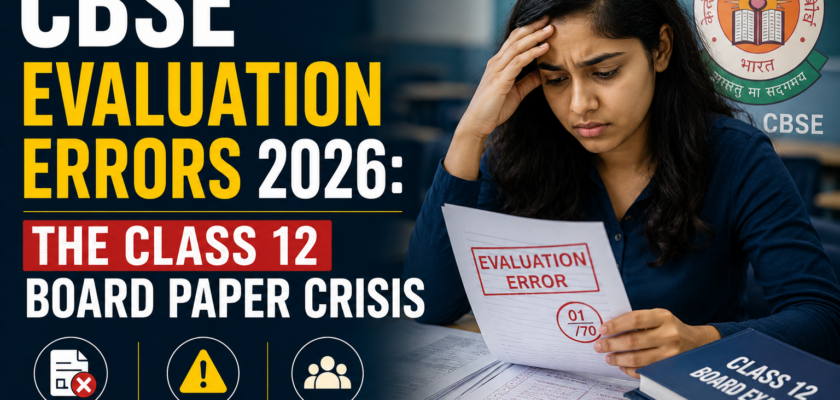
The Revaluation Crisis: CBSE Acknowledges Major Answer Sheet Mix-Up for Class 12 Boards.
The institutional credibility of India’s secondary education evaluation framework faces an unprecedented structural crisis. For generations, the final marks awarded by the Central Board of Secondary Education (CBSE) in the Class 12 Board examinations served as an unshakeable, definitive academic passport. Millions of high school students structured their entire learning schedules around maximizing these performance metrics. A high board score acted as the ultimate key to secure competitive university admissions, claim merit-based scholarships, and establish foundational career baselines across the country.
However, the rapid rollout of an automated digital grading infrastructure has triggered widespread systemic chaos.
The immediate fallout of the CBSE evaluation errors 2026 controversy has forced the board into an uncomfortable public retreat.
Following intense pushback on social networks from high-scoring science students who received unexpectedly low single-digit marks, officials have formally acknowledged severe processing flaws.
The structural failure traces straight back to the newly deployed On-Screen Marking (OSM) system. Rather than encountering simple mathematical calculation mistakes, students accessing their scanned papers discovered that entire answer books were incorrectly mapped to wrong roll numbers. This major digital tagging failure has sparked an intense national debate regarding grading safety and process verification.
1. The Digital Swap: Inside the On-Screen Marking Mapping Failure
The specific mechanical breakdown that shattered student confidence emerged immediately after the post-result transparency window opened. When dissatisfied candidates paid the regulated verification fees to download scanned copies of their evaluated papers, they were shocked by what they saw.
Instead of viewing their original work, multiple students discovered entirely different handwriting styles attached beneath their personal registration coversheets.
                     [ The OSM Grading Pipeline Break ]
                                      │
         ┌────────────────────────────┴────────────────____________┐
         ▼                                                         ▼
┌──────────────────────────────────┐              ┌──────────────────────────────────┐
│      Digital Scanning Step       │              │     Algorithmic Tagging Break    │
│ • Scripts processed by batch bots│              │ • Scripts mapped to wrong profiles│
│ • Barcodes scanned into databases│              │ • Handwriting mismatches emerge  │
│ • Physical context gets unlinked │              │ • Low marks assigned to top names│
└──────────────────────────────────┘              └──────────────────────────────────┘
                                      │
                                      ▼
                     [ The Public Correction Crisis ]
         (Viral Post Realities ──► Official Emails Admit Answer Sheet Swaps)
The structural failures within the digital pipeline caused severe real-world disruption across multiple evaluation centers:
- The Handwriting Discrepancy: High-profile cases, including a viral student report from New Delhi, proved that the internal pages of uploaded Physics scripts featured entirely different letter formations and spacing metrics compared to the students’ actual writing.
- The Chemistry Mismatch: Concurrently, parallel systemic issues surfaced in Chemistry grading tracks. Candidates noted that while the initial validation page carried their true personal data, the actual answers belonged to completely separate individuals.
- The Board Acknowledgment: Faced with undeniable physical proof shared across public forums, the CBSE headquarters formally emailed affected students. The board admitted that the wrong papers were uploaded to candidate profiles and rushed to send out corrected copies, confirming that the digital mapping process had failed.
2. The Legal Counter-Offensive: High Courts Step In
The far-reaching consequences of this structural breakdown have quickly expanded beyond individual student complaints into a major legal battle. A comprehensive Public Interest Litigation (PIL) has been filed directly before the Allahabad High Court, challenging the board’s digital evaluation methods.
  [ Hurried Tech Rollout ] ───► [ Unexpectedly Low Marks in Core Sciences ]
                                                   │
                                                   ▼
                                    [ High Court PIL Filed ]
                              "Demands Free Global Re-Evaluation for All"
                                                   │
                                                   ▼
                                    [ Admission Protection Mandates ]
                              "Universities Ordered to Freeze Seat Cut-Offs"
The legal petition argues that CBSE deployed the unvetted OSM framework without conducting proper multi-city pilot programs or providing comprehensive training for aging evaluators.
- The Performance Drop: The court filing highlights a historic drop in high scores across the country. Only 5.3% of students cleared the 90% threshold this year, marking the lowest performance baseline in recent memory.
- Demanding Financial Relief: Consequently, lawyers are urging the court to mandate a complete, fee-free re-evaluation for all affected candidates. They argue that forcing students to pay high per-question fees to fix the board’s own software errors is highly unfair.
- Safeguarding College Admissions: Crucially, the litigation requests immediate protective orders for university entries. The goal is to force higher education institutions to preserve admission opportunities for affected students until the board delivers corrected data, ensuring a flawed school grade doesn’t destroy a student’s college prospects.
3. Strategic Matrix: Reliable Physical Evaluation vs. 2026 Digital OSM Infrastructure
| Evaluation Parameter | Traditional Manual Grading Workflows | Digital On-Screen Marking Systems (2026) |
| Script Mapping Security | High; physical booklets stay tied to roll bundles | Vulnerable; software errors cause sheet swaps |
| Visual Content Clarity | Perfect; markers interact with real paper sheets | Variable; blurry scans lead to unchecked diagrams |
| Portal Infrastructure | Not applicable; grades processed on localized sheets | Unstable; frequent portal crashes and payment loops |
| System Testing History | Multi-decade operational baseline across India | Abrupt; launched mid-session without pilot tests |
| Risk Characterization | Minor clerical math errors easily caught by hand | Sustained Risk; tech bugs alter full results |
4. Re-Engineering Trust: The Roadmap to Save Examination Integrity
To restore complete transparency and prevent future software errors from harming another generation of students, academic experts are demanding a sweeping overhaul of the post-result verification architecture:
- Mandatory Two-Factor Cryptographic Tagging: The board must completely replace vulnerable barcode tags with a dual-key cryptographic system. Every page of an answer booklet must feature a unique, dynamically generated hash token that links directly to both the center’s secure scanner and the candidate’s verified digital locker, making digital sheet swaps mathematically impossible.
- Implementing a Hybrid Human Audit Loop: Before final marks are locked into national servers, the system must run an automated check to catch unusual grade drops. If a student with a consistent 95% academic average across internal metrics is flagged by the software as scoring under 15% in a core science subject, the paper must be automatically routed to a senior human supervisor for physical validation.
- Open-Source Scoring Verification Paths: The evaluation portal must be upgraded using stable, distributed cloud servers to handle massive transaction volumes smoothly. Furthermore, if a student flags a clear handwriting mismatch on their scanned copy, the platform must provide an instant, free pathway to report the mix-up, ending the need for families to wage expensive public social media campaigns to get the board’s attention.
Conclusion
The disruptive grading crisis reshaping the CBSE evaluation errors 2026 landscape delivers a vital lesson to modern educational administrators: technological progress must never prioritize speed over process safety. The old abacus maze of assuming a digital system is inherently perfect just because it runs on a computer has caused severe stress for thousands of households.
By adjusting incorrect scores, addressing payment bugs, and engaging openly with student feedback, the board is taking initial steps to fix the damage.
However, rebuilding complete trust in the national examination system requires making deep structural upgrades to the digital evaluation pipeline. As the high court reviews the grading process over the coming weeks, the path forward is clear. True innovation isn’t achieved by simply removing paper from the classroom; it requires building secure, transparent, and completely accurate systems that protect the hard work and bright futures of our students.


