


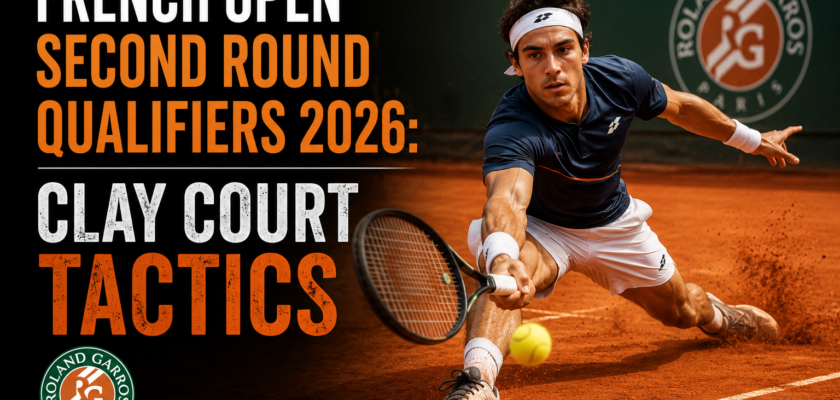
Roland Garros Round 1: Analyzing the Strategic Dominance in the Early Slams of the Clay Season.
The physical chess match that defines elite clay-court tennis has returned to its absolute pinnacle in Paris. For professional players, transitioning away from the lightning-fast, highly predictable ball bounces of spring hard courts to navigate the demanding red dirt of Roland Garros requires a complete overhaul of athletic strategy. On clay, raw power and 140 mph flat serves lose their absolute authority as the crushed brick surface acts as a natural brake, slowing down ball speeds by up to 25%.
Consequently, victory on this surface cannot be secured through short, explosive points.
Instead, success belongs entirely to the master tactician who can slide smoothly to maintain court balance, hit heavy topspin angles, and survive grueling baseline rallies.
As the tournament shifts directly into the French Open second round qualifiers 2026 phase, the opening matches have delivered immense tactical drama.
With extreme heat baking the Parisian courts, the clay is playing faster and bouncing higher than in recent seasons.
This climatic shift has completely disrupted conventional tournament predictions. From emotional grand slam farewells to major upsets pulled off by unseeded qualifiers, the initial round has forced top-tier seeds to adjust their baseline tactics or face an early departure from the most physically demanding major on the tennis calendar.
1. The Farewell to Magic: Wawrinka’s Final Parisian Bow
The emotional core of the opening round centered on Court Philippe-Chatrier, where the 2015 Roland Garros champion, Stan Wawrinka, stepped onto the red clay for his final career appearance at the tournament. Drawing one of France’s brightest rising stars, Arthur Fils, the 41-year-old Swiss veteran faced a massive physical task.
                     [ The Generational Clay Clash ]
                                      │
         ┌────────────────────────────┴────────────────____________┐
         ▼                                                         ▼
┌──────────────────────────────────┐              ┌──────────────────────────────────┐
│      Arthur Fils (17th Seed)     │              │      Stan Wawrinka (Legend)      │
│ • Extreme baseline explosion     │              │ • Rare one-handed backhand magic │
│ • Heavy topspin depth dominance  │              │ • Deep court placement tactics   │
│ • Fresh 21-year-old court speed  │              │ • Emotional crowd-backed energy  │
└──────────────────────────────────┘              └──────────────────────────────────┘
                                      │
                                      ▼
                     [ The Structural Match Outcome ]
       (Fils Out-Grinds the Veteran: 6-3, 3-6, 6-3, 6-4 ──► Wawrinka Bows Out)
The matchup delivered a brilliant contrast of generations and styles, keeping the passionate French crowd completely enthralled:
- The Topspin Squeeze: The 17th-seeded Fils utilized his superior lateral movement to systematically pull Wawrinka wide, striking heavy topspin forehands that forced the veteran deep behind the baseline.
- The One-Handed Defiance: Despite facing intense physical pressure, Wawrinka unleashed his legendary one-handed backhand to paint the lines, claiming a magnificent second set to level the match.
- The Final Summary: Ultimately, the younger Frenchman’s elite conditioning wore down Wawrinka, sealing a 6-3, 3-6, 6-3, 6-4 victory. Leaving the court to a standing ovation, Wawrinka shared a poignant farewell, stating, “I don’t want to say goodbye,” marking the end of a historic era for one-handed backhand artistry in Paris.
2. The Qualifier Sensation: Chwalinska Stuns the Olympic Champion
While the men’s draw witnessed passing-of-the-torch battles, the women’s singles draw delivered an absolute shockwave that completely altered the tournament’s second-quarter projections.
Polish qualifier Maja Chwalinska pulled off a historic upset, executing a flawless tactical plan to dismantle reigning Olympic Champion Zheng Qinwen.
  [ Zheng Prefers High-Power Rallies ] ───► [ Chwalinska Deploys Deep Clay Variety ]
                                                       │
                                                       ▼
                                        [ Heavy Topspin Replaced by Slices ]
                                  "Breaks the Rhythm of the Aggressive Seed"
                                                       │
                                                       ▼
                                        [ Unprecedented First-Round Upset ]
                                  "Qualifier Claims Dominant 6-4, 6-0 Victory"
Zheng, who loves to dictate points using heavy topspin and a massive first serve, found her rhythm completely destroyed by Chwalinska’s creative variety.
- Neutralizing the Weapon: Instead of engaging in high-velocity baseline exchanges, the Polish qualifier utilized low, biting backhand slices, sudden drop shots, and looping high moonballs to keep the Olympic Champion off-balance.
- The Saturated Collapse: Unable to find a clean hitting zone on the baking clay, Zheng’s unforced error count climbed rapidly.
- The Historic Scoreline: Chwalinska capitalised brilliantly on every break point opportunity, storming through the final stretch to secure a staggering 6-4, 6-0 victory. This dominant win marks her as an incredibly dangerous floater within the second-round bracket.
3. Strategic Matrix: High-Power Hard Court Styles vs. Elite Clay Court Mastery
| Tactical Tennis Dimension | Hard-Court Power-Hitting Baselines | Elite Clay-Court Tactical Mastery |
| Primary Movement Tool | Abrupt stopping and directional plants | Controlled sliding into the ball to recover fast |
| First Serve Effectiveness | Massive; yields direct free points and aces | Reduced; slower bounces allow deep return blocks |
| Point Construction Loop | Short; focused on 1-3 stroke aggressive kills | Patient; long multi-shot patterns to open angles |
| Racket String Tension Stance | Tight; maximizes absolute directional control | Looser; increases pocket depth and heavy topspin |
| Risk Characterization | High vulnerability to unforced errors on dirt | Withdrawn Risk; tech-backed baseline safety |
4. Technical Evolution: The Importance of String Tension and Under-Spun Slices
The final core trend defining clay court match analysis across the grounds highlights a brilliant technical shift in equipment setup and baseline geometry. Because the high Parisian heat is drying out the courts, players are adjusting their racket metrics to combat the changing ball reactions.
Many players are dropping their string tension by 2 to 3 pounds to generate a deeper “trampoline effect,” helping them match the heavy topspin depth needed to control points.
  [ Heat Dries Court Dirt ] ───► [ Ball Bounce Skyrockets Off the Clay ]
                                                │
                                                ▼
                                 [ Lower String Tensions Applied ]
                            "Increases Topspin RPMs and Baseline Clearance"
                                                │
                                                ▼
                                 [ Multi-Tier Tactical Variety Wins ]
                            "Drop Shots and Heavy Slices Claim Point Control"
Concurrently, defensive strategy has evolved to feature the heavy use of the under-spun defensive slice.
When sliding deep into the corners to defend against a heavy topspin forehand, smart players don’t attempt to hit a high-risk running pass.
Instead, they absorb the speed by floating a deep, slow slice with maximum backspin back into the opponent’s court.
This smart tactical choice forces the attacking player to bend low and lift the ball over the net, completely taking away their offensive momentum.
Thus, the early matches prove that the path to a grand slam title on clay is won by embracing patience, mixing up your shots, and out-thinking your opponent across every single point.
Conclusion
The spectacular tactical battles defining the French Open second round qualifiers 2026 landscape outline a permanent truth in professional tennis: Roland Garros remains the ultimate test of an athlete’s mental and physical endurance. The old abacus maze of assuming a top-tier world ranking or high-power serve will automatically guarantee success runs into a wall of clay-court reality.
By breaking up rhythms with precise variety, adjusting equipment setups to handle intense heat, and constructing points with infinite patience, the master tacticians are rewriting the tournament scripts.
These impressive early matches don’t just entertain the fans; they highlight the beautiful complexity of clay-court tennis. As the remaining seeds prepare to face the rising qualifiers over the coming days, the tournament’s message is clear: true dominance on the red dirt isn’t about striking the ball hardest, but about out-sliding, out-lasting, and out-strategizing your opponent until the final ball is won.


