


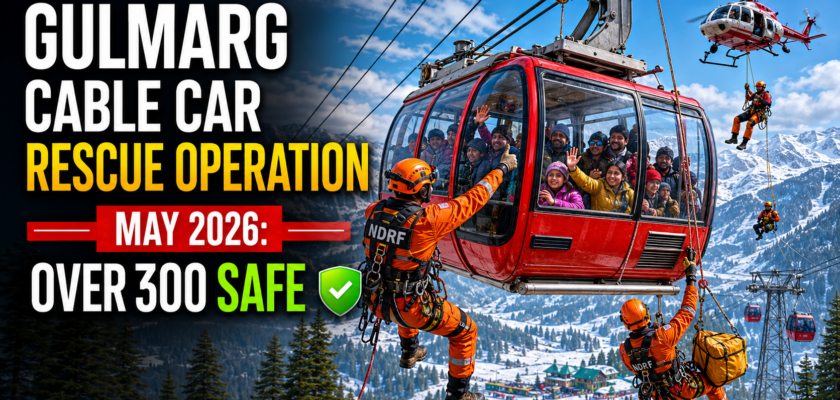
High-Altitude Hazards: Over 300 Tourists Rescued Safely From Stranded Gulmarg Gondola Cable Cars.
The operational framework governing high-altitude mountain tourism faces a critical structural reminder regarding passenger safety rules. For decades, embarking on a cable car journey across mountain resorts was treated as a routine, low-risk vacation highlight. Global travelers automatically trust these ropeway networks to provide safe, comfortable transit to sky-high observation ridges. Families and sightseers step into these hanging glass cabins with a simple expectation: to enjoy panoramic alpine views without facing any personal danger or structural mechanical failures.
However, unexpected mechanical glitches in remote mountain areas can instantly turn a casual holiday into a tense emergency.
The intense, successful execution of the Gulmarg cable car rescue operation May 2026 mission highlights the vital importance of multi-agency disaster response readiness.
An abrupt technical failure at Asia’s highest ropeway system left a massive wave of holidaymakers trapped mid-air.
Suspended across both phases of the high-altitude transit line, hundreds of passengers dangled hundreds of feet above the rocky slopes.
Promptly triggered by a sudden machinery stoppage around noon on Monday, May 25, 2026, the incident launched a dramatic six-to-seven-hour emergency evacuation. This highly coordinated operation successfully brought every single traveler back to safety, proving that robust safety protocols are essential to protect modern mountain tourism.
1. The Mid-Air Stoppage: How Worsening Alpine Weather Heightened the Crisis
The sudden mechanical breakdown that immobilized the famous line occurred at approximately 1:20 PM, instantly freezing 65 individual cabins along the mountain cables. What began as a standard afternoon excursion quickly turned into a high-stakes emergency as the alpine environment shifted rapidly.
                     [ The High-Altitude Snag ]
    (Technical Drive Malfunction ──► 65 Cabins Immobilized ──► 320 Passengers Trapped)
                                     │
                                     ▼
                [ The Environmental Complication Loop ]
    (Sudden Cold Winds ──► Heavy Mountain Rain & Hail ──► Amplified Passenger Panic)
The rescue teams faced a highly complex situation due to a sudden deterioration in local weather conditions:
- The Saturated Cabin Matrix: Out of the 65 suspended gondola cars, official logs confirmed that 52 cabins were fully occupied with active travelers, while 10 sat empty.
- The Crucial Elevation Threat: Multiple cabins were stuck high up the mountain line, swaying nearly 500 feet above the steep valley ground.
- The Storm Influx: Worsening the crisis, the local weather turned severe as strong winds, drop in temperatures, heavy mountain rain, and hail lashed the resort, increasing panic among stranded families.
2. Inside the Evacuation: The Multi-Agency Rescue Alignment
The successful evacuation of the high-altitude line relied on an extraordinary, well-coordinated response by both military forces and regional emergency services.
A. Deploying Specialized Extraction Teams
Local authorities immediately activated advanced disaster response protocols to manage the widespread emergency.
The Jammu and Kashmir Police mobilized their complete regional station staff alongside specialized “Snow Leopard” units and eight dedicated Mountain Rescue teams.
Concurrently, the State Disaster Response Force (SDRF) rushed 15 separate teams to the base stations, providing the scale needed to handle multiple stranded cabins at once.
These expert teams used megaphones to communicate across the slopes, reassuring frightened passengers and urging them to stay calm while rescuers worked down the lines.
B. The Elite Military Intervention
Furthermore, the Indian Army’s Chinar Corps and elite personnel from the High Altitude Warfare School (HAWS) handled the most dangerous extractions:
  [ Distress Signal Received ] ───► [ Indian Army Mobilizes 9 Raj Rif Units ]
                                                    │
                                                    ▼
                                     [ High-Risk Cable Traverses ]
                                "Soldiers Crawl Ropes to Secure Hanging Cabins"
                                                    │
                                                    ▼
                                     [ Manual Lowering Operations ]
                                "Ropes and Ladders Guide Families Safely Down"
Soldiers from the 9 Rajputana Rifles climbed the high support towers and crawled along the guide ropes to reach the isolated cabins.
Using specialized mountain ropes, safety harnesses, and heavy ladders, the rescue teams manually lowered terrified passengers down the vertical drops.
Additionally, the military deployed all-terrain vehicles (ATVs), teaming up with local pony riders and civilian helpers to transport rescued families safely down the slippery mud slopes in pitch-black conditions.
3. Strategic Matrix: High-Altitude Ropeway Vulnerabilities vs. 2026 Advanced Safety Controls
| System Operational Vector | Fragmented Legacy Cable Frameworks | Next-Gen Advanced Safety Controls (2026) |
| Emergency Power Access | Weak; relies on slow manual backup generators | Native; automated dual-redundant auxiliary drives |
| Passage Extractions Mode | Manual; relies entirely on external rope rescues | Integrated; automated self-lowering cabin kits |
| Weather Monitoring Link | Basic; manual wind tracking at base stations | Smart; real-time sensor grids trigger early locks |
| Communications Array | Isolated; zero direct audio lines to cabins | Connected; constant two-way intercom networks |
| Risk Characterization | High risk of prolonged passenger isolation loops | Withdrawn Risk; tech-backed structural security |
4. Restoring Confidence: Enforcing Zero-Tolerance Safety Inspections
The long-term impact of this high-altitude rescue has shifted regional tourism focus toward implementing strict, zero-tolerance infrastructure audits.
Following the successful extraction of all 320 passengers with zero injuries, Jammu and Kashmir Chief Minister Omar Abdullah ordered an immediate, detailed inquiry to find the root cause of the system failure.
Consequently, safety managers are using advanced diagnostic technology to insulate ropeway systems from future breakdowns.
  [ Post-Incident Shut Order ] ───► [ Complete Two-Day Micro-Scanner Diagnostics ]
                                                    │
                                                    ▼
                                     [ Digital Ultrasound Core Testing ]
                                "Maps Cable Friction Lines and Hub Wear"
                                                    │
                                                    ▼
                                     [ Certified System Restorations ]
                                "Locks in Verified Operational Clearance"
The Cable Car Corporation closed the entire line for two days to perform extensive maintenance and technical checks.
Engineers used digital ultrasound scanners to inspect the entire length of the haulage ropes, checking for any metal fatigue or micro-fissures.
Furthermore, maintenance teams updated the primary drive sensors to ensure better warning times.
Thus, the swift response to the incident demonstrates a deep commitment to visitor safety, proving that long-term tourism success is won by building open, highly transparent, and rigorously tested transport networks that keep travelers safe in any environment.
Conclusion
The remarkable resolution of the Gulmarg cable car rescue operation May 2026 crisis outlines a permanent lesson for the travel industry: the true strength of a holiday destination is measured by the speed, skill, and heart of its emergency services. The old abacus maze of leaving high-altitude safety to basic mechanical maintenance is being updated with smart, multi-agency response strategies.
By combining elite military climbing skills with rapid local team deployment and strict technical audits, responders protected hundreds of lives.
These proactive safety steps do not discourage alpine travel; they build the deep trust that allows mountain tourism to thrive. As the resort town reopens its doors to global visitors, the experience leaves a clear message for modern travel management: the ultimate unfair advantage in global tourism isn’t just boasting the highest peaks, but maintaining the unshakeable safety systems that keep every journey completely secure.


