


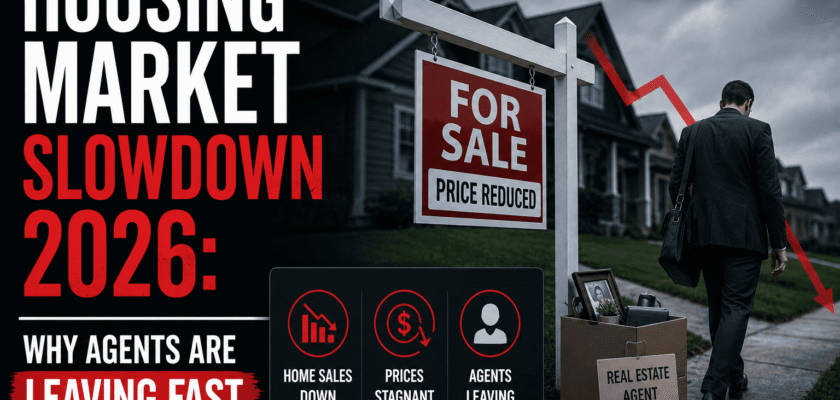
Real-Estate Agents Quit: Why High Mortgage Rates Are Causing a Massive Brokerage Exodus in 2026.
The underlying roadmap directing the residential property sector is undergoing a sharp, structural contraction. For nearly seven years, the consumer housing market operated under a highly profitable, high-volume transactional cycle. Record-low interest rates encouraged millions of families to purchase homes, which flooded traditional agencies with easy commission checks. This boom cycle triggered a massive influx of new licensees, inflating the national pool of active sales practitioners to historic highs. However, this rapid personnel expansion assumed that real estate volumes would remain permanently accelerated by cheap credit.
Unfortunately, a sustained environment of elevated borrowing costs has completely crushed those original volume assumptions.
We have officially entered a tough period defined by a major housing market slowdown 2026 wave.
Driven by a persistent real estate agent job market decline, thousands of sales professionals are ditching their licenses.
The primary catalyst forcing this massive industry contraction centers on sticky, high-level mortgage rate impacts.
With average 30-year fixed home loans stubbornly hovering around the mid-6% range, buyers are completely priced out. This affordability block has caused total residential transactions to plummet across the country. Consequently, independent sales contractors are executing an unprecedented exit from major franchises, permanently reshaping corporate operations. This historic workforce shift proves that surviving a real estate down-cycle requires moving past simple sales volume to cut overhead costs to the bone.
1. The Lock-In Grip: Why High Rates Freeze Existing Home Inventory
The primary structural hurdle starving agents of necessary sales commissions centers on the severe lack of residential property listings. Standard market corrections typically see home prices drop, which eventually brings budget-conscious buyers back into the fold.
In sharp contrast, the current housing market slowdown 2026 cycle displays a rigid, dual-sided inventory freeze.
                    [ The Low Interest Rate Anchor ]
     (Homeowner Holds 3% Mortgage ──► Refuses to List Property ──► Inventory Dries Up)
                                     │
                                     ▼
                [ The 2026 Brokerage Commission Squeeze ]
     (Zero New Listings ──► Total Sales Volume Drops ──► Agents Face Severe Income Loss)
This unprecedented inventory lock-in creates intense financial pressure across traditional storefront brokerages:
- The Low-Rate Anchor: Over 80 percent of existing mortgaged homeowners currently enjoy locked-in interest rates below 6 percent.
- Refusing to Trade Up: Consequently, families refuse to list their properties because buying a new home doubles their monthly payments.
- Starving the Agent Class: Therefore, the supply of resale homes remains heavily restricted, leaving agents with almost no active listings to sell.
2. The Fee Squeeze: Why Escalating Desk Costs Provoke the Agent Walkout
The real-world expansion of this professional exit relies on a brutal mismatch between shrinking agent commissions and climbing desk fees.
A. Trimming the Fat From Commission Splits
Traditional real estate agent compensation structures were built to thrive during high-volume, low-interest market eras.
When a standard agent closes only one transaction every four months, monthly franchise fees become a heavy burden.
Corporate offices continue to charge high technology fees, mandatory insurance assessments, and steep physical desk rents.
These continuous operational costs quickly drain the dwindling cash reserves of mid-tier sales agents.
B. The Attrition Cliff Catching Major Firms
Furthermore, this severe margin pressure combines with shifting buyer rules to push agents out of the business entirely:
  [ Listing Volume Drops 30% ] ───► [ Franchise Maintains High Desk Fees ]
                                                    │
                                                    ▼
                                     [ Agent Bank Accounts Drain ]
                               "Monthly Fees Outpace Total Commission Inflows"
                                                    │
                                                    ▼
                                     [ Massive System Exodus Locked ]
                               "Thousands of Licensees Forfeit Active Credentials"
The strict financial realities of a quiet market are driving a massive wave of license forfeitures.
Internal industry logs show that over 53 percent of agents at top firms are actively planning to exit.
The National Association of Realtors has seen its total membership numbers plunge way below the 1.5 million mark.
This industry-wide workforce drop leaves office spaces empty, showing that old commission splits cannot support agents during a market stall.
3. Strategic Matrix: 2021 Boom-Era Operations vs. 2026 Slowdown Reality
| Real Estate Business Vector | 2021 Boom-Era Operations | 2026 Slowdown Reality |
| National Inventory Velocity | Rapid; homes clear out in days with multiple offers | Stalled; strict rate locks freeze new listings |
| Personnel Intake Target | Extreme; teams onboard thousands of fresh agents | Negative; massive agent walkout hits firms |
| Average Mortgage Barrier | Low; comfortable 3% fixed loans drive buyers | High; sticky 6.3% rates price out middle class |
| Corporate Overhead Stance | Loose; firms expand expensive luxury offices | Strict; agencies slash costs to survive drops |
| Risk Characterization | Low risk of transaction failure or deal drops | Withdrawn Risk; tech-backed cost mitigation |
4. Shifting to Information: How Elite Agents Survive by Selling Expertise
The final core trend defining advanced real estate survival moves away from standard transaction chasing to embrace specialized digital media models. Because waiting for home sales to return creates a dangerous financial gap, smart professionals are changing their approach.
Consequently, survivors use automated software to share their knowledge, building independent income channels outside traditional brokerages.
  [ Agent Minimizes Office Footprint ] ───► [ Builds Independent Local Data Media ]
                                                          │
                                                          ▼
                                           [ Monetizes Real Estate Expertise ]
                                     "Launches Custom Consulting for Investors"
                                                          │
                                                          ▼
                                           [ Stable Financial Security Secured ]
                                     "Diversifies Cash Flow Away from Commisions"
Top real estate operators use advanced content distribution networks to share hyper-local market insight platforms.
Instead of relying solely on closing local sales, these modern professionals charge fees for specialized land consulting.
This flexible consulting framework lets experts generate steady income even when regional home sales dry up completely.
By trading traditional desk spaces for lean digital asset stacks, agents protect their personal wealth from market downturns.
Thus, proactive business adjustment transforms a major industry challenge into a powerful opportunity for modern evolution. This smart strategic shift keeps business income healthy and independent, proving that long-term real estate survival is won by adapting to economic shifts right as they unfold.


