


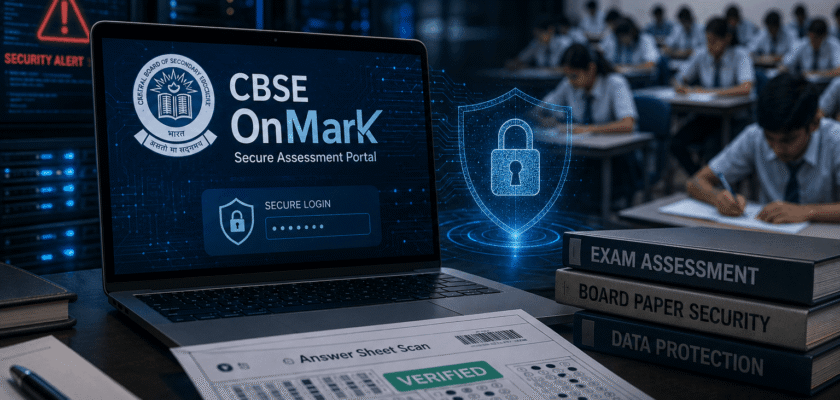
CBSE OnMark Portal Vulnerabilities: Why This Issue Became Serious
CBSE OnMark portal vulnerabilities became a major education concern after security weaknesses were reported around the digital evaluation system used for board paper assessment. The issue raised questions about student data safety, answer sheet access, and the strength of digital exam infrastructure.
CBSE said the identified vulnerabilities have been contained. The board also stated that cybersecurity experts from government agencies and IITs are helping strengthen the system.
This matter is important because board exam evaluation needs maximum trust. Students, parents, teachers, and schools must feel sure that marks, answer sheets, and digital records stay safe.
Why CBSE OnMark Portal Vulnerabilities Matter for Students
CBSE OnMark portal vulnerabilities matter because board exam marks can affect college admission, scholarships, and future academic choices. Even a small doubt in evaluation security can create stress for students.
Digital evaluation can improve speed and transparency. However, it also needs strong cybersecurity. If scanned answer sheets, marks, or student details face weak protection, public confidence can fall quickly.
Therefore, the OnMark issue is not only a technical problem. It is also a trust problem.
What Is the OnMark Portal and OSM System?
The OnMark portal is linked with the On-Screen Marking, or OSM, process. In this system, physical answer sheets are scanned and checked digitally by evaluators.
This method can reduce paper handling and make evaluation faster. It can also help with tracking, moderation, and verification.
However, any digital system needs strict security controls. These include login protection, role-based access, data encryption, audit logs, secure storage, and regular testing.
Without these layers, a digital evaluation platform can become vulnerable.
CBSE OnMark Portal Vulnerabilities: What CBSE Said
CBSE said it has contained the identified vulnerabilities in the OnMark portal operated by its service provider. The board also said that other exploitable weaknesses are being ruled out.
In addition, CBSE has involved cybersecurity experts from government organisations and IITs to fortify the system. This step shows that the board is treating the matter seriously.
Earlier, CBSE had clarified that the actual evaluation portal was not hacked and said the website mentioned in viral claims was a testing site, not the live evaluation platform. Later updates focused on vulnerabilities in the broader OnMark portal ecosystem.
So, the safest reading is this: CBSE has not confirmed a full compromise of the actual evaluation portal, but it has acknowledged and contained identifiable vulnerabilities in the service provider’s system.
Why the “Breach” Word Needs Careful Use
Many social media posts used the word “breach” quickly. However, in cybersecurity, there is a difference between a vulnerability, an attempted access, and a confirmed data breach.
A vulnerability means a weakness exists.
A breach means someone successfully accessed or exposed protected data.
A hack claim means someone says they entered or tested a system.
In this case, CBSE has acknowledged vulnerabilities and said they were contained. At the same time, reports also mention claims that answer sheets may have been exposed online. These claims need careful verification through official investigation.
Therefore, responsible reporting should avoid exaggeration and focus on confirmed facts.
How Ethical Hackers Entered the Discussion
The OnMark issue gained attention after ethical hacker claims surfaced online. Reports said a 19-year-old ethical hacker flagged serious weaknesses and claimed that scanned answer sheets and question papers were accessible without proper authorization.
Ethical hacking can help institutions find problems before criminals misuse them. However, responsible disclosure is important. A researcher should report issues safely, avoid public exposure of private data, and give the institution time to fix the problem.
CBSE also thanked ethical hackers and citizens who flagged potential security issues, according to reports.
This shows that public digital systems need a healthy and formal vulnerability reporting process.
Board Paper Assessment Security: Why It Is Difficult
Board paper assessment security is difficult because it involves many steps. Answer sheets move from exam centres to scanning systems, digital storage, evaluator access, moderation, marks entry, verification, and result processing.
Each step needs protection.
A secure assessment system must protect:
- Student identity
- Answer sheet scans
- Question papers
- Evaluator login data
- Marks records
- Rechecking requests
- Verification files
- Server access
- Admin controls
- Audit trails
If any layer becomes weak, the full system can face questions.
What Security Weaknesses Can Affect Digital Evaluation?
Digital evaluation platforms can face different types of security weaknesses. These may include weak authentication, exposed URLs, poor access control, insecure file storage, missing encryption, weak session management, and poor audit logging.
A platform may also face risks from vendor systems, testing servers, misconfigured cloud storage, or old software components.
This is why security testing should happen before, during, and after every high-stakes exam cycle.
Moreover, systems that handle lakhs of student records need stronger checks than normal websites.
Why Service Provider Security Matters
CBSE’s statement mentions the OnMark portal of its service provider. This is important because many public bodies use private technology partners for large digital systems.
However, outsourcing technology does not remove responsibility. The board, vendor, and cybersecurity teams must work together to protect student data.
A strong vendor contract should include:
- Security audit rules
- Data protection standards
- Access control requirements
- Incident reporting timeline
- Backup and recovery plan
- Penetration testing
- Log monitoring
- Data deletion policy
- Accountability clauses
- Regular compliance checks
Without these controls, vendor-side weakness can become an institutional crisis.
CBSE OnMark Portal Vulnerabilities and Student Data Privacy
CBSE OnMark portal vulnerabilities also raise a student data privacy question. Answer sheets are not ordinary files. They contain roll numbers, handwriting, subject responses, marks, and academic records.
If such files become exposed, students may face privacy risk. Their academic performance and personal details should not circulate online.
Therefore, digital evaluation systems should follow strict privacy-by-design rules. Only authorized people should access answer sheets, and every access should be logged.
In addition, sensitive data should not stay on public or poorly protected servers.
Why Parents and Students Became Worried
Parents and students became worried because board exam results are emotional and important. Many students already felt pressure over marks and re-evaluation.
Reports also mentioned student complaints around answer sheet discrepancies, including concerns that scanned copies did not match expectations or had issues. These complaints increased public attention around the OSM system.
When security concerns and evaluation complaints appear together, the trust problem becomes bigger.
That is why CBSE’s response, cybersecurity review, and transparent communication are very important.
What Students Should Do If They Notice a Problem
Students should not panic after reading social media posts. Instead, they should follow official CBSE procedures.
If a student finds any issue with scanned answer sheets, marks, or verification, they should:
- Check official CBSE notices
- Use the official verification portal
- Keep application and roll number ready
- Save official screenshots or receipts
- Avoid sharing answer sheets publicly
- Contact school authorities if needed
- Follow re-evaluation timelines
- Avoid rumours and fake links
This creates a proper record and protects student privacy.
What CBSE Should Do Next
CBSE has already said it is working with cybersecurity experts. However, long-term trust needs more steps.
CBSE should consider:
- Independent security audit
- Public summary of fixes
- Stronger vendor accountability
- Bug bounty or responsible disclosure policy
- Better student grievance support
- Clear timeline for corrections
- Stronger encryption
- Role-based access controls
- Real-time monitoring
- Regular penetration testing
These steps can help rebuild confidence in digital evaluation.
How Digital Evaluation Can Still Be Useful
The OnMark issue does not mean digital evaluation is a bad idea. On-Screen Marking can still improve exam processing if it is built safely.
A good OSM system can offer:
- Faster checking
- Better tracking
- Reduced paper movement
- Clear audit logs
- Easy verification
- Lower manual error
- Better moderation
- Stronger record keeping
However, security must come first. A fast system without trust cannot work for board exams.
Therefore, digital evaluation should continue only with stronger safeguards.
Why Transparency Is Important in Exam Technology
Transparency helps reduce fear. When students and parents understand what happened, what was fixed, and what steps come next, trust improves.
CBSE does not need to reveal sensitive technical details that could help attackers. However, it can share a simple public update explaining:
- What kind of issue was found
- Whether student data was affected
- What steps were taken
- Which experts reviewed the system
- How students can report concerns
- What protections now exist
Clear communication is better than silence.
Lessons for India’s Digital Education Systems
The CBSE OnMark portal vulnerabilities show a larger lesson for India’s education system. As exams, admissions, scholarships, and results move online, cybersecurity becomes part of academic fairness.
Every digital education platform should treat security as a core feature, not an afterthought.
Important lessons include:
- Test systems before launch
- Separate testing and live environments
- Protect student data by default
- Verify vendor security
- Train staff
- Monitor logs
- Encourage responsible reporting
- Respond quickly to issues
- Communicate clearly with students
This will help future digital exams become safer.
Final Verdict
CBSE OnMark portal vulnerabilities have raised serious questions about board paper assessment security, student data privacy, and digital evaluation trust. CBSE has said the identified vulnerabilities were contained and experts from government agencies and IITs are strengthening the system.
The key point is balance. Digital evaluation can improve speed and transparency, but it must run on strong cybersecurity. Students should not suffer because of weak systems, unclear communication, or vendor-side gaps.
In simple words, board exam technology must be fast, fair, and secure. If CBSE can fix the weaknesses, improve transparency, and protect student data, the OnMark controversy can become a lesson for stronger digital education infrastructure in India.


