


Regional Transit High-Speed Corridors: Why Real Estate Money Is Moving
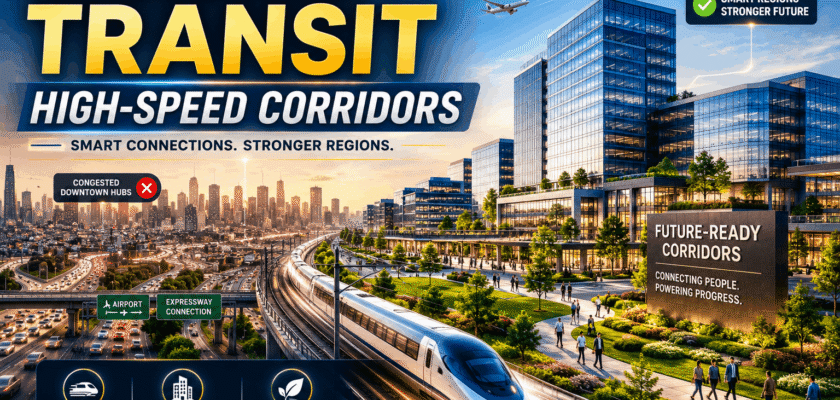
Regional transit high-speed corridors are changing how commercial real estate developers choose office locations in 2026. Earlier, most premium office projects focused on crowded downtown hubs. Now, developers are looking toward expressways, metro extensions, airport zones, rapid rail routes, and future high-speed rail corridors.
This shift is not random. Companies want better employee access, lower traffic stress, larger land parcels, cleaner campuses, and more flexible office planning. At the same time, infrastructure is creating new business zones outside old city centres.
Therefore, commercial real estate inflows are slowly moving from only “central address value” to “connectivity value.”
Why Regional Transit High-Speed Corridors Matter in 2026
Regional transit high-speed corridors matter because office location strategy has changed. A company does not only ask, “Is this office in the city centre?” It now asks, “Can employees reach this office faster?”
This question is important because long commutes hurt productivity and employee satisfaction. If an office sits near a strong transit corridor, it can attract tenants even outside the traditional downtown.
Moreover, high-speed corridors can connect secondary cities, suburban zones, airport districts, logistics hubs, and commercial clusters. As a result, real estate demand can spread beyond one congested business district.
What Are Regional Transit High-Speed Corridors?
Regional transit high-speed corridors are transport routes that connect cities, suburbs, and economic zones with faster mobility. These corridors may include high-speed rail, semi-high-speed rail, rapid rail, metro extensions, expressways, airport links, and multimodal transit systems.
In real estate terms, these corridors become growth lines.
When connectivity improves, nearby land can become more attractive for:
- Office parks
- Retail centres
- Hotels
- Warehousing
- Housing projects
- Co-working spaces
- Data centres
- Business campuses
- Education hubs
- Healthcare zones
This is why developers track transit plans closely.
Regional Transit High-Speed Corridors and Transit Premium
Regional transit high-speed corridors create what developers call a transit premium. This means properties near strong transport routes may attract better demand, better occupancy, and stronger long-term value.
The premium comes from simple logic. People prefer locations that save time. Companies prefer locations that help hiring and reduce travel stress.
For example, a suburban office park near a metro, expressway, or airport link can become more useful than an expensive downtown building stuck in traffic.
Therefore, transit premium is becoming a real business factor.
Why Downtown Hubs Are Losing Some Advantage
Downtown hubs still matter. They have banks, hotels, government offices, premium retail, and business history. However, many downtown areas now face serious pressure.
Common problems include:
- High rent
- Traffic congestion
- Limited parking
- Older buildings
- High redevelopment cost
- Low expansion space
- Employee commute fatigue
- Air and noise pollution
- Poor last-mile access
- Higher operating cost
Because of this, many companies now prefer well-connected suburban or regional office zones.
The old rule was “central is best.” The new rule is “connected is best.”
Commercial Real Estate Inflows Are Following Infrastructure
Commercial real estate inflows are increasingly following infrastructure. When a corridor becomes functional, investors gain confidence. When a new airport, expressway, or rail route becomes visible, developers start planning nearby projects.
For example, Times of India recently reported that Dwarka Expressway is redefining Gurugram’s real estate dynamics and turning New Gurugram into a key growth corridor. The report linked the shift to better connectivity and improving investor confidence.
This shows how infrastructure can change market perception.
High-Speed Rail Corridors and Future Office Demand
India’s Budget 2026–27 announced plans to develop seven new high-speed rail corridors. NDTV reported that these corridors were described as “growth connectors,” which means they are expected to support faster passenger movement and regional economic growth.
For commercial real estate, this matters because future office demand can follow better inter-city access.
If a high-speed route connects major economic and cultural cities, it can support business travel, regional offices, hotels, coworking spaces, and mixed-use projects.
However, developers must remember one point: announcement alone does not create value. Execution creates value.
India Office Market 2026: Demand Is Still Strong
India’s office market remains strong in 2026. JLL reported that Q1 2026 recorded India’s best-ever Q1 gross leasing at 21.5 million sq. ft.
Colliers also projected Grade A office demand at 70–75 million sq. ft. in 2026, with growth supported by GCC expansion, flex adoption, tech-enabled workspaces, and sustainability-focused workplaces.
This demand gives developers confidence to build outside old downtown zones. If tenants are expanding, new connected corridors can absorb part of that demand.
Why Integrated Office Parks Are Becoming Popular
Integrated office parks are becoming popular because companies want more than office space. They want a full work ecosystem.
A modern integrated office park may include:
- Grade A office towers
- Green campus space
- Cafes and retail
- Fitness zones
- EV charging
- Smart parking
- Shuttle services
- Security systems
- Flexible workspaces
- ESG-friendly design
CBRE-linked reports suggest India’s office stock may cross 1 billion sq. ft. in 2026, and a large part of future supply may concentrate in integrated technology parks.
This supports the shift from isolated towers to campus-style business zones.
Regional Transit High-Speed Corridors and GCC Growth
Regional transit high-speed corridors can support Global Capability Centers, or GCCs. GCCs often need large office spaces, talent access, and strong digital infrastructure.
Many GCCs prefer campuses that offer expansion capacity, employee amenities, and better transport links. Downtown buildings may not always provide that scale.
CBRE’s Q1 2026 office figures show record-high GCC leasing of 9.1 million sq. ft., which confirms the strength of this occupier segment.
Therefore, connected suburban and regional campuses can become more attractive for GCC expansion.
Airport Zones Are Becoming Business Magnets
Airport-linked corridors are also gaining real estate attention. Good airport access helps companies that need frequent business travel, logistics support, executive movement, and global connectivity.
Times of India reported that Jewar Airport is helping nearby NCR markets gain more real estate attention, with Faridabad emerging as a stronger growth zone.
This shows a wider pattern. When transport infrastructure improves, nearby residential and commercial interest can rise.
So, airport-linked corridors can become strong office and mixed-use development areas.
Why Employee Commute Is Driving Office Decisions
Employee commute has become a serious business issue. Long travel time can reduce productivity, increase stress, and make hiring harder.
A company may save rent by choosing a cheaper location, but if employees struggle to reach the office, the decision can fail.
Regional transit high-speed corridors help solve this problem. They offer better movement between home clusters and job zones.
This is especially useful in hybrid work. Employees may not come daily, but when they come, they want a smoother commute.
Why Housing and Offices Must Grow Together
A corridor becomes stronger when housing and offices grow together. If employees can live near work, the area becomes more stable.
Mixed-use development can support:
- Shorter commute
- Better rental demand
- Stronger retail activity
- Higher office occupancy
- Better local services
- More balanced urban growth
- Lower pressure on downtown areas
- Better lifestyle quality
Therefore, developers now study both office demand and residential growth before entering a corridor.
Smart Office Parks vs Downtown Towers
Smart office parks and downtown towers serve different needs.
| Factor | Smart Office Parks | Downtown Towers |
|---|---|---|
| Land availability | Higher | Limited |
| Expansion space | Better | Lower |
| Commute | Depends on corridor | Often congested |
| Campus amenities | Strong | Limited by space |
| Rent pressure | Often balanced | Often high |
| Brand address | Emerging | Strong legacy |
| Parking | Easier | Difficult |
| Future growth | High if transit improves | Stable but crowded |
This does not mean one model wins everywhere. It means tenants now have more choices.
What Developers Check Before Investing in a Corridor
Developers should not invest blindly in every “upcoming” corridor. They must check real demand.
Important checks include:
- Is the corridor already functional?
- Is the project only announced?
- Are large companies leasing nearby?
- Is housing demand growing?
- Is last-mile transport available?
- Are schools, hospitals, and retail nearby?
- Is the developer ecosystem strong?
- Are civic services ready?
- Is land pricing realistic?
- Is there oversupply risk?
Good infrastructure can create value, but weak execution can trap capital.
Risks in Corridor-Based Real Estate
Corridor-based real estate has risks. Many investors buy early only because of future promises. However, delays can reduce returns.
Common risks include:
- Infrastructure delay
- Overpriced land
- Poor last-mile connectivity
- Weak public transport frequency
- Low tenant demand
- Too much speculative supply
- Civic infrastructure gaps
- Water and power issues
- Unclear zoning rules
- Slow policy approvals
Therefore, real estate inflows should follow verified progress, not only hype.
Why Policy Support Is Important
Policy support plays a major role in corridor growth. Zoning, floor area rules, metro integration, parking norms, mixed-use permissions, affordable housing, and utility planning all affect success.
If government planning and private development move together, a corridor can become a strong business zone. If planning stays weak, the area may face traffic, water shortage, and unplanned growth.
So, smart policy can turn transport corridors into real economic corridors.
What Investors Should Watch in 2026
Real estate investors should watch corridor execution carefully.
Important signals include:
- New metro approvals
- Expressway completion
- High-speed rail progress
- Airport connectivity
- Large office lease deals
- GCC announcements
- Land auction prices
- Residential absorption
- Rental growth
- Infrastructure deadlines
These signals show whether a corridor is truly maturing or only getting media attention.
What Tenants Should Watch
Corporate tenants should also be careful while choosing corridor-based offices.
They should check:
- Employee travel time
- Metro or rail access
- Shuttle support
- Parking availability
- Nearby housing
- Food and retail options
- Power backup
- Internet reliability
- Safety and security
- ESG standards
A cheaper office is not always better. The best office supports people, cost, brand, and future growth together.
Regional Transit High-Speed Corridors and the Future of Work
Regional transit high-speed corridors can support the future of work by spreading business activity across more locations. This can reduce pressure on old city cores and help secondary cities grow.
In the long term, companies may use hub-and-corridor models. They may keep one main office in a city and add smaller offices near fast transit zones.
This can help employees work closer to home while staying connected to the larger business network.
Final Verdict
Regional transit high-speed corridors are reshaping commercial real estate inflows in 2026. Downtown hubs still have value, but they no longer control the full office story. Companies now want connected, scalable, employee-friendly, and cost-efficient locations.
Strong office demand, GCC expansion, integrated office parks, airport zones, expressways, and high-speed rail planning are all pushing developers toward new growth corridors.
However, investors must stay practical. Infrastructure announcements are not enough. Real value comes from execution, tenant demand, last-mile access, and civic readiness.
In simple words, commercial real estate is following movement. The future office market will grow where people, infrastructure, and business demand meet.


