


Praggnanandhaa Norway Chess Win: Why This Result Feels Historic
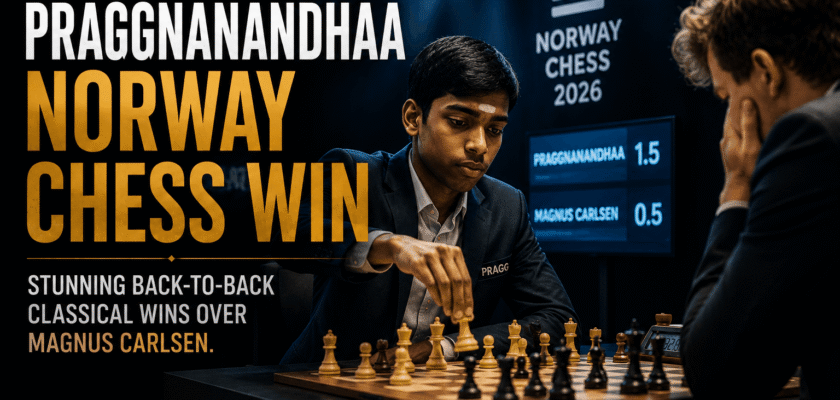
Praggnanandhaa Norway Chess win has become one of the biggest chess stories of 2026 because the young Indian Grandmaster defeated Magnus Carlsen twice in the same classical tournament. Beating Carlsen once is already special. Beating him twice in classical chess at Norway Chess is a different level of statement.
This win matters because classical chess is the toughest format of the game. It gives players more time to think, calculate, defend, attack, and recover. Luck can help in one moment, but long-format consistency needs real depth.
Therefore, Praggnanandhaa’s back-to-back classical wins over Carlsen show that Indian chess is not only producing young talents. It is producing players who can challenge the strongest names in the world.
Why Praggnanandhaa Norway Chess Win Matters in 2026
Praggnanandhaa Norway Chess win matters because it came against World No. 1 Magnus Carlsen, one of the greatest chess players in history. Times of India reported that Praggnanandhaa defeated Carlsen in Round 8 at Norway Chess 2026, and after the game, he said Carlsen’s rare blunder might have come from “panic.”
This is important because Carlsen usually creates panic in others. Here, Praggnanandhaa forced pressure in the opposite direction.
The result also damaged Carlsen’s chances of winning an eighth Norway Chess title. Economic Times reported that only two rounds remained and that Praggnanandhaa had moved closer to a possible historic Norway Chess title challenge.
In simple words, this was not a symbolic win. It changed the tournament race.
What Happened at Norway Chess 2026?
At Norway Chess 2026, Praggnanandhaa defeated Carlsen twice in classical games. ChessBase reported that the first classical win came in Round 3, where Praggnanandhaa beat Carlsen in a wild rollercoaster game.
Then, in Round 8, Praggnanandhaa defeated Carlsen again. The Statesman reported that he beat Carlsen for the second time at Norway Chess 2026, while Gukesh and Divya Deshmukh suffered classical losses in the same round.
This double win made the tournament more dramatic.
It also gave Indian chess fans a moment to remember.
Praggnanandhaa Norway Chess Win and Classical Chess Supremacy
Praggnanandhaa Norway Chess win is special because it happened in classical chess. Classical chess is the traditional long format where each player gets much more thinking time compared with rapid or blitz.
Times of India explained that classical chess uses longer time controls, usually allowing deeper thinking and strategic planning over several hours. The same report noted that Praggnanandhaa became only the second player ever to beat Carlsen twice in one classical event, after Viswanathan Anand did it in 2007 at Linares.
This comparison is powerful.
When a young Indian player’s result is placed beside Anand’s historic achievement, it shows how big this moment is.
Why Beating Carlsen Twice Is So Difficult
Beating Carlsen twice is extremely difficult because he is one of the best defenders and endgame players ever. Even when he is worse, he often finds ways to create counterplay. Even when opponents get winning positions, they can lose control under pressure.
Carlsen is dangerous because he has:
- Deep opening preparation
- Strong middlegame understanding
- Excellent endgame technique
- Psychological pressure
- Time-trouble resilience
- Practical fighting spirit
- Ability to punish small mistakes
- Experience in elite events
- Strong tournament instincts
- Incredible defensive resourcefulness
So, defeating him twice in one classical tournament is a rare achievement.
Praggnanandhaa did not only win games. He passed a mental pressure test.
Round 3: The First Classical Blow
The first win came in Round 3. ChessBase described it as a rollercoaster game, where Praggnanandhaa scored the only classical win of the round by beating Carlsen.
That game mattered because it broke a psychological barrier.
Before this tournament, beating Carlsen in faster formats was already a known part of Praggnanandhaa’s rise. But beating him in classical chess carried a different weight.
After Round 3, the message was clear: Praggnanandhaa could beat Carlsen not only in speed chess, but also in deep strategic battles.
Round 8: The Second Win That Changed the Tournament
Round 8 made the story bigger. Praggnanandhaa again defeated Carlsen, this time with the black pieces according to ChessBase India’s public update.
NDTV reported that the victory lifted Praggnanandhaa to 12 points and third place. It also dealt a major blow to Carlsen’s hope of winning an eighth Norway Chess title.
This second win was not just a repeat. It confirmed that the first result was not a one-off.
It showed preparation, confidence, and the ability to handle Carlsen’s pressure twice.
Why Praggnanandhaa’s Calm Reaction Matters
After beating Carlsen earlier in the tournament, Praggnanandhaa reportedly said he did not think it was “such a big win” and that he got lucky at the end. Indian Express reported his calm reaction after the game, showing how high his own standards are.
This attitude matters.
Young players can get overwhelmed by big victories. They can celebrate too much, lose focus, and struggle in the next round. Praggnanandhaa’s calm reaction shows maturity.
He knows that one win is not enough.
A champion mindset looks beyond headlines.
The “Panic” Moment Against Carlsen
After the Round 8 win, Praggnanandhaa suggested that Carlsen’s rare blunder may have come from panic. Times of India reported his honest take after the game.
This is interesting because Carlsen is usually the player who creates panic. He keeps games alive, makes opponents solve problems, and often wins from equal or unclear positions.
If Praggnanandhaa forced Carlsen into panic, that shows serious competitive growth.
At elite level, chess is not only calculation. It is also nerves.
India’s New Classical Chess Confidence
Praggnanandhaa’s wins are part of a bigger Indian chess story. India now has multiple young elite players competing against the world’s best. Gukesh, Arjun Erigaisi, Nihal Sarin, Vaishali, Divya Deshmukh, and many others have made Indian chess deeper than ever.
Praggnanandhaa’s Norway Chess performance adds another strong layer.
It shows that Indian players can:
- Beat elite opponents
- Compete in classical format
- Handle pressure events
- Stay calm after wins
- Fight for top tournament titles
- Create global headlines
- Inspire young chess learners
- Build India’s chess future
- Challenge old power centres
- Carry Anand’s legacy forward
This is why the win matters beyond one tournament.
Norway Chess 2026 Title Race
The title race remained competitive after Praggnanandhaa’s win. Economic Times reported that Wesley So had extended his lead at the top, while Praggnanandhaa remained in strong contention and Gukesh’s challenge had ended.
This makes the final rounds very important.
Praggnanandhaa needed not only to celebrate his win, but also to keep collecting points.
In Norway Chess, every round can change the standings because the scoring system includes classical results and Armageddon tie-breaks.
So, title hopes depend on consistency until the last game.
What Makes Norway Chess Special?
Norway Chess is one of the most prestigious elite tournaments in the world. It attracts top players and uses a format that creates fighting chess.
The tournament often includes:
- Classical games
- Armageddon tie-breaks
- Elite field
- High-pressure scoring
- Strong media attention
- Home pressure for Carlsen
- Top Indian players
- Global chess audience
- Title race drama
- Legacy moments
Winning or performing well at Norway Chess carries major prestige.
That is why Praggnanandhaa’s performance is so important.
Classical Chess vs Rapid and Blitz
Classical chess is different from rapid and blitz because players get more time. This allows deeper calculation and better planning.
Classical Chess
Long time control, deep strategy, several-hour games.
Rapid Chess
Shorter time, faster decisions, still strategic.
Blitz Chess
Very fast, heavy time pressure, instinct-based.
Carlsen is strong in all formats. Praggnanandhaa has also shown strength in multiple formats. But beating Carlsen twice in classical chess sends the strongest message.
It shows long-format maturity.
Why Time Pressure Decides Elite Chess
Time pressure often decides elite chess games. Even great players can make mistakes when the clock becomes low.
A player under time pressure must:
- Calculate quickly
- Avoid blunders
- Trust intuition
- Manage nerves
- Choose practical moves
- Avoid emotional collapse
- Use opponent’s clock pressure
- Stay physically calm
- Watch tactical tricks
- Convert advantages
Praggnanandhaa’s comments about panic show that time and nerves were part of the story.
At top level, one bad move can undo hours of work.
Praggnanandhaa’s Playing Style
Praggnanandhaa’s playing style has matured over the years. He is known for calculation, patience, and fighting spirit. He does not fear big names, and he often keeps games complex enough to create chances.
His strengths include:
- Tactical sharpness
- Calm defence
- Practical decision-making
- Opening preparation
- Endgame improvement
- Psychological balance
- Strong calculation
- Ability to fight long games
- Confidence against elite players
- Low-drama attitude
This combination makes him dangerous in classical tournaments.
Why Carlsen Losses Are Still Big News
Carlsen losses are still big news because he has dominated chess for more than a decade. Even after stepping away from the classical world title, he remains World No. 1 and one of the strongest players alive.
When Carlsen loses, especially twice to the same player in classical format, the chess world notices.
It suggests:
- The younger generation is rising
- Carlsen can be pressured
- Elite chess is becoming more open
- Indian players are becoming serious title contenders
- Tournament psychology is changing
- Classical chess still produces drama
This is why the story went viral.
The Anand Comparison
The Anand comparison makes this achievement even more meaningful. Times of India reported that Praggnanandhaa became only the second player to beat Carlsen twice in the same classical event, after Viswanathan Anand in 2007.
For Indian chess, this is emotional.
Anand built the foundation.
The new generation is expanding it.
Praggnanandhaa’s achievement connects India’s chess past with its future.
It shows continuity from one Indian legend to a new wave of contenders.
Why This Win Inspires Young Indian Players
This win inspires young Indian players because it proves that world-class chess is no longer distant. A young player from India can beat the best in the world on the biggest stage.
For young chess learners, the lesson is clear:
- Study deeply
- Play serious tournaments
- Learn from losses
- Stay calm under pressure
- Respect opponents but fear no one
- Build classical strength
- Improve endgames
- Manage time better
- Keep mental balance
- Think long term
This kind of win can bring more students to chess.
Media Buzz Around the Win
The win also created strong media buzz. Economic Times reported that Anand Mahindra praised Praggnanandhaa with the wordplay “Impraggnable” after the second win over Carlsen.
This matters because chess is becoming more mainstream in India.
Earlier, chess news stayed mostly within chess circles. Now, major wins by Indian players reach business leaders, celebrities, schools, and general sports fans.
This wider attention can help chess grow.
Why Praggnanandhaa Still Needs Consistency
Even after big wins, consistency remains the key. Elite tournaments are not won by one or two great games alone. A player must perform across all rounds.
Praggnanandhaa must continue to manage:
- Energy
- Preparation
- Time pressure
- Recovery
- Opponent-specific strategy
- Opening surprises
- Armageddon pressure
- Media attention
- Title race expectations
- Final-round nerves
A great tournament needs both brilliance and stability.
What Carlsen May Learn From This
Carlsen is still a giant of chess, but these losses may force him to review his approach against younger players.
He may look at:
- Opening choices
- Risk management
- Time usage
- Psychological pressure
- Endgame decisions
- Practical chances
- Tournament motivation
- Preparation against Indian players
- Handling sharp positions
- Avoiding panic under pressure
Great champions adapt after setbacks.
Carlsen has done that many times before.
What This Means for Gukesh and Other Indians
This tournament had mixed results for Indian players. Times of India reported that Gukesh and Divya Deshmukh suffered classical losses in Round 8, while Praggnanandhaa beat Carlsen again.
This shows how difficult elite chess is.
Even top Indian talents can have tough days. But the broader picture remains positive. Indian players are competing regularly with the world’s best.
That exposure will make the next generation stronger.
What Chess Fans Should Watch Next
Chess fans should watch the final rounds closely.
Important questions include:
- Can Praggnanandhaa keep title hopes alive?
- Can Wesley So hold the lead?
- Can Carlsen recover after two losses?
- Will Armageddon results change the standings?
- Can Indian players finish strongly?
- Will Praggnanandhaa create another big moment?
- How will the final standings affect rankings?
- What openings will players choose under pressure?
- Will Carlsen take more risks?
- Can Pragg manage media pressure?
The tournament is still alive.
Why This Result Matters for Indian Sports Culture
This result matters for Indian sports culture because chess is becoming a serious mainstream sport in India. Cricket still dominates headlines, but chess is gaining respect as a high-intellect competitive arena.
Praggnanandhaa’s win shows that Indian sports excellence is expanding.
India now celebrates:
- Chess grandmasters
- Olympic athletes
- Badminton players
- Javelin champions
- Shooters
- Wrestlers
- Table tennis players
- Football talent
- Esports players
- Para-athletes
This wider sports culture is healthy.
It gives young people more role models.
The Mental Side of Elite Chess
Elite chess is mentally exhausting. Players sit for hours, calculate deep lines, manage emotions, and make decisions under pressure.
A single game can require:
- Memory
- Calculation
- Pattern recognition
- Emotional control
- Physical stamina
- Strategic patience
- Clock management
- Psychological resilience
- Confidence
- Recovery after mistakes
Praggnanandhaa’s calm handling of Carlsen shows mental growth.
In chess, the strongest move often comes from the calmest mind.
Final Verdict
Praggnanandhaa Norway Chess win is a landmark moment for Indian chess. Defeating Magnus Carlsen twice in the same classical tournament is rare, historic, and deeply meaningful. It shows that Praggnanandhaa is not only a talented young player, but a serious elite-level contender.
The win also strengthens India’s global chess story. From Viswanathan Anand’s legacy to the current young generation, Indian chess has moved from respect to real dominance potential.
In simple words, Carlsen is still a legend, but Praggnanandhaa has shown that the next era is already knocking.
If he maintains consistency in the final rounds, Norway Chess 2026 could become one of the defining tournaments of his career.


