


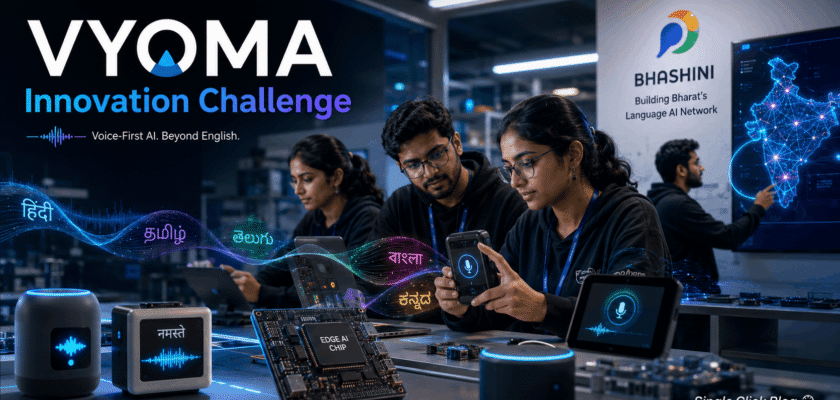
VYOMA Innovation Challenge: Why India’s AI Market Must Go Beyond English
VYOMA Innovation Challenge is important because India’s AI future cannot depend only on English. Most Indians speak, search, learn, work, and access services in regional languages. Yet many AI tools still work best in English or a few major global languages.
This creates a serious gap. If AI assistants, government services, healthcare tools, education platforms, and financial support systems do not understand Indian languages, millions of users remain underserved.
Therefore, VYOMA Innovation Challenge is not only a startup competition. It is a push toward multilingual, voice-first, edge AI solutions that can work for real India.
Why VYOMA Innovation Challenge Matters in 2026
VYOMA Innovation Challenge matters because AI adoption is moving from cloud chatbots to local, voice-enabled, and offline-ready devices. BHASHINI’s official challenge page says the mission is to transcend language barriers and help every citizen access digital services in their own language.
This is especially important for India because digital inclusion needs more than apps. It needs language comfort, voice interaction, and low-friction access.
Many users may not type well in English. Some may not be comfortable with complex menus. Others may live in areas where internet connectivity is weak.
Voice-first edge AI can solve many of these barriers.
What Is the VYOMA Innovation Challenge?
VYOMA Innovation Challenge is an initiative connected with BHASHINI, Current AI, and Kalpā Impact to encourage innovators to build multilingual AI solutions. The challenge brings together BHASHINI’s multilingual AI infrastructure and open-source edge AI innovation support.
The core idea is simple.
Build AI tools that can understand and respond in Indian languages, work on handheld or edge devices, and support practical use cases for citizens.
This can include:
- Voice assistants
- Translation tools
- Local language service bots
- Offline AI devices
- Government service access
- Education support
- Healthcare support
- Agriculture guidance
- Financial literacy
- Citizen helpdesk tools
This makes the challenge valuable for startups, students, researchers, and hardware builders.
VYOMA Innovation Challenge and Voice-First Edge AI
VYOMA Innovation Challenge focuses on voice-first edge AI because voice is the most natural interface for many Indian users. A farmer, shopkeeper, student, ASHA worker, driver, or elderly citizen may find voice easier than typing.
Edge AI means the AI can run partly or fully on a device instead of depending completely on cloud servers.
This matters because edge AI can offer:
- Lower latency
- Better offline support
- Lower data usage
- More privacy control
- Faster local response
- Better field usability
- Lower dependence on constant internet
- Practical deployment in rural areas
- Lower cloud cost
- Device-level accessibility
Together, voice-first and edge AI can make AI more inclusive.
Why English-Only AI Cannot Serve Bharat
English-only AI cannot serve Bharat because India is multilingual at every level. People may speak one language at home, another at work, and another for education or government services.
Many citizens understand digital services better when they are offered in their mother tongue.
India needs AI systems that can support Hindi, Tamil, Telugu, Bengali, Marathi, Gujarati, Kannada, Malayalam, Punjabi, Odia, Assamese, Urdu, Sanskrit, and many more languages.
A BHASHINI social update around VYOMA highlighted the need to support India’s official constitutional languages and close the language gap in AI.
This shows the real challenge: AI must speak India’s languages, not force India to speak AI’s language.
Multilingual Scale Frameworks: What Startups Need
Multilingual scale frameworks help startups build products that can serve many languages without rebuilding everything from zero. A startup should not design only for one language and then struggle to add others later.
A strong multilingual framework should include:
- Speech recognition
- Text-to-speech
- Translation
- Local language datasets
- Dialect handling
- Offline mode
- Voice command design
- Error correction
- User feedback loop
- Device optimization
This is where BHASHINI’s infrastructure can help startups build faster.
Why Voice AI Is Better for First-Time Digital Users
Voice AI is better for many first-time digital users because it reduces typing and reading pressure. A user can simply ask a question.
For example:
- “Mera ration card status kya hai?”
- “Meri fasal ke liye kaunsi dawa sahi hai?”
- “Mujhe bank loan ka form samjhao.”
- “Mera hospital appointment kaise book hoga?”
- “Is document ka meaning batao.”
Voice feels natural.
For people with low digital literacy, this can make AI less scary and more useful.
Edge AI: Why Offline Capability Matters
Offline capability matters because not every user has stable internet. Rural areas, field locations, transport routes, disaster zones, schools, clinics, and small shops may face network problems.
If AI works only when cloud connection is strong, it fails in many real situations.
Edge AI can help by running important features locally.
This can support:
- Basic translation
- Voice commands
- Local knowledge prompts
- Emergency information
- Device-level workflows
- Low-bandwidth sync
- Offline-first services
- Field worker assistance
- Local language forms
- Quick search and response
This is why edge AI startups have a real opportunity.
VYOMA Innovation Challenge and Open-Source AI
VYOMA Innovation Challenge is connected with open-source innovation. Open-source systems can help developers build faster, inspect code, improve trust, and adapt tools for local needs.
Open-source is useful for India because language and dialect needs are diverse.
A closed system may not support every local use case. But open-source tools allow communities, startups, and researchers to improve the ecosystem.
Open-source AI can help with:
- Faster experimentation
- Lower startup cost
- Community testing
- Local language improvement
- Transparency
- Research collaboration
- Public sector adoption
- Custom device development
- Trust-building
- Long-term ecosystem growth
This makes the challenge more than a pitch event.
Startups Can Build for Real Indian Problems
Startups participating in VYOMA Innovation Challenge should focus on real Indian problems, not only demo-friendly products.
Good use cases may include:
- Voice-based government service guide
- Farmer advisory assistant
- Healthcare triage support
- School learning assistant
- Local language legal explainer
- Banking and UPI safety assistant
- Skill training assistant
- Public transport information tool
- Disaster alert voice device
- Field worker documentation tool
The best startups will solve painful problems in simple language.
Agriculture Use Case: Voice AI for Farmers
Farmers can benefit from multilingual voice-first AI because many agriculture questions are local and time-sensitive.
A farmer may ask:
- Which crop disease is this?
- What is today’s mandi price?
- How much fertilizer should I use?
- Is rain expected this week?
- Which government scheme applies to me?
- How do I apply for subsidy?
A voice-first edge device can help farmers even when they are in the field.
If the system supports local language and offline basics, adoption can improve.
Healthcare Use Case: Better Access in Local Languages
Healthcare is another major use case. Many patients struggle to understand medical instructions in English.
A multilingual voice AI assistant can help explain:
- Appointment process
- Basic symptoms
- Medicine timing
- Health scheme eligibility
- Hospital directions
- Post-care instructions
- Vaccination information
- Preventive health tips
- Emergency helpline guidance
- Follow-up reminders
However, healthcare AI must be careful. It should support doctors and patients but should not replace medical professionals for serious diagnosis.
Education Use Case: Voice Learning Beyond English
Education can benefit strongly from multilingual voice AI. Many students understand concepts better in their own language.
Research on multilingual voice-based code learning shows that language barriers can make programming education harder for Indian students. A 2025 paper on CodeVaani presented a multilingual speech-driven assistant that helps learners explore programming concepts in native languages.
This shows how voice AI can make learning more inclusive.
Students can ask questions naturally and receive answers in both text and audio.
Financial Literacy Use Case
Financial literacy is a strong use case because many people struggle to understand banking terms, insurance, UPI safety, loans, and fraud prevention.
A voice-first AI tool can explain:
- UPI safety
- Loan terms
- Interest rate meaning
- EMI calculation
- Insurance basics
- Scam warnings
- Savings habits
- Government schemes
- KYC steps
- Digital payment safety
If this works in local languages, it can reduce financial confusion and fraud risk.
Government Services Use Case
Government services often require forms, portals, documents, and deadlines. Many citizens need help understanding steps.
A multilingual edge AI assistant can guide users through:
- Scheme eligibility
- Document checklist
- Application steps
- Status tracking
- Local office information
- Complaint filing
- Certificate process
- Pension support
- Scholarship support
- Public welfare benefits
This directly supports digital inclusion.
BHASHINI’s mission of helping citizens access digital services in their own language fits this use case well.
Why Handheld AI Devices Matter
Handheld AI devices matter because not every AI experience needs to be inside a smartphone app. Some users may benefit from simple dedicated devices with microphones, speakers, local AI models, and offline support.
A public LinkedIn post about VYOMA described the initiative as focused on offline, voice-enabled edge AI in several languages, with shortlisted applications possibly receiving developer kits and mentorship.
Handheld AI devices can be useful for:
- Field workers
- Rural service centres
- Schools
- Clinics
- Farmers
- Local government desks
- Transport staff
- Elderly users
- Shopkeepers
- Disaster response teams
Simple hardware can reduce dependence on complex apps.
Why Startups Need Hardware and Software Together
Voice-first edge AI often needs both hardware and software. A good model is not enough if the microphone is poor, battery is weak, or device cannot handle local noise.
Startups must think about:
- Microphone quality
- Speaker clarity
- Battery life
- Offline model size
- Local storage
- Language switching
- Noise cancellation
- Rugged design
- Update system
- Privacy protection
A product that works in a quiet demo room may fail in a noisy market or village office.
So, real-world testing is essential.
Challenge for Indian Language AI: Dialects
Indian language AI must handle dialects. Hindi spoken in Rajasthan may differ from Hindi in Bihar or Delhi. Tamil, Bengali, Marathi, and other languages also have regional variations.
This creates a challenge for voice AI.
The system must handle:
- Accent variation
- Code-mixing
- Hinglish
- Local words
- Dialect expressions
- Background noise
- Different speaking speeds
- Gender and age voice differences
- Informal grammar
- Mixed-language questions
This is why data diversity matters.
Code-Mixing Is a Real User Behaviour
Many Indian users do not speak in one pure language. They mix English with Hindi or other languages.
For example:
- “Mera account login nahi ho raha.”
- “Ye document upload kaise karna hai?”
- “Loan ka interest kitna lagega?”
- “Mujhe form ka status check karna hai.”
A useful AI assistant must understand such mixed language.
This is why multilingual AI in India must support real speech, not textbook speech only.
Voice Latency Must Be Low
Voice AI must respond fast. If response time is too slow, users lose trust.
Modern voice foundation model research is also pushing toward low-latency real-time interaction. A 2025 paper on Voila described a voice-language model with 195 ms response latency in its research setting, showing the direction of real-time voice AI development.
For startups, low latency matters because voice conversation feels broken if the user waits too long.
Edge AI can help by reducing cloud round-trips for basic tasks.
Privacy and Trust in Voice-First AI
Voice-first AI handles sensitive information. Users may speak about money, health, documents, family details, or government benefits.
So, privacy must be built from the start.
Startups should protect:
- Voice recordings
- Transcripts
- Personal identity
- Location data
- Financial queries
- Health information
- Government document details
- User consent
- Data retention
- Device security
Edge AI can improve privacy if sensitive processing happens locally. But storage and updates still need strong safeguards.
Why AI Startups Should Build for Low-Cost Deployment
India-scale AI products must be affordable. A solution that works only on expensive hardware may not reach the people who need it most.
Startups should focus on:
- Low-cost devices
- Lightweight models
- Offline-first design
- Open-source components
- Local repairability
- Low power use
- Simple user interface
- Regional support
- Durable hardware
- Scalable deployment
Affordability is not a side issue. It is the core of inclusion.
Business Model Opportunities
VYOMA Innovation Challenge can open business model opportunities for startups.
Possible models include:
- Government deployment
- SaaS for rural service centres
- Device sales
- Subscription support
- NGO partnerships
- Enterprise field-worker tools
- School licensing
- Healthcare kiosk integration
- Agriculture advisory services
- Financial literacy modules
The best model will depend on who pays and who benefits.
For inclusion products, the paying customer may be government, NGO, enterprise, or institution, while the end user may be a citizen.
Why Corporate India Should Watch VYOMA
Corporate India should watch VYOMA because multilingual AI is not only a public sector need. Businesses also need local language customer support, sales, training, onboarding, and field operations.
Companies can use voice-first AI for:
- Customer care
- Sales assistants
- Distributor support
- Retail staff training
- Compliance guidance
- HR support
- Field service documentation
- Regional marketing
- Product education
- Rural distribution
A multilingual AI assistant can reduce support cost and improve reach.
Voice-First Commerce in Local Languages
Voice-first commerce can become a big opportunity. Many customers prefer asking questions before buying, especially for complex products.
AI assistants can help customers understand:
- Product features
- Price differences
- Warranty
- Delivery timing
- Return policy
- Payment options
- EMI
- Installation
- Service centres
- Local availability
If this happens in local language, conversion can improve.
This makes VYOMA-style innovation relevant for retail and e-commerce too.
Why Mentorship and Developer Kits Matter
Mentorship and developer kits matter because edge AI is harder than a simple app. Teams need help with hardware integration, model optimisation, speech recognition, translation, and deployment.
A good challenge should support teams with:
- Reference hardware
- APIs
- Language tools
- Technical mentors
- Testing support
- Use case guidance
- User feedback
- Open-source resources
- Deployment pathways
- Investor visibility
This can turn hackathon ideas into real products.
Risks Startups Must Avoid
Startups should avoid building products that look impressive but fail in the field.
Common mistakes include:
- Supporting only polished Hindi or English
- Ignoring dialects
- Requiring constant internet
- Weak microphone design
- Slow response time
- Poor privacy policy
- No clear use case
- Too many features
- No human handoff
- No field testing
A simple working product is better than a complex demo.
How VYOMA Can Catalyze an Ecosystem
VYOMA can catalyze an ecosystem by connecting public infrastructure, open-source tools, startup creativity, and real citizen needs.
A healthy ecosystem needs:
- Language datasets
- Speech models
- Translation APIs
- Edge hardware
- Testing environments
- User communities
- Government partners
- Funding pathways
- Mentorship
- Deployment pilots
If these pieces work together, India can build AI products that serve local realities.
Future of Voice-First Edge AI in India
The future of voice-first edge AI in India looks strong because the need is real. Millions of users want digital help, but language, literacy, and connectivity barriers remain.
Future AI devices may help people:
- Understand government schemes
- Learn in local language
- Get healthcare guidance
- Avoid financial fraud
- Access legal information
- Translate conversations
- Fill forms
- Train for jobs
- Run small businesses
- Use digital services confidently
This is why VYOMA Innovation Challenge is strategically important.
Final Verdict
VYOMA Innovation Challenge can become an important catalyst for India’s multilingual AI startup ecosystem. By combining BHASHINI’s multilingual AI infrastructure with open-source edge AI innovation, the challenge points toward a future where AI is not limited to English-speaking users.
The biggest opportunity is voice-first access. If startups build low-cost, offline-ready, privacy-safe, multilingual AI tools, they can serve farmers, students, patients, shopkeepers, field workers, and first-time digital users.
In simple words, India does not need AI that only speaks English. India needs AI that listens and responds in the language of its people.
VYOMA can help turn that idea into a scalable startup movement.


