


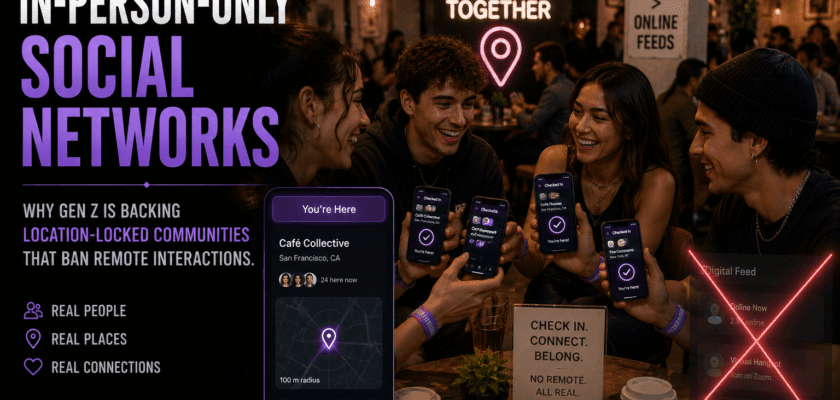
In-Person-Only Social Networks: Why Gen Z Wants Real Life Back
In-person-only social networks are becoming popular because Gen Z is tired of endless feeds, fake engagement, algorithm pressure, and remote-only interaction. Many young users still love technology, but they do not want every friendship, event, community, and conversation to stay trapped inside a screen.
This shift is not anti-tech. It is anti-empty-scroll. Gen Z wants apps that help them meet people, attend events, join local communities, and create memories in real places.
Therefore, in-person-only social networks are becoming a new lifestyle trend. These platforms use location, events, verification, and local access to turn digital discovery into real-world connection.
Why In-Person-Only Social Networks Matter in 2026
In-person-only social networks matter because the old social media model is creating fatigue. Users are surrounded by posts, reels, comments, DMs, filters, AI content, and influencer-style performance. Yet many still feel lonely.
Lenovo’s March 2026 Gen Z report says young people are turning online energy into IRL community by creating, hosting, and attending in-person gatherings, sports events, music festivals, and shared real-life experiences.
This is important because it shows a deeper behavioural shift.
Young people are not only asking, “Who follows me?”
They are asking, “Who will actually show up?”
That is the emotional reason behind in-person-only social networks.
What Are In-Person-Only Social Networks?
In-person-only social networks are platforms designed to connect people through real-world presence. They may allow users to discover nearby events, local groups, verified communities, campus meetups, hobby circles, private gatherings, or location-locked chats.
They are different from normal social media because they reduce remote scrolling and push users toward physical interaction.
These platforms may include:
- Location-locked communities
- Event-only access
- Real-time check-ins
- Nearby friend discovery
- Campus groups
- Hobby meetups
- Verified identity
- IRL-only posting
- Limited remote browsing
- Safety controls
In simple words, these apps use the phone to get people off the phone.
In-Person-Only Social Networks and Location-Locked Communities
In-person-only social networks often depend on location-locked communities. A location-locked community means users can access certain groups, chats, events, or posts only when they are physically near that place.
This can apply to:
- College campuses
- Cafés
- Music festivals
- Gyms
- Co-working spaces
- Apartment communities
- Sports events
- Local clubs
- Bookstores
- Weekend meetups
This model changes the social experience.
Instead of talking to strangers from anywhere, users meet people who share the same space.
That makes connection feel more immediate and more real.
Why Gen Z Is Escaping the Digital Feed
Gen Z is escaping the digital feed because the feed has become exhausting. It rewards constant posting, comparison, attention-seeking, and algorithm-friendly behaviour. Many users feel they are performing instead of connecting.
Common feed problems include:
- Doomscrolling
- Social comparison
- Fake lifestyles
- AI-generated content
- Influencer pressure
- Low-quality comments
- Endless short videos
- Attention fatigue
- FOMO
- Weak real friendships
In-person-only social networks try to solve this by making social media less about broadcasting and more about belonging.
The goal is not to go viral.
The goal is to meet.
Swipe Fatigue and the Move Toward Events
Swipe fatigue is another reason in-person social apps are rising. Dating and social discovery platforms have trained users to swipe, match, chat, and often never meet. Many users now want lower-pressure real-world events instead.
Business Insider reported that Tinder is testing an Events tab in Los Angeles to connect users with local dating events, responding to changing consumer tastes and Gen Z’s desire for more in-person interaction.
This is a major signal.
Even apps built on swiping now understand that offline interaction is the future growth area.
A match is not enough.
A meeting matters more.
Why Location-Locked Communities Feel More Trustworthy
Location-locked communities can feel more trustworthy because users share a physical context. A person in the same college, event, café, gym, or neighbourhood feels less random than a completely anonymous online account.
Shared location can create:
- Common ground
- Local relevance
- Faster trust
- Better event planning
- Real accountability
- Lower fake-profile risk
- Stronger community identity
- Better safety checks
- More meaningful introductions
- Higher chance of meeting again
This does not remove all risk. But it can make interaction more grounded.
A person who can show up matters more than a profile that only looks good.
The Privacy Problem With Location-Based Social Apps
Location-based social apps also create privacy concerns. Sharing location can feel useful, but it can also feel invasive. Users may not want every friend, follower, app, or platform to know where they are.
The Washington Post reported that Gen Z location-sharing became a social norm through tools like Find My, but Instagram Map created concern because users feared broader surveillance, exposure, and loss of control over who sees location.
This is a serious warning for in-person-only social networks.
Location can create trust.
But location can also create risk.
Good apps must design privacy carefully from the start.
Privacy Rules Every Location-Locked App Needs
A good location-locked social app should not expose users carelessly. It should make location sharing limited, temporary, and easy to control.
Strong privacy rules should include:
- Opt-in location sharing
- Temporary check-ins
- No always-on tracking by default
- Clear visibility settings
- Easy location hiding
- Event-only access
- Ghost mode
- Block and report tools
- No public exact address
- Strong consent controls
Users should know exactly who can see them, where, and for how long.
Privacy must be simple, not hidden inside settings.
Safety Must Come Before Virality
Safety must come before virality because in-person apps can create real-world risks. If an app helps strangers meet, it must protect users with strong safety design.
Safety features should include:
- Identity verification
- Face verification
- Event moderation
- Host review
- Community rules
- Report tools
- Emergency contacts
- Location blur
- Group-first meetups
- Trust scoring
Tinder’s 2026 shift also includes stronger safety tools like mandatory Face Check in many markets, showing that trust and identity are now central to offline social discovery.
If people are expected to meet offline, verification becomes much more important.
Why Gen Z Wants Lower-Pressure Social Spaces
Gen Z wants lower-pressure social spaces because many online platforms feel competitive. Users compare looks, lifestyle, relationships, money, travel, and popularity. That makes socialising feel like performance.
In-person-only networks can create lower-pressure experiences through:
- Small group events
- Hobby-based meetups
- No follower counts
- No public like counts
- No endless profiles
- No viral feed
- Local-only discovery
- Shared activities
- Timed access
- Real conversation prompts
This makes social life feel less like content creation.
The best social apps will reduce performance pressure.
Why Hobby-Based Meetups Work Better
Hobby-based meetups work better because people connect faster around shared activities. It is easier to talk when the event already gives a reason to interact.
Examples include:
- Running clubs
- Book clubs
- Board game nights
- Football screenings
- Cooking classes
- Photography walks
- Startup meetups
- Dance sessions
- Fitness challenges
- Music jam nights
A shared activity removes the awkward “What do we talk about?” problem.
This is why location-locked communities often work best around events, not empty chatrooms.
The Rise of Friendship Apps
Friendship apps are growing because young people want connection beyond dating. The Korean app Setlog recently went viral among Gen Z and Gen Alpha users. Business Insider reported that Setlog asks users to capture short videos through the day and creates daily vlogs, fitting the trend of friendship apps like BeReal and Locket that focus on authentic, real-time sharing.
Setlog is not exactly in-person-only, but its popularity shows the same emotional direction.
Young users want:
- Authenticity
- Real life
- Casual updates
- Less polish
- Friend closeness
- Daily presence
- Low-pressure sharing
- Smaller circles
In-person-only social networks take this one step further by moving connection from daily clips to real places.
Why Campus Communities Are Perfect for This Model
Campus communities are perfect for in-person-only social networks because students share location, schedules, events, and social needs. A college campus already has natural density.
A campus-based social app can support:
- Study groups
- Club events
- Sports meetups
- Cafeteria hangouts
- Freshers’ introductions
- Project teams
- Lost-and-found posts
- Workshop alerts
- Cultural festivals
- Local safety updates
Location-locked access can keep the community relevant.
Only people near the campus or verified students may access certain spaces.
This can reduce spam and improve trust.
Why Apartment and Neighbourhood Communities Matter
Apartment and neighbourhood communities can also benefit from location-locked social networks. Many people live near each other but barely talk.
A local community app can support:
- Fitness groups
- Carpooling
- Local events
- Buy-sell exchange
- Pet groups
- Emergency alerts
- Festival planning
- Sports groups
- Skill-sharing
- Local recommendations
This is especially useful in cities where people feel socially disconnected despite living close together.
Location can turn strangers into neighbours.
Why Events Are Better Than Endless Chat
Events are better than endless chat because they create action. Many social apps fail because users message for days but never meet. In-person-only networks can design around scheduled interaction.
Event-based design can include:
- Limited seats
- RSVP confirmation
- Host verification
- Location check-in
- Time-bound chat
- Group introductions
- Post-event feedback
- No-show scoring
- Safety rules
- Repeat community rituals
This creates momentum.
The app becomes a bridge to real life, not a replacement for it.
The No-Remote Interaction Rule
Some location-locked communities may ban or limit remote interaction. This means users cannot fully participate unless they are physically present or near the event.
This rule can feel strict, but it has benefits.
It can:
- Reduce lurkers
- Improve attendance
- Increase accountability
- Protect local relevance
- Reduce spam
- Encourage real meetings
- Make events feel exclusive
- Support small communities
- Reduce parasocial scrolling
- Increase trust
However, this rule should not exclude people unfairly. Apps must balance presence with accessibility.
Accessibility Concerns With In-Person-Only Apps
In-person-only social networks must consider accessibility. Not everyone can attend events easily. Some users have disabilities, social anxiety, financial limits, transport issues, health concerns, or caregiving duties.
Apps should include:
- Accessible venues
- Clear event details
- Cost transparency
- Safe transport guidance
- Small group options
- Quiet events
- Accessibility filters
- Friend invite options
- Host support
- Hybrid information without remote replacement
The goal should be better real-life connection, not exclusion.
A good IRL app must be inclusive.
Why Gen Z Still Needs Digital Tools
Gen Z still needs digital tools because real-life connection needs coordination. People need to know where to go, who is coming, what the vibe is, and whether the event is safe.
Digital tools help with:
- Discovery
- RSVP
- Maps
- Verification
- Reminders
- Group chat
- Safety alerts
- Feedback
- Payments
- Repeat events
So, the future is not offline-only.
The future is digital-to-physical.
Phones become gateways to real connection.
In-Person-Only Social Networks and Digital Detox
In-person-only social networks support digital detox by reducing passive screen time. Instead of scrolling through strangers’ lives, users can attend a small event and create their own experience.
Digital detox does not always mean deleting apps.
It can mean using apps differently.
A healthy social app should:
- Reduce endless feed time
- Encourage real meetings
- Limit addictive loops
- Avoid public popularity metrics
- Promote smaller groups
- Reward participation, not scrolling
- Support local connection
- Protect privacy
- Reduce comparison
- Help users log off
That is the lifestyle value.
Why Brands Are Watching This Trend
Brands are watching in-person-only social networks because Gen Z spending often follows community. If young people gather at concerts, cafés, sports events, pop-ups, gaming nights, and fashion markets, brands want to be part of those spaces.
Brands can use IRL communities for:
- Product launches
- Pop-up events
- Campus campaigns
- Local creator meetups
- Fitness challenges
- Food tastings
- Fashion drops
- Gaming events
- Music experiences
- Community sponsorships
However, brands must be careful.
If they make every community feel like an ad, users will leave.
Why Authenticity Beats Advertising
Authenticity beats advertising in IRL communities. Gen Z can quickly sense when a brand is forcing itself into a space. The best brand involvement supports the community without taking over.
Good brand participation includes:
- Useful sponsorship
- Free tools
- Safe event spaces
- Local artist support
- Food or drinks
- Community grants
- Discounts for members
- Helpful workshops
- Creative collaborations
- Respect for community culture
Bad participation feels like spam.
In-person-only communities must protect trust.
The Role of AI in In-Person Social Apps
AI can help in-person social apps, but it should not dominate them. AI can suggest events, match people by interests, detect safety issues, summarise community preferences, or help hosts plan better.
AI can support:
- Event recommendations
- Safety moderation
- Spam detection
- Interest matching
- Group balancing
- Schedule suggestions
- Accessibility info
- Local trend analysis
- Host support
- Feedback analysis
But AI should not turn the app back into another algorithmic feed.
The goal is real life, not deeper platform addiction.
Why Algorithm-Free Feeds Appeal to Gen Z
Algorithm-free or low-algorithm feeds appeal to users who feel manipulated by social media. Hootsuite’s 2026 new social apps report notes that many newer platforms focus on community, authenticity, niche interests, simpler feeds, fewer algorithms, real-time interaction, and unedited content.
This supports the in-person-only trend.
Users want more control.
They do not want every post ranked for outrage, envy, or watch time.
A local community feed can be simple:
- What is happening near me?
- Who is attending?
- What can I join?
- What do I need to know?
- How do I show up safely?
Simple can be powerful.
Why Location Creates Stronger Community Signals
Location creates stronger community signals because people who share places often share routines. They may visit the same gym, college, café, library, co-working space, or event venue.
Research on location-based social networks shows that place-focused communities can differ from normal social networks, meaning location data can reveal groups that social graphs alone may miss.
This supports the idea that place can shape community.
A user may not follow someone online, but they may repeatedly meet at the same basketball court.
That local overlap can become friendship.
Co-Located Play and Social Design
In-person apps can also use playful co-located design. Research on Project IRL explored mobile augmented reality apps that support in-person social interaction and developed design guidelines around device arrangement, shared objects, reality modification, and co-located play.
This shows that phones can support real-world play instead of replacing it.
Examples include:
- Group AR games
- Shared scavenger hunts
- Festival challenges
- Campus quests
- Team photo tasks
- Local discovery games
- Fitness missions
- Café conversation prompts
- Event icebreakers
- Co-op social activities
Technology can make meeting easier when designed around presence.
Why Trust Signals Matter
Trust signals matter because users need confidence before meeting people offline. A profile photo and username are not enough.
Good trust signals include:
- Verified identity
- Mutual communities
- Event attendance history
- Friend references
- Host approval
- Behaviour score
- Report history
- Clear community rules
- Real profile details
- Optional social proof
However, trust signals should not become popularity contests.
The goal is safety, not status ranking.
The Risk of Exclusion and Cliques
In-person-only social networks can create cliques if not designed well. If groups become too closed, new users may feel left out.
Risks include:
- Social gatekeeping
- Popularity circles
- Event exclusivity
- Class-based access
- Location privilege
- Gender imbalance
- Safety concerns
- Discrimination
- Hidden bullying
- Status competition
Apps should design for healthy inclusion.
They can use rotating groups, host guidelines, new-member welcomes, moderation, and clear rules.
Why Small Groups Work Better Than Big Feeds
Small groups often work better than big feeds because people feel seen. A giant feed can make users passive. A small group creates responsibility.
Small groups support:
- Better conversation
- More trust
- Higher attendance
- Easier moderation
- Less performance pressure
- Better follow-up
- Deeper friendships
- Safer events
- More accountability
- Real belonging
In-person-only social networks should prioritise depth over scale.
Not every community needs millions of users.
Revenue Models for In-Person-Only Social Networks
These platforms need sustainable revenue without harming trust.
Possible revenue models include:
- Event ticket fees
- Host tools subscription
- Community membership
- Brand sponsorships
- Venue partnerships
- Premium safety features
- Local business deals
- Verified organiser tools
- Group booking fees
- Campus partnerships
The challenge is balance.
If monetisation becomes too aggressive, the community may lose authenticity.
Revenue should support better gatherings, not turn users into products.
Venue Partnerships Can Build Stronger Networks
Venue partnerships can help location-locked communities grow. Cafés, bookstores, gyms, co-working spaces, sports arenas, and cultural centres can host verified meetups.
Venues benefit through:
- More footfall
- Repeat customers
- Event revenue
- Community identity
- Better off-peak use
- Social media visibility
- Brand loyalty
- Local relevance
- New customers
- Higher dwell time
Apps benefit because they get safe, known locations for real-world interaction.
This is a strong model.
The Future of In-Person-Only Social Networks
The future of in-person-only social networks looks strong because people are hungry for real connection. Digital platforms will not disappear, but the best new platforms may focus on getting users into real rooms, parks, cafés, stadiums, and campuses.
Future features may include:
- Location-locked groups
- Verified event hosts
- No-remote participation modes
- Safety-first check-ins
- Local discovery maps
- AI-assisted event matching
- Community reputation tools
- Phone-free event modes
- Small group rituals
- Venue partnerships
The winning platforms will not ask users to scroll more.
They will help users live more.
Final Verdict
In-person-only social networks are rising because Gen Z wants to escape the digital feed and rebuild real-world connection. These platforms use location-locked communities, events, safety tools, and local discovery to turn online interest into offline experience.
The trend is not about rejecting technology. It is about using technology as a bridge to real life. From IRL community events to Tinder’s local event testing and growing location-sharing culture, the direction is clear: young users want apps that help them show up, not just scroll.
However, privacy and safety must come first. Location-based platforms must avoid surveillance, protect user consent, verify identity carefully, and support inclusive access.
In simple words, the next social network may not be the one with the biggest feed. It may be the one that helps people meet in real places and build real memories.


