


1. Why the Ruling Matters to Indian IT
The H-1B visa fee ruling removed one of the largest sudden cost threats facing technology employers that move skilled workers into the United States. Indian IT-services companies rely on a mix of local U.S. hiring, offshore delivery and selected H-1B deployment for client projects.
✓ The $100,000 fee was far above the normal filing-cost range.
✓ It threatened project margins on new onsite placements.
✓ Smaller employers faced a stronger deterrent than large technology groups.
✓ The ruling improves short-term planning visibility.
2. What Judge Leo Sorokin Decided
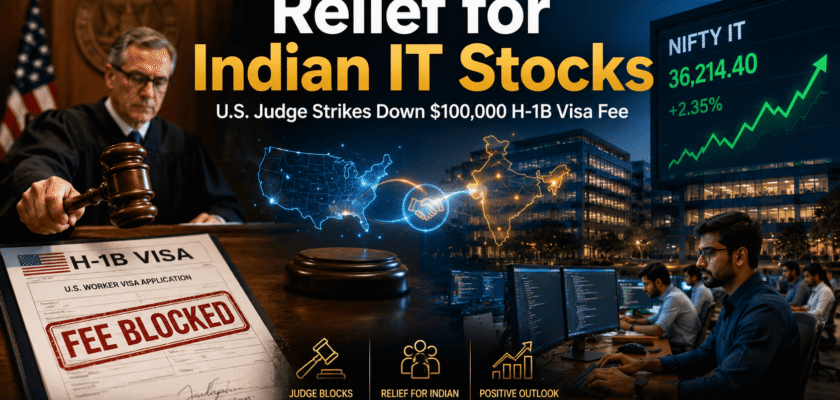
Judge Leo Sorokin in Boston concluded that the president lacked congressional authorization to create the charge. The administration argued it was a lawful penalty connected to entry restrictions, but the court found that it operated as a tax.
◆ Congress, not the president, holds the core taxing authority.
◆ Immigration-entry powers did not authorize this specific charge.
◆ USCIS and the State Department were barred from enforcing it.
◆ The court applied nationwide relief rather than a narrow state-only remedy.
3. How the Fee Changed the Cost Equation
| Cost Area | Before the Policy | With $100K Fee |
| Typical government fees | About $2,000–$5,000 | Additional $100,000 |
| Mid-sized project staffing | Usually workable | Could destroy margin |
| Small employer hiring | Selective but possible | Often prohibitive |
| Indian IT onsite rotation | Managed through project economics | Major cost shock |
4. Why Indian Professionals Are Central to H-1B
Indians account for a large majority of approved H-1B beneficiaries. Reuters reported that 71% of approved beneficiaries in the prior year were Indian nationals.
→ Software engineering and cloud skills remain major demand areas.
→ U.S. clients still require selected onsite specialists.
→ AI companies are increasing filings for scarce technical talent.
→ Indian graduates in the U.S. often shift from student status into H-1B roles.
5. Relief Does Not Mean the Old Model Returns Completely
Indian IT companies have already reduced their dependence on large-scale visa rotation. They now hire more employees locally in the United States and deliver more work from India, nearshore hubs and global capability centres.
✓ Local U.S. hiring remains important.
✓ Automation and AI reduce some staffing demand.
✓ Clients want more work delivered remotely.
✓ Wage-based selection and enhanced vetting still matter.
| → QUICK TAKEAWAY: The judgment removes an extreme cost barrier, but it does not remove tougher U.S. visa scrutiny or the shift toward local hiring. |
6. Why TCS, Infosys and Other Majors Care
✓ They manage thousands of client-facing roles across the U.S.
✓ High fees could have reduced flexibility during urgent projects.
✓ Cost increases may have required repricing client contracts.
✓ The ruling reduces a potential hit to operating margins.
✓ It improves employee-mobility planning.
7. Who Would Have Faced the Greatest Damage
The largest companies could absorb more cost than startups, staffing firms and universities. The policy therefore risked concentrating access to skilled foreign workers among the biggest employers.
◆ Small technology companies
◆ Research universities
◆ Hospitals and specialist employers
◆ IT staffing businesses
◆ Early-stage AI startups
8. Why Only 85 Payments Were Recorded
Reuters reported that USCIS had received only 85 payments as of February 15. The low number reflected narrow applicability, legal uncertainty and employer attempts to avoid the new cost.
○ Many new H-1B workers were already in the U.S. on student visas.
○ Employers changed hiring and filing strategies.
○ Multiple lawsuits challenged the policy.
○ Some companies delayed or relocated roles.
9. Appeal Risk Remains
The White House has indicated that it expects the decision to be overturned. An appeal or request for a stay could restore uncertainty.
⚠ Watch whether the government seeks emergency relief.
⚠ Check whether enforcement remains blocked during appeal.
⚠ Expect conflicting court decisions from separate lawsuits.
⚠ Do not treat the policy as permanently dead until appeals finish.
10. Wider H-1B Reforms Still Continue
The fee ruling does not stop the administration’s broader attempt to reshape the H-1B programme.
◆ Enhanced applicant vetting
◆ Preference for higher-paid and higher-skilled roles
◆ Lower tolerance for low-wage staffing models
◆ More attention to employer compliance
◆ Possible changes to selection rules
11. Indian IT Stock Impact: Positive but Not Transformational
The ruling is fundamentally positive for Indian IT sentiment because it removes a large policy shock. However, stock returns still depend on client technology budgets, AI-led productivity, U.S. economic growth, currency movement and deal wins.
| Factor | Impact After Ruling | Remaining Risk |
| Visa cost | Strong relief | Appeal could revive uncertainty |
| Onsite deployment | More flexible | Vetting still stricter |
| Margins | Potential protection | U.S. wage costs remain high |
| Hiring model | Less disruption | Local hiring trend continues |
| Valuation | Sentiment positive | Demand slowdown can offset benefit |
12. Investor Checklist
✓ Track Nifty IT and company-specific reactions.
✓ Review U.S. revenue exposure.
✓ Check onsite/offshore employee mix.
✓ Monitor operating margin guidance.
✓ Watch appeal developments.
✓ Evaluate AI productivity and deal pipeline.
13. Common Misunderstandings
✗ The ruling does not abolish the H-1B programme.
✗ It does not guarantee visa approval.
✗ It does not remove normal filing fees.
✗ It does not stop enhanced vetting.
✗ It does not automatically create a permanent stock rally.
14. Final Verdict
The H-1B visa fee ruling is a meaningful legal and financial relief for Indian IT companies, U.S. technology employers and skilled workers.
| ★ FINAL TAKEAWAY: The court removed the most extreme cost shock from the H-1B system, but Indian IT companies still need local hiring, offshore delivery, AI efficiency and disciplined compliance to protect long-term margins. |


