


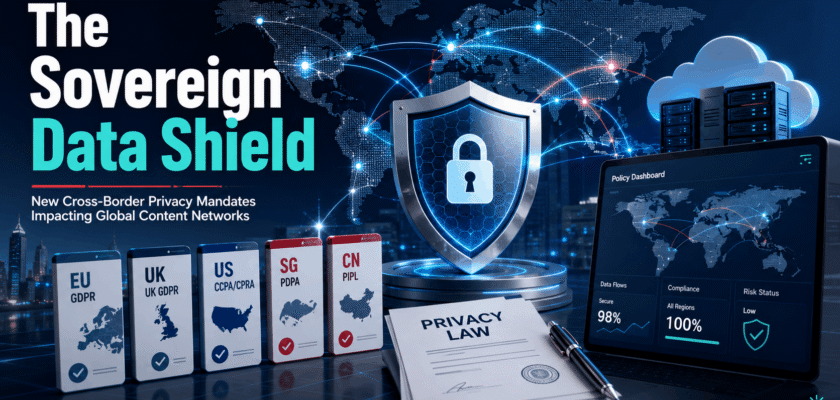
Sovereign Data Shield: Why This Debate Matters
Sovereign data shield rules are now shaping the web.
They affect apps, news sites, video platforms, and ad networks.
Earlier, data moved across borders with fewer checks.
Now, governments want stronger control.
Therefore, content networks need a new playbook.
They must know where data lives.
They must also know why it moves.
The Core Change
The new policy shift is simple.
Data privacy is no longer only a legal page.
It is now a routing choice.
It is also a hosting choice.
Moreover, it is a trust choice.
A platform must prove consent.
It must also prove purpose.
Then it must prove safe transfer.
Why Content Networks Feel Pressure
✓ They serve users in many countries.
✓ They collect ad and login data.
✓ They use cloud and edge servers.
✓ They share data with vendors.
✓ They face local privacy rules.
✓ They also face platform safety rules.
Data Transfers Are Now Political
Cross-border data transfer sounds technical.
However, it is also political.
One country may allow a transfer.
Another country may ask for local storage.
Also, a regulator may demand user control.
So, global networks need region-aware systems.
EU Rules Set a Strong Signal
The EU Data Act applies from September 12, 2025.
It gives users more control over connected-device data.
It also supports cloud switching.
Meanwhile, EU SCCs still help many data transfers.
These clauses give a legal base for EU-to-non-EU transfers.
In addition, the DSA adds platform safety duties.
Large platforms must handle risk with more care.
India Adds Its Own Privacy Layer
India has also moved ahead.
Reuters reported new DPDP rules in November 2025.
These rules limit unnecessary data collection.
They also give users more control.
Therefore, global platforms need clearer Indian workflows.
Consent, breach notice, and data minimization matter more.
The UK Takes a Different Route
The UK also changed its data law.
The Data Use and Access Act became law in 2025.
GOV.UK says it simplifies international data transfer rules.
It also adds clarity for subject access requests.
So, companies must watch UK timing too.
What A Sovereign Data Shield Means
A sovereign data shield is not one product.
It is a policy stack.
It combines law, cloud, consent, logs, and routing.
It helps a network follow local rules.
It also keeps global service quality stable.
Core Parts
✓ Local data maps.
✓ Clear consent logs.
✓ Regional hosting rules.
✓ Vendor risk checks.
✓ Breach notice plans.
✓ Transfer impact reviews.
✓ User rights workflows.
The Hosting Impact
Hosting strategy now needs legal input.
A network may need local storage for some data.
It may also need local logs.
However, not all data needs the same rule.
So, data classification becomes vital.
The Ad-Tech Impact
Ad systems face more pressure.
They often use many vendors.
They also move data quickly.
Therefore, teams must reduce data collection.
They should also check sensitive data rules.
In many cases, simpler ads reduce risk.
The AI Impact
AI tools add another layer.
They may process user text.
They may also store prompts.
So, companies need strict data limits.
They should avoid training on private data without consent.
Also, they should keep audit records.
A Simple Compliance Plan
✓ Map every user data field.
✓ Remove data with no clear purpose.
✓ Mark data by country and risk.
✓ Review every vendor contract.
✓ Use approved transfer tools.
✓ Keep breach alerts ready.
✓ Test user rights workflows monthly.
✓ Train teams in simple language.
Mistakes To Avoid
⚠ Do not copy one privacy policy everywhere.
⚠ Do not store data forever.
⚠ Do not ignore small vendors.
⚠ Do not mix children data with ad data.
⚠ Do not hide consent choices.
⚠ Do not delay breach notices.
What This Means For Publishers
Publishers need cleaner data use.
First, they should reduce tracking scripts.
Next, they should check consent banners.
Then, they should audit ad partners.
This can improve trust.
It can also reduce legal risk.
What This Means For Platforms
Platforms need stronger controls.
They must explain user rights clearly.
They must also keep logs ready.
Moreover, they should design regional data paths.
This helps teams respond faster.
Organic Search Summary
The sovereign data shield is now a major policy idea.
It affects privacy, hosting, ads, AI, and transfers.
Global content networks must act early.
They need simple data maps.
They also need clear consent and vendor controls.
Above all, they need local legal checks.
Conclusion
The sovereign data shield is changing digital policy.
It turns privacy into a daily business task.
So, content networks must rebuild data workflows.
They should collect less data.
They should store data with purpose.
They should transfer data with proof.
This approach protects users.
It also protects the business.
Frequently Asked Questions
Q. What is a sovereign data shield?
It is a data control model for local privacy rules.
Q. Why does it matter now?
Many countries are tightening privacy and data transfer rules.
Q. Does it affect small sites?
Yes, if they collect user data or use ad tools.
Q. What should a site do first?
It should map data, vendors, consent, and hosting locations.
Q. Is this legal advice?
No. It is a policy explainer for readers.


