


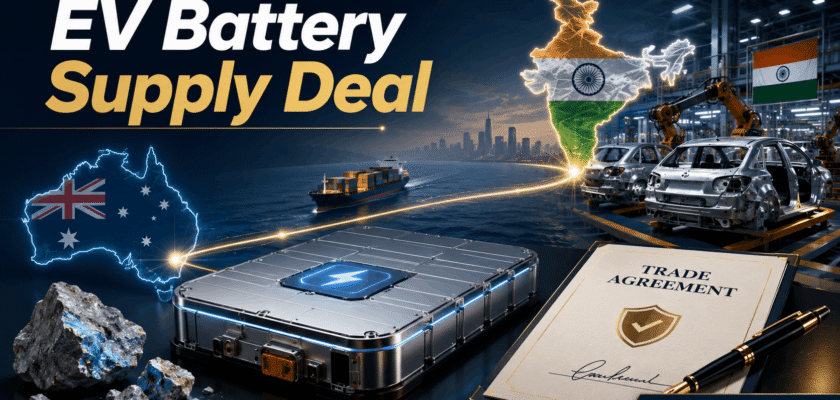
Introduction: India Australia CECA Agreement 2026 and the EV Battery Race
India Australia CECA agreement 2026 is becoming a key phrase for India’s next auto growth story.
The reason is simple.
Electric vehicles need stable access to lithium, cobalt, nickel, rare earths, and battery parts.
India wants more EVs on road.
However, the battery supply chain still depends on imports.
That is why Prime Minister Narendra Modi’s Australia business pitch matters for automakers, battery firms, and EV buyers.
It can help India reduce supply shocks and build a cleaner auto future.
India Australia CECA Agreement 2026: What Is Actually Moving?
The latest official update does not say that the final CECA has been signed.
Instead, it says India wants an early conclusion of the proposed CECA.
That matters because CECA is deeper than the earlier ECTA trade pact.
ECTA opened a stronger trade base between India and Australia.
CECA can take that base toward mining, critical minerals, clean energy, EVs, batteries, electronics, and advanced supply chains.
So, the story is not only about tariffs.
It is about long-term industrial security.
Why Australia Matters for EV Battery Lithium Sourcing
Australia is one of the world’s strongest critical mineral partners.
It has major lithium resources and a mature mining ecosystem.
It also offers regulatory stability and transparent business systems.
For India, this is useful because EV battery lithium sourcing needs trust.
A car company cannot plan battery packs on uncertain mineral access.
A cell maker cannot invest in a new plant without clear raw material pathways.
Therefore, Australia can become a safer upstream partner for Indian EV growth.
The Battery Problem India Must Solve
India is building electric two-wheelers, cars, buses, and battery storage at high speed.
Yet the hardest part is not only assembly.
The harder part is refining, cathode material, cell chemistry, and quality supply.
India still depends heavily on imported battery inputs.
This creates a new risk.
The country may reduce oil dependence but create battery import dependence.
That is why critical minerals are now an automobile policy issue, not only a mining issue.
How Automotive Supply Chain Deals Can Change the Market
Automotive supply chain deals can help India in four direct ways.
- ✅ First, they can give battery makers more predictable lithium access.
- ✅ Second, they can support local cell manufacturing plans.
- ✅ Third, they can reduce sudden price shocks for EV companies.
- ✅ Fourth, they can help Indian suppliers join global clean mobility chains.
This can benefit OEMs, component makers, fleet operators, and charging firms.
It can also support better planning for battery warranties and EV pricing.
Why PM Modi’s Australia Pitch Matters for Automakers
At the Melbourne business event, the Indian side highlighted rare earths, lithium, batteries, electronics, EVs, semiconductors, AI, and defence supply chains.
This list shows how the auto sector is changing.
A modern EV is no longer only a vehicle.
It is also a battery platform, software device, sensor hub, and energy asset.
So, battery security now affects everything from scooter prices to premium EV launches.
That is why the India Australia CECA agreement 2026 track is important for the automobile industry.
What Indian EV Companies May Gain
Indian EV companies may gain better mineral visibility.
They may also get new chances to partner with Australian miners and processors.
Battery startups can use this route to build stronger procurement plans.
Large automakers can use it to reduce single-country dependence.
In addition, supplier confidence may improve if the policy direction becomes clearer.
That can support more investment in packs, cells, recycling, and battery management systems.
What EV Buyers Should Understand
This deal track will not make EVs cheaper overnight.
Battery supply chains move slowly.
Mines, processing plants, and cell factories take time.
However, stronger sourcing can reduce future uncertainty.
It can also help brands offer better model planning.
Over time, stable battery inputs may support better pricing and better after-sales confidence.
The Big Risk: Mining Is Not the Same as Refining
India must avoid one mistake.
Buying minerals is not enough.
The country also needs refining, processing, cell material production, testing, and recycling.
Without this, raw mineral access may not fully solve battery dependence.
This is where policy support becomes important.
India needs clean refining capacity and strong battery ecosystem rules.
What the Government and Industry Should Do Next
- ✅ Close the CECA framework with clear critical mineral pathways.
- ✅ Link Australia sourcing with Indian refining and cell plants.
- ✅ Support battery recycling to reduce fresh mineral pressure.
- ✅ Create transparent supply chain tracking for EV batteries.
- ✅ Help MSME auto suppliers enter EV component chains.
- ✅ Protect buyers with strong battery safety and warranty rules.
These steps can turn a trade push into real industrial strength.
Conclusion: A Supply Chain Deal Can Shape India’s EV Future
India Australia CECA agreement 2026 is more than a trade headline.
It is a chance to build a stronger EV battery lithium sourcing route.
It can also support better automotive supply chain deals for Indian companies.
Still, India must move carefully.
The final benefit will depend on refining, cell manufacturing, recycling, and long-term execution.
If done well, this CECA push can help India source the future of clean mobility.
FAQs
What is the India Australia CECA agreement 2026?
It is the deeper trade and economic cooperation track that India wants to conclude with Australia. In 2026, it is important because critical minerals, EVs, batteries, and clean energy are part of the discussion.
Has the final CECA been signed?
The latest official update says India called for early conclusion of the proposed CECA. So this article treats it as a major CECA push, not a confirmed final signed text.
Why is Australia important for India’s EV battery plans?
Australia has strong critical mineral resources, including lithium. India needs trusted partners for EV battery lithium sourcing and clean mobility supply chains.
Will this make EVs cheaper in India quickly?
Not immediately. Supply chains take time. However, stable sourcing can improve long-term pricing confidence and battery planning.


