


�� Quick Summary
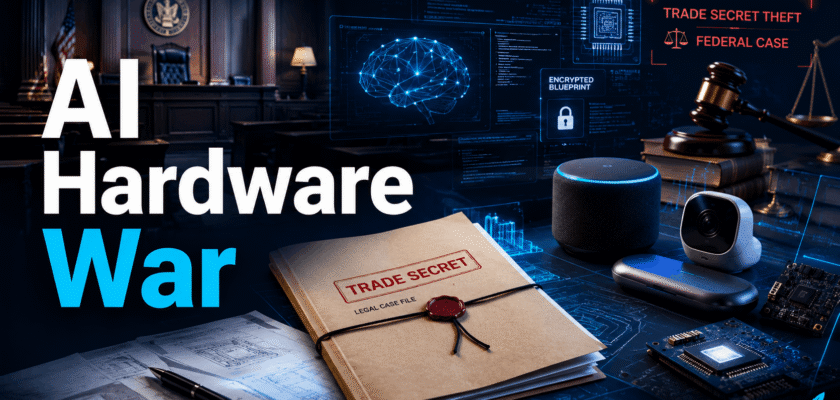
Apple sues OpenAI trade secret theft 2026 is now a major Silicon Valley flashpoint. Apple has filed a federal lawsuit in Northern California against OpenAI, io Products, and two former Apple employees.
The case alleges misuse of confidential hardware designs, supplier data, and manufacturing know-how. OpenAI denies any interest in competitors’ trade secrets.
Therefore, the story is bigger than one court filing. It is about who controls the next consumer AI device: the phone in your pocket, or a new edge AI gadget built around voice, sensors, and local intelligence.
�� Apple Sues OpenAI Trade Secret Theft 2026: What Is Confirmed
The lawsuit was filed in the U.S. District Court for the Northern District of California. The case names OpenAI entities, io Products, Tang Yew Tan, and Chang Liu as defendants.
Reuters reported that Apple claims OpenAI used former employees, recruitment practices, and supplier links to gain access to confidential information. AP also reported that Apple says it raised concerns with OpenAI in February.
However, these are still legal allegations. So, readers should treat the details as claims until the court tests the evidence.
⚖️ Key Case Snapshot
| Point | Reported Detail | Why It Matters |
| Court | Northern District of California federal court. | This makes the fight a major U.S. tech law case. |
| Defendants | OpenAI, io Products, Tang Yew Tan, and Chang Liu are named in reports. | The case connects AI hardware, talent movement, and trade secrets. |
| Core claim | Apple alleges misappropriation of hardware designs, supplier data, and manufacturing processes. | The claim targets the foundation of future AI devices. |
| OpenAI response | OpenAI says it has no interest in other companies’ trade secrets. | The dispute is contested and must be tested in court. |
| Relief sought | Apple is seeking damages and an injunction, according to reports. | The case could slow or reshape OpenAI’s hardware plans. |
�� Tang Tan Hardware Chief Federal Lawsuit San Jose: Why Talent Is Central
Tang Yew Tan is a key name in the dispute. Reports describe him as a former Apple product design leader who later became OpenAI’s chief hardware officer.
Apple alleges that Tan used confidential Apple information and encouraged Apple-linked candidates to share sensitive hardware details. Apple also names Chang Liu, a former Apple engineer, in the case.
This matters because hardware knowledge is not only about sketches. It can include tolerances, metal finishes, suppliers, component decisions, testing patterns, and manufacturing shortcuts.
In consumer electronics, those small details can decide whether a new device feels premium or fails at scale.
�� Why Edge AI Consumer Hardware Is The Real Prize
The future of edge AI consumer hardware components is now a strategic battleground. OpenAI wants AI to move beyond chat windows. Apple wants to protect the device layer it has built for decades.
Edge AI means more processing can happen on or near the user’s device. This can improve speed, privacy, battery planning, and offline response.
However, the hardware stack is hard. It needs chips, sensors, microphones, speakers, thermal design, secure memory, batteries, displays, and manufacturing partners.
So, if a company can shorten this learning curve, it gains a major advantage. That is why Apple’s allegations are so serious.
�� Why This Case Could Shake The AI Device Market
First, it could slow OpenAI’s hardware rollout. If a court grants strong restrictions, OpenAI may need to prove that its product roadmap is independent.
Second, it could change hiring practices across Big Tech. Companies may tighten interview rules, exit audits, laptop returns, and supplier access checks.
Third, it could push Apple to become more aggressive in AI hardware. Apple already owns the device ecosystem. Yet, OpenAI is trying to build a direct relationship with users.
As a result, the case may become a warning for every AI startup hiring from hardware giants.
✅ What Readers Should Watch Next
- Court filings that show whether Apple can identify exact trade secrets.
- OpenAI’s formal legal response to the complaint.
- Any injunction request that could affect OpenAI’s hardware timeline.
- Supplier-related evidence, because manufacturing claims can be hard to prove.
- Apple and OpenAI partnership changes inside iPhone software and Siri integrations.
�� What It Means For Everyday Users
For users, the lawsuit does not change ChatGPT access overnight. It also does not automatically mean Apple and OpenAI will stop every existing integration.
But it does show that the AI race is moving from software into physical devices. The next battle may not be only about better models. It may be about who owns the daily AI interface.
That interface could be a phone, wearable, pin, headset, smart speaker, or a new screen-free device. Therefore, hardware trust will matter as much as AI accuracy.
�� Conclusion
Apple sues OpenAI trade secret theft 2026 is not just another tech lawsuit. It is a signal that the AI hardware war has entered a tougher phase.
Apple wants to protect its device knowledge. OpenAI wants to build a new consumer hardware category. Meanwhile, users, developers, and investors will watch how the court handles talent movement, supplier data, and edge AI hardware claims.
For now, the safest reading is simple. The allegations are serious, OpenAI denies wrongdoing, and the future of edge AI consumer hardware components may depend on how this case develops.


