
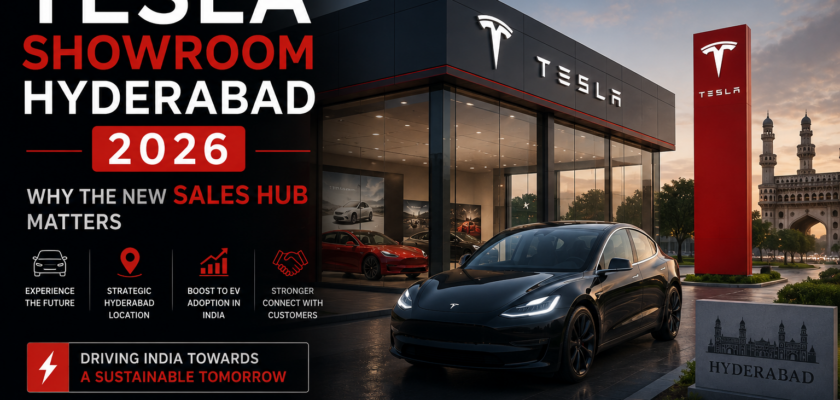
Tesla Expanding in India: Why the New Hyderabad Sales and Service Center Matters for EV Buyers.
The retail architecture backing India’s luxury electric vehicle (EV) pivot has just taken a massive leap forward. On May 22, 2026, the Telangana government officially confirmed that global EV pioneer Tesla has formalized its intent to establish a state-of-the-art sales and service center in Hyderabad.
The declaration came directly following a high-level corporate meeting between Telangana’s IT and Industries Minister D. Sridhar Babu and senior Tesla India executives.
This marks Tesla’s fifth major physical hub in the country, building cleanly upon its existing direct-to-consumer footprint in Mumbai, Delhi, Gurugram, and Pune.
The timing of this infrastructure expansion couldn’t be more strategic for luxury car buyers. Following the commercial launch of the 2026 Tesla Model Y (starting at ₹59.89 lakh) and the brand-new, highly anticipated six-seater Model Y L with an exceptional 681 km WLTP range, the Silicon Valley automaker is transitioning from a localized novelty to a full-scale national player.
For south Indian car buyers who have historically faced a long abacus maze of interstate transport regulations and remote software servicing dependencies, a dedicated hub in Hyderabad shifts everything.
1. Breaking the Service Barrier: The Direct-to-Consumer Shift
The primary friction point holding affluent Indian buyers back from purchasing high-end imports has never been the initial price tag—it is the long-term operational anxiety surrounding software updates, specialized body shop access, and physical component maintenance.
                    [ The Old Premium Import Loop ]
       (Third-Party Imports ──► Zero Local Support ──► Month-Long Parts Delays)
                                    │
                                    ▼
                 [ The 2026 Tesla Direct Infrastructure ]
       (Online Direct Ordering ──► Remote OTA Diagnosis ──► Local Hub Service)
                                    │
         ┌──────────────────────────┴──────────────────────────┐
         ▼                                                     ▼
┌─────────────────────────────────┐               ┌─────────────────────────────────┐
│     The Digital Service Layer   │               │   The Physical Security Layer   │
│ • Cloud-based OTA troubleshooting│               │ • Localized structural body shop│
│ • Eliminates routine garage runs│               │ • Direct factory parts supply   │
│ • Real-time component tracking  │               │ • Certified in-house mechanics  │
└─────────────────────────────────┘               └─────────────────────────────────┘
Tesla’s country head for India, Sharad Agarwal, has repeatedly highlighted that the brand’s approach to vehicle longevity completely removes the middleman.
By operating a direct-to-consumer digital portal that bypasses the traditional franchise dealership structure, Tesla can diagnose the vast majority of electronic errors, battery cooling fluctuations, and drivetrain calibrations remotely via over-the-air (OTA) cloud pushes.
However, when mechanical adjustments, suspension balancing, or physical body repairs are strictly necessary, having a dedicated sales and service center right in the heart of Hyderabad gives buyers absolute peace of mind. It ensures that high-voltage battery arrays are handled by factory-trained specialists, eliminating the extreme risks associated with third-party service garages.
2. Building the Highway Supercharger Corridors
The launch of the Tesla Showroom Hyderabad 2026 anchor hub acts as the core foundational piece for a much broader regional mobility layout. A sales showroom is only as strong as the charging grid backing it, and Tesla is moving aggressively to address highway range anxiety.
  [ Hyderabad Anchor Center ] ───► [ Integrated Supercharger Grid ] ───► [ Intra-State Charging Corridors ]
                                                                                   │
                                                                                   ▼
                                                                     [ High-Speed Highway Linking ]
                                                                     • Hyderabad ──► Bengaluru
                                                                     • Hyderabad ──► Chennai
The next operational phase for Tesla India centers on linking major southern industrial hubs through high-speed transit lanes.
By installing high-output V4 Supercharger networks along primary highway corridors, Tesla will connect Hyderabad seamlessly with neighboring economic hubs like Bengaluru and Chennai.
This allows long-haul business commuters to tap into rapid 250 kW charging loops—reclaiming up to 275 kilometers of driving range in a crisp 15-minute window—effectively validating the long-wheelbase Model Y L as a highly efficient, production-ready replacement for traditional diesel luxury sedans.
3. Strategic Matrix: Traditional Luxury Auto Outlets vs. Tesla India Framework
| Operational Parameter | Legacy Premium Automakers (Mercedes, BMW, Audi) | Tesla India Direct Operations (2026) |
| Retail Sales Channel | Third-party independent franchise dealer lots | 100% Direct-to-consumer online custom ordering |
| Diagnostic Processing | High friction; manual garage visits required | Remote cloud-based OTA system diagnostics |
| Long-Haul Charging | Scattered, multi-app third-party public networks | Proprietary, fully integrated Supercharger grid |
| Price Consistency | High volatility; regional dealer markup variations | Absolute transparency; unified nationwide pricing |
| Risk Characterization | Exposed to franchise dealer inventory overheads | Minimized Risk; demand-matched factory deliveries |
4. Driving the Localized EV Ecosystem Forward
Beyond providing premium electric SUVs to buyers, the Hyderabad expansion carries deep economic implications for the state of Telangana. During the corporate briefings, Minister Sridhar Babu heavily emphasized that the state has intentionally engineered a premier tech ecosystem.
By acting as a central destination for semiconductor design, deep artificial intelligence workflows, and automotive computing software, Hyderabad offers a rich pool of technical talent.
The government is actively leveraging Tesla’s retail entry to pitch the state as an ideal destination for ancillary component manufacturing and supply chain infrastructure.
While Tesla has scaled back its immediate plans for a massive gigafactory complex within the country, its growing operational footprint ensures that local component suppliers specializing in battery sub-assemblies, precision wiring harnesses, and advanced electronic control units can integrate directly into a global network.
This high-trust collaboration de-risks regional supply chains, establishes high-yield engineering roles, and firmly cements Hyderabad as a primary nerve center for the next era of smart mobility.
Conclusion
The introduction of the Tesla Showroom Hyderabad 2026 platform marks a permanent evolution in how the Indian consumer evaluates the electric vehicle market. The old abacus maze of buying a luxury vehicle and praying that software support holds up over the years has been cleanly replaced by a unified, factory-backed infrastructure network.
By combining the structural convenience of remote digital diagnostics with a physical, high-tech sales and service center, Tesla is demonstrating exactly how to build long-term consumer trust.
As the V4 Supercharger highway networks go active across the state over the coming quarters, range anxiety will continue to dissolve into ancient history. The premium EV market is no longer a futuristic concept confined to automotive trade expos; it is a highly optimized, un-bottlenecked reality resting comfortably right on our city roads—proving that the future of transport belongs to those who build the infrastructure to sustain it.


