
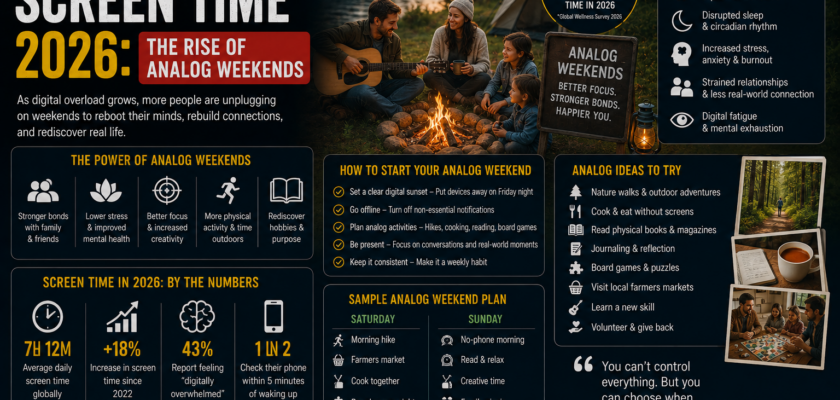
The Slow Living Reset: Why High-Performing Professionals are Adopting “Analog Weekends”.
We have completely outsourced our cognitive peace to the notification engine. In the hyper-connected professional landscape, the boundary between active work streams and personal recovery has been completely erased. The modern professional wakes up to a digital alarm, scans corporate communication threads before leaving bed, monitors market graphs during transit, and stares at dual-monitor layouts for nine hours straight. Even our leisure hours have been digitized—we unwind by looking at a secondary phone display while streaming video content on a smart television panel.
But as we cross through May 2026, the human brain is pushing back against this continuous sensory bombardment. High-performing operators are experiencing acute screen fatigue, leading to fractured attention spans, chronic background anxiety, and a severe decline in creative thinking.
To protect their mental bandwidth from absolute burnout, elite professionals across tech, finance, and corporate management are abandoning standard digital trackers.
Instead, they are executing a profound lifestyle change: The Analog Weekend.
Operating under the core principles of the global slow living movement, this self-enforced protocol requires individuals to completely disconnect from all digital interfaces for 48 hours straight. Here is a look at how this lifestyle shift re-calibrates your brain, reclaims your focus, and provides the ultimate guide on how to reduce screen time 2026 styles.
1. The Biological Toll of the Infinite Scroll
To understand why a radical disconnect is necessary, we must look at the neurological strain caused by modern app architectures. Micro-rewards—such as likes, swipe-refreshes, and brief notification bursts—are engineered using variable reward schedules, the exact same psychological mechanism that makes slot machines addictive.
                    [ The Daily Overstimulation Loop ]
     (Continuous App Pings ──► Cortisol Spikes ──► Severe Dopamine Desensitization)
                                     │
                                     ▼
                  [ The 48-Hour Analog Weekend Reset ]
     (100% Screen Blackout ──► Parasympathetic Dominance ──► Restored Mental Windshield)
                                     │
         ┌───────────────────────────┴────────────────___________┐
         ▼                                                       ▼
┌─────────────────────────────────┐                     ┌─────────────────────────────────┐
│     Cognitive Decompression     │                     │      Tactile Reality Re-Engaged │
│ • Restores deep linear focus    │                     │ • Physical book reading loops   │
│ • Lowers baseline ambient stress│                     │ • Real world social connections │
│ • Clears mental workspace blocks│                     │ • Natural outdoor motor movement│
└─────────────────────────────────┘                     └─────────────────────────────────┘
When you process hundreds of these micro-signals daily, your neural pathways remain locked in a continuous state of alertness. Your brain is flooded with cortisol and adrenaline, keeping your sympathetic nervous system activated and preventing true deep rest.
By practicing a disciplined blackout period, you cut off this chemical overload at the root. Your nervous system drops out of high-alert mode, letting your dopamine baseline settle back to normal levels. This break clears out your mental windshield, helping you return to your Monday morning work blocks with sharp focus and renewed motivation.
2. The Analog Weekend Protocol: How to Execute the Shift
Transitioning into a slow living structure isn’t about moving into a remote cabin; it is about building strict, intentional boundaries around your existing physical space. High-performing professionals use a specific three-step framework to safely step away from their devices without losing touch with what matters.
A. The Friday Evening “Hard Shutdown”
At 6:00 PM on Friday night, execute a complete digital boundary sweep. Power down your corporate laptop, place your primary smartphone inside a designated opaque storage box, and turn off your main home displays. This physical separation acts as a clear signal to your mind that the high-stress production cycle is over and the recovery window has officially begun.
B. Re-Engage the Tactile Senses
When you remove screens, your mind will naturally crave replacement activities to fill the sudden quiet. Replace the urge to scroll with physical, real-world hobbies:
  [ Friday Night Smartphone Lockout ] ───► [ Immediate Reduction in Cognitive Friction ]
                                                      │
                                                      ▼
                                       [ High-Utility Tactile Alternatives ]
                                  • Turning physical book pages in silence
                                  • Mechanical drafting or writing in journals
                                  • Extended outdoor walking and nature tracking
                                                      │
                                                      ▼
                                       [ Deep Biological Restoration ]
                                   "Restores Natural 8-Hour Circadian Sleep"
- Read long-form literature printed on physical paper to rebuild your deep, linear focus.
- Write down your strategic thoughts, personal goals, and creative ideas inside a high-quality paper journal using a classic fountain pen.
- Spend uninterrupted time outdoors, engaging in real-world sports, cooking from scratch without video tutorials, or having face-to-face conversations with family without a device resting on the table.
C. The Low-Tech Emergency Valve
If the fear of missing critical family emergencies makes a 100% device blackout feel impossible, use a basic, low-tech alternative. Swap your high-powered smartphone for a simple, first-generation feature phone (a “dumbphone”) that only handles standard voice calls and basic text messages. Keep this number restricted exclusively to your inner family circle, allowing you to remain completely unreachable to work chats and algorithmic distractions while staying safe.
3. Strategic Matrix: Connected Living vs. The Analog Weekend
| Lifestyle Matrix | Continuous 24/7 Digital Connectivity | The Controlled 48-Hour Analog Weekend |
| Cognitive Framework | Reactive; continuous multi-tasking app loops | Proactive; deep focus on a single physical task |
| Nervous System State | Constant sympathetic drive (fight-or-flight) | Parasympathetic dominance (rest-and-recover) |
| Creative Thought Yield | Low; mind is flooded with external ideas | Exceptional; native problem-solving returns |
| Sleep Quality Profile | Fractured; disrupted by screen blue-light bloom | Deep, natural REM recovery cycles |
| Risk Characterization | High vulnerability to chronic fatigue & burnout | Minimized Risk; sustained long-term performance |
4. Reclaiming Creative Vision Through Boredom
The primary professional benefit of discovering how to reduce screen time 2026 models is the rapid return of strategic, creative vision. When your brain is constantly consuming content, it loses the quiet space it needs to sort information, build deep conceptual links, and generate fresh insights.
Stepping away from digital inputs allows your mind to slip into natural boredom. This quiet phase activates your brain’s internal network to process background memories and synthesize scattered data points.
You’ll find that your most innovative business models, creative solutions to tough engineering bugs, or long-term personal goals flash into your mind when you are doing something simple, like staring out a window or washing dishes by hand.
By stepping away from the daily noise of the digital workspace, you transform yourself from a passive consumer into an active creator—proving that intentional stillness is the ultimate way to stay ahead in a fast-paced world.
Conclusion
The growing adoption of the Analog Weekend protocol marks a healthy cultural pivot in modern society: true human potential isn’t about building faster connections to tech networks; it is about protecting our internal capacity for deep, independent thought. Learning how to reduce screen time is no longer a soft self-care suggestion—it is a critical requirement for anyone looking to sustain high-level mental clarity over a long career.
By trading the exhausting abacus maze of notification feeds for the absolute peace of an analog environment, you take back control of your attention span.
You break out of the cycle of reactive consumption to give your mind the breathing room it needs to heal, create, and thrive. Turn off your devices, step into the offline world, and discover the deep mental energy that returns when you give yourself permission to simply be human.


