
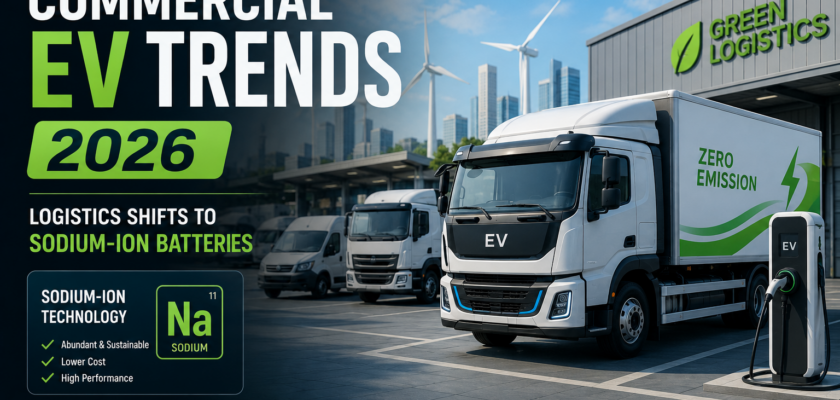
The Sodium-Ion Shift: Why Global Logistics Firms are Phasing Out Lithium-Ion Batteries by 2027.
The global delivery infrastructure is quietly engineering a massive, chemistry-level rebellion. For the past decade, the blueprint for electrifying commercial delivery fleets was entirely dependent on the exact same battery architecture powering consumer passenger cars: liquid-electrolyte lithium-ion cells. Logistics giants looking to slash their carbon footprints wrapped their investment strategies around high-nickel or lithium iron phosphate (LFP) platforms. This calculation assumed that scaling up massive, centralized battery packs was the only viable path to keep delivery trucks running smoothly.
But as we advance through May 2026, the realities of high-volume urban logistics have exposed major structural cracks in that assumption. Fleet operators do not navigate the roads like casual suburban drivers. A commercial delivery van runs continuously for multiple shifts, experiences rapid, harsh fast-charging cycles multiple times a day, operates in brutal climate extremes, and must maintain strict cost predictability to preserve thin profit margins.
Faced with extreme lithium price volatility, intense supply chain vulnerabilities, and high degradation overheads, global transport networks are abandoning old multi-year procurement plans.
We have officially reached a tipping point in commercial EV trends 2026: a sweeping, structural transition away from premium lithium to sodium-ion (Na-ion) battery frameworks.
Driven by rapid mass-production rollouts from manufacturing giants like CATL and BYD, logistics firms are locking in a 2027 completion target to phase out lithium entirely across their localized, last-mile delivery networks.
1. The Volumetric Paradox: Why Energy Density Matters Less in Last-Mile Logistics
The primary historical argument leveled against sodium-ion technology has always been its lower volumetric energy density. Because a sodium atom ($Na^+$) possesses a significantly larger ionic radius and higher atomic mass than a lithium atom ($Li^+$), early sodium-ion cells topped out at a modest 150 to 160 Wh/kg—noticeably below the 250+ Wh/kg delivered by premium lithium-ion alternatives. For a luxury passenger EV trying to market an 800-kilometer range to anxious consumers, this physical bulk is a clear dealbreaker.
However, for a modern urban logistics fleet, that energy density deficit is a complete non-factor.
               [ The Fleet Operational Matrix ]
                              │
       ┌──────────────────────┴──────────────────────┐
       ▼                                             ▼
┌───────────────────────────────┐             ┌───────────────────────────────┐
│   Standard Urban Delivery Van │             │  The Sodium-Ion Reality (2026)│
│ • Daily route loops: <180 km  │             │ • 210 to 350 km real range    │
│ • Predictable hub returns     │             │ • Bypasses range anxiety loops│
│ • Volume limits before weight │             │ • Charges 3x faster than Li   │
└───────────────────────────────┘             └───────────────────────────────┘
                              │
                              └──────────────────────┬───────────────────────┘
                                                     ▼
                                      [ Unlocked Capital Efficiency ]
                        (35% Drop in Upfront Fleet Acquisition Overheads)
The day-to-day work patterns of last-mile delivery vehicles are highly structured and predictable. The vast majority of inner-city delivery vans travel fewer than 150 to 180 kilometers per day before returning to a central depot.
The latest second-generation sodium-ion battery packs safely deliver a real-world driving range of 250 to 350 kilometers on a single charge. This output easily clears the daily operational requirements of localized transit.
Because commercial vans almost always reach their physical storage volume limits before hitting maximum gross vehicle weight constraints, the minor physical size increase of a sodium pack causes zero reduction in cargo capacity—allowing firms to easily trade excess passenger range for unmatched operating economics.
2. Reclaiming the Ledger: The Economic and Safety Superpowers of Sodium
The strategic push to deploy sodium-ion architecture across the future of logistics vehicles rests on three un-falsifiable operational advantages that lithium simply cannot match:
A. Radical Upfront Cost Reduction
Sodium is roughly 500 times more abundant than lithium, harvested at a fraction of the cost from common table salt and vast soda ash deposits across the globe.
Furthermore, sodium-ion chemistry utilizes cheap, abundant aluminum for both its anode and cathode current collectors, completely cutting out the expensive, high-overhead copper foils required in lithium cells.
This chemistry shift results in immediate, sweeping capital savings. While a high-grade lithium iron phosphate (LFP) commercial pack costs upwards of $90 to $110 per kWh to manufacture at scale, current mass-produced sodium-ion packs are dropping rapidly toward an unprecedented $50 to $60 per kWh manufacturing baseline. This milestone slashes the upfront acquisition cost of a commercial electric van by an estimated 30% to 35%.
B. The Zero-Volt Transport Shield
Lithium-ion batteries suffer from a critical chemical vulnerability: if a pack is drained down to a 0% State-of-Charge (SoC) for extended periods, the internal copper current collectors dissolve into the electrolyte, causing permanent cell degradation and catastrophic fire risks upon re-charging. To prevent this, dead vehicles must be transported under strict, high-friction safety rules with a minimum storage charge.
  [ Depleted Vehicle Storage ] ───► [ Lithium-Ion: Cell Damage Risks at 0% SoC ]
                                                    │
                                                    ▼
                                     [ Sodium-Ion: Zero-Volt Immunity ]
                               "Can be Short-Circuited and Stored at Absolute 0V"
                                                    │
                                                    ▼
                                     [ Total Logistics Protection ]
                                "Safe Ground Transit & Zero Fire Hazards"
Sodium cells possess a unique superpower: they can be completely discharged to absolute zero volts without suffering a single trace of chemical damage or structural capacity loss.
Logistics networks can short-circuit sodium packs for safe long-distance shipping, park unused delivery vans in storage lots for months without tracking passive battery drain, and completely eliminate the threat of sudden battery fires—dramatically reducing insurance premiums across centralized distribution hubs.
C. Unmatched Cold-Weather Efficiency
Traditional lithium batteries experience severe energy drops when winter temperatures plummet, losing up to 30% to 40% of their operational range due to increased electrolyte viscosity. This drop forces logistics operators to run fewer routes or install heavy, power-hungry thermal management systems to keep the packs warm.
The latest generation of sodium-ion hard carbon batteries performs flawlessly in freezing conditions, retaining a staggering 90% of their nominal capacity at temperatures as low as -30°C. This unshakeable climate resilience ensures absolute route predictability and year-round delivery consistency, whether a van is operating in scorching summer heat waves or freezing winter blizzards.
3. Strategic Matrix: Fleet Lithium-Ion vs. Next-Gen Fleet Sodium-Ion Architecture
| Fleet Operational Parameter | Legacy Commercial Lithium-Ion Packs | Next-Gen Fleet Sodium-Ion Systems (2026–2027) |
| Raw Material Cost Index | Volatile and premium; tied to scarce minerals | Ultra-low; utilizes infinitely abundant sodium salts |
| Anode Current Collector | Expensive copper foil layers | Affordable, lightweight aluminum arrays |
| Deep Discharge Profile | Damaged if drained below a 5% baseline safety margin | Absolute safety; handles continuous 0-volt storage |
| Extreme Cold Retention | Loses up to 35% performance in winter loops | Exceptional; holds 90% capacity down to -30°C |
| Risk Characterization | High vulnerability to supply chain and price swings | Minimized Risk; tech-backed economic stability |
4. Accelerating the Turnaround: Sub-15 Minute Fleet Top-Ups
Beyond raw acquisition cost and safety profiles, the absolute clincher driving logistics operators to execute the 2027 phase-out target is the dramatic reduction in vehicle downtime enabled by sodium’s unique kinetic properties. In a high-volume hub-and-spoke delivery system, every minute a vehicle sits stationary attached to a charger represents direct lost revenue.
Recent breakthrough studies from the Tokyo University of Science confirm that sodium insertion into porous hard carbon anodes is fundamentally faster than lithium intercalation into graphite.
Because sodium ions form pseudo-metallic clusters within carbon nanopores with a significantly lower activation energy barrier, the chemistry is naturally optimized for intense, ultra-fast charging speeds.
  [ Van Enters Logistics Hub ] ───► [ High-Power DC Fast-Charger Attached ]
                                                    │
                                                    ▼
                                     [ 10 to 12 Minute Charging Sprint ]
                                "Pumps Battery Level from 10% straight to 80%"
                                                    │
                                                    ▼
                                     [ Immediate Shift Deployment ]
                               "Van Returns to the Road for Next Route Loop"
Commercial sodium-ion packs seamlessly support aggressive charging rates, allowing a delivery van to pump its battery level from 10% straight to 80% in just 10 to 12 minutes without causing a single trace of microcracking or internal cell degradation.
This rapid charging sprint allows logistics networks to seamlessly run multi-shift operations.
Drivers can pull into a loading dock, attach a high-power rapid charger during a brief 15-minute cargo reload, and head right back onto the streets for their next delivery loop. This cycle effectively doubles the daily utilization rate of every single van in the fleet—proving that true operational efficiency isn’t achieved by packing more range into a vehicle, but by getting cars back onto the road faster.
Conclusion
The sweeping progress redefining commercial EV trends 2026 outlines an undeniable, long-term truth for global industrial operations: sustainable engineering success is achieved when technology scales past speculative hype to embrace the pragmatic realities of mass production. The old abacus maze of relying on fragile, volatile, and geographically bottlenecked mineral reserves to power our global supply chains is rapidly coming to an end.
By replacing expensive, high-maintenance lithium packs with transparent, stable, and zero-volt immune sodium alternatives, global logistics operators are building a highly resilient delivery network.
Of course, luxury passenger vehicles will continue to utilize high-density lithium formulations to hit extreme range benchmarks for consumers. However, across the hard-nosed world of industrial transport, the rapid scale of sodium-ion manufacturing gigafactories ahead of the 2027 phase-out delivers a clear message to the broader energy market: the backbone of tomorrow’s global trade will be built on abundant, sustainable, and un-bottlenecked resources that keep our world moving safely, efficiently, and infinitely more affordably.


