
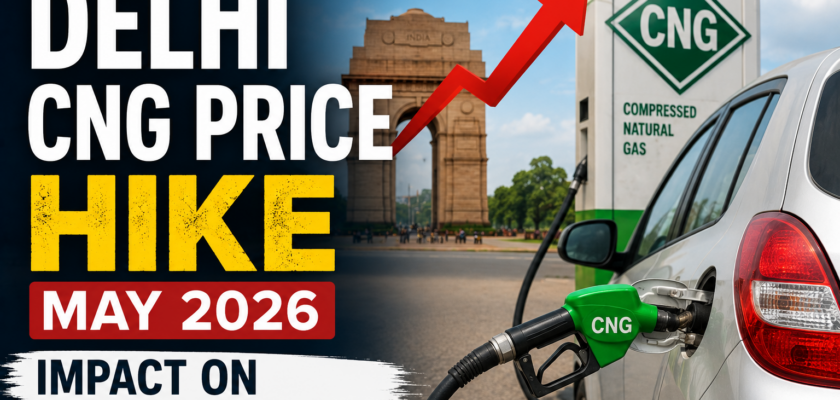
The Cost of Commuting: How the New Delhi CNG Price Hike Impacts Urban Vehicle Budgets.
The economic equation supporting clean, alternative urban transportation in India has faced a sharp disruptive shift. For nearly a decade, choosing a Compressed Natural Gas (CNG) powered vehicle was regarded as a smart protective shield against volatile petroleum prices. Budget-conscious families, middle-class commuters, and commercial fleet operators focused their purchasing habits entirely on factory-fitted CNG variants. This calculated strategy accepted a slightly higher upfront vehicle purchase cost in exchange for a simple, reliable benefit: achieving significantly lower, highly predictable per-kilometer running costs over the vehicle’s operational lifecycle.
However, a sudden wave of price hikes has transformed those household budget projections.
The immediate impact of the Delhi CNG price hike May 2026 updates reveals a historic increase in compressed gas rates.
Faced with a sequential series of aggressive retail rate increases, the cost advantages of alternative green fuels are narrowing rapidly.
Announced directly by Indraprastha Gas Limited (IGL), the newest market revision pushes the base retail price of CNG in the National Capital Territory (NCT) of Delhi up to ₹83.09 per kg. Consequently, commuter households are dealing with a notable expansion in their monthly transportation outlays. This shift demands a thorough re-evaluation of long-term vehicle ownership costs across the metropolitan area.
1. The Geopolitical Surge: Why Alternative Fuel Rates are Increasing
To understand why localized transit expenses are climbing so rapidly, one must look at the macro-level supply disruptions affecting global energy networks. The retail price changes rolling across Indian fuel stations are driven by intense geopolitical conflicts thousands of miles away in West Asia.
                    [ Geopolitical Energy Shock ]
     (West Asia Conflict ──► Strait of Hormuz Choke ──► Global Gas Index Spikes)
                                     │
                                     ▼
                  [ Domestic City Gas Impact ]
     (IGL Input Expenses Rise ──► 4 Price Hikes in 2 Weeks ──► Retail Rate at ₹83.09/kg)
The ongoing international conflict has severely choked trade paths around the strategically vital Strait of Hormuz, through which nearly one-fifth of global energy commodities must pass.
- The Interruption Matrix: Military actions have forced international gas benchmark prices up significantly, directly increasing raw material import costs for domestic city gas distribution (CGD) companies.
- The Rapid Rate Revisions: Consequently, the latest ₹2 per kg increase on Tuesday, May 26, 2026, marks the fourth distinct upward revision in compressed gas rates in less than two weeks.
- The Cumulative Burden: This rapid cycle raises the cumulative CNG price jump since May 15 to a substantial ₹7 per kg, wiping out months of stable retail price baselines.
2. Re-Calculating the Ledger: The Squeeze on Urban Commuter Wallets
The sudden tightening of the alternative fuel market forces a strict reassessment of household finances for owners of affordable running cost vehicles. For years, a standard factory-fitted CNG hatchback delivered an unmatched running cost of roughly ₹2.5 to ₹3 per kilometer, compared to the steep ₹6 to ₹7 per kilometer demanded by traditional petrol cars.
Now, that margin is shrinking due to parallel increases in fuel rate increases India metrics across the board.
  [ Daily Commuter Budget Loop ] ───► [ CNG Cumulative Rise Hits ₹7/kg in 11 Days ]
                                                    │
                                                    ▼
                                     [ Shrinking Efficiency Shield ]
                               "Per-Kilometer Fuel Cost Disadvantage Grows"
                                                    │
                                                    ▼
                                     [ Budget Baseline Re-Alignment ]
                               "Squeezes Commercial Fleets & Daily Drivers"
With state-run fuel retailers simultaneously raising petrol prices to ₹102.12 per litre and diesel to ₹95.20 per litre in the capital city, transport expenses are rising globally.
For an average corporate professional covering a 50-kilometer daily round-trip commute, the cumulative ₹7 per kg CNG spike translates directly into thousands of rupees in unexpected annual overheads.
Furthermore, the price increase hits hardest across commercial ridesharing networks, auto-rickshaw drivers, and last-mile logistics fleets.
Because these operators cannot easily pass on sudden fuel cost spikes to consumers due to regulated platform fare caps, the price hike cuts directly into their net daily earnings, triggering widespread concern over general transport inflation across the National Capital Region.
3. Strategic Matrix: High-Emission Petroleum Options vs. Modern CNG Value Profiles
| Vehicle Operational Vector | Traditional Petrol Passenger Models | Modern Eco-Friendly CNG Fleet Systems |
| Capital Retail Cost (Delhi) | Base vehicle price tracking standard market trends | Higher upfront cost premium for factory kits |
| Current Fuel Rate Baseline | Premium tier; sits at ₹102.12 per litre in capital | Risen significantly; priced at ₹83.09 per kg |
| Recent Price Volatility | Elevated; 4 major hikes executed within 11 days | High-frequency shifts; up ₹7/kg since May 15 |
| Environmental Footprint | Higher tailpipe emissions and greenhouse outputs | Notably cleaner; drops particulate matters fully |
| Risk Characterization | High vulnerability to international crude swings | Minimized Risk; tech-backed fuel diversification |
4. Re-Balancing the Asset: Strategies to Maintain Efficiency Goals
To protect your personal transport budget from getting completely derailed by these climbing operational expenses, vehicle owners must transition from passive fuel buying to active, smart vehicle management:
- The Strict Pressure Audit: Always insist that filling station operators pump gas at an optimal pressure level of 200 to 220 bar during your fills. Lower dispenser pressure leads to incomplete tank packaging, which reduces your real driving range and forces more frequent trips to the fuel pump.
- The Specialized Ignition Refresh: Ensure your car’s spark plugs and ignition coils are inspected every 10,000 kilometers. Because compressed natural gas requires a significantly higher ignition temperature than atomized petrol to achieve proper combustion, keeping your electrical components fresh optimizes fuel efficiency and saves substantial capital over time.
- The Progressive Clean-Drive Pivot: Adopt smooth acceleration habits and maintain stable highway speeds between 60 to 70 km/h to keep your engine running in its peak efficiency zone. Eliminating aggressive, high-RPM acceleration steps helps maximize your car’s fuel economy, ensuring you wring every bit of value out of every kilogram of gas.
Conclusion
The undeniable structural changes reshaping the Delhi CNG price hike May 2026 landscape outline a permanent lesson for modern urban planners and asset owners: long-term transport viability cannot rely on a single alternative fuel option. The old abacus maze of treating gas power as a permanent, ultra-cheap shield against global energy shocks is evolving into a more complex, multi-fuel reality.
By understanding these changing fuel metrics and adopting smart maintenance habits, drivers can still achieve solid operating advantages over traditional petroleum cars.
These cost-saving adjustments ensure that alternative-fuel vehicles remain a practical tool for urban commuting. While navigating international supply chain challenges will require ongoing budget flexibility over the coming months, smart vehicle operation provides a reliable buffer against inflation—proving that true transport efficiency is won through proactive planning and precise, waste-free vehicle care.


