
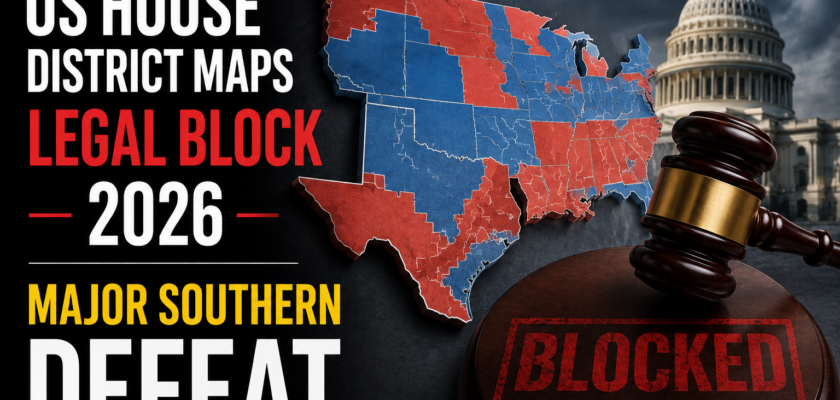
Electoral Redistricting Blocked: Federal Courts Stymie Key House Mapping Proposals in Alabama and South Carolina.
The strategic roadmap determining the balance of power in the United States Congress has faced a sudden, high-stakes judicial intervention. For several months, the battle over mid-decade congressional redistricting dominated the legislative agendas of multiple Southern states. Following recent high-court adjustments to the Voting Rights Act (VRA), state legislatures raced to redraw their congressional boundaries. From a partisan perspective, the operational goal was clear: adjust key district boundaries to maximize party advantages, secure vulnerable incumbents, and build a protective wall around narrow legislative majorities ahead of the upcoming midterm elections.
However, a sweeping series of legal decisions has temporarily halted that aggressive boundary transformation.
Factual updates surrounding the US House district maps legal block 2026 landscape confirm a massive judicial check on state-led mapping plans.
In a decisive sequence of events, federal courts and internal legislative pushbacks have stymied efforts to implement modified voting lines in Alabama and South Carolina.
Labeling the proposed changes as non-compliant with core constitutional protections, panels of federal judges have ordered states to halt last-minute district adjustments. Consequently, state election officials are forced to maintain existing, court-approved boundary models. This major intervention completely disrupts immediate campaign strategies, limits party advantages, and injects significant operational complexity into the rapidly approaching midterm voting cycle.
1. The Alabama Injunction: Taking Callais at Its Word
The primary flashpoint in this nationwide legal battle occurred in Montgomery, Alabama, where a three-judge federal panel issued a striking unanimous preliminary injunction. The decision directly blocked the state’s GOP-led legislature from reinstating a highly controversial 2023 congressional map.
                     [ The Southern Mapping Bottleneck ]
                                      │
         ┌────────────────────────────┴────────────────____________┐
         ▼                                                         ▼
┌──────────────────────────────────┐              ┌──────────────────────────────────┐
│      Proposed Enacted Map        │              │     Judicial Remedial Mandate    │
│ • Packs Black voters into 1 hub  │              │ • Preserves two minority nodes   │
│ • Lowers opportunity to choose   │              │ • Uses race-blind 2024 lines     │
│ • Targets narrow House additions │              │ • Minimizes user primary chaos   │
└──────────────────────────────────┘              └──────────────────────────────────┘
                                      │
                                      ▼
                     [ Immediate Structural Outcome ]
       (Judges Halt Last-Minute Swaps ──► Keeps the Court-Approved Framework)
The judicial panel—which includes two judges appointed by Donald Trump—refused to allow the state to bypass established non-discriminatory boundaries:
- The Determination of Intent: The judges explicitly ruled that the state’s updated map plan “intentionally discriminated based on race” by diluting minority voting power down to a single Black-majority district.
- Preserving the 2024 Grid: Instead of allowing the switch, the court ordered Alabama to maintain the race-blind remedial map utilized during the 2024 cycle. This framework preserves two districts where Black voters have a fair opportunity to elect candidates of their choice.
- Rejecting the Partisan Defense: Furthermore, the court sharply dismissed arguments that the map lines were drawn purely for partisan political strategy, confirming that the undisputed evidence pointed directly to illegal constitutional violations.
2. The Threat of Logistical Chaos: Managing Active Election Windows
Beyond addressing deep constitutional violations, the federal bench focused heavily on preventing severe voter disruption across active primary pipelines.
  [ Active Primary Progressing ] ───► [ High Risk of Voter Line Allocation Chaos ]
                                                     │
                                                     ▼
                                      [ Federal Court Injunction Enforced ]
                                 "Halts Mid-Decade Border Shifting Instantly"
                                                     │
                                                     ▼
                                      [ Orderly Midterm Voting Secured ]
                                 "Protects Basic Election Infrastructure"
The panel emphasized that attempting to swap full congressional maps while primary processes were already advancing would trigger extreme administrative stress.
- The Reassignment Barrier: Judges pointed out that forcing an expensive, aggressive, and perhaps logistically impossible voter reassignment effort mid-stream was completely unjustified.
- The Confusion Factor: The court explicitly noted that candidate and voter confusion is highly troublesome and warrants significant defensive consideration, using the injunction to stabilize the system.
- The Immediate Appeal Response: In response to the setback, Alabama Attorney General Steve Marshall announced the state will immediately appeal the preliminary injunction to the U.S. Supreme Court, setting up a high-stakes legal showdown.
3. Strategic Matrix: Proposed Partisan Re-Mappings vs. Preserved Court Remedial Grids
| Redistricting Vector | State-Enacted Partisan Re-Mapping Plans | Preserved Court-Ordered Remedial Grids |
| Minority Voting Power | Dilutes strength; limits equal representation | Preserves fair opportunity across two districts |
| Logistical Stability | High risk of voter confusion and primary splits | Maintains consistent lines from past cycles |
| Primary Target Objective | Secures narrow party additions for majorities | Protects constitutional non-discrimination rules |
| Judicial Standing Status | Blocked; flagged as an intentional gerrymander | Active; approved by independent special masters |
| Risk Characterization | High vulnerability to legal invalidation loops | Withdrawn Risk; tech-backed system balance |
4. The South Carolina Retreat: Internal Legislative Collapses
Parallel to the dramatic federal court orders handed down in Alabama, the multi-state push to shift district lines faced a separate, internal roadblock in South Carolina.
The state’s Republican-led Senate abruptly dropped its pursuit of a similar last-minute gerrymander.
  [ Propose Map Switch Bill ] ───► [ Plan to Cancel Active Primary Votes ]
                                                   │
                                                   ▼
                                    [ Pushback Against Voting Chaos ]
                              "Lawmakers Object to Throwing Out June Ballots"
                                                   │
                                                   ▼
                                    [ Legislative Plan Abandoned ]
                              "State Preserves Existing Midterm Outlines"
State legislators had actively considered a plan that would throw out the votes from its upcoming June 9 congressional primary.
The abandoned strategy aimed to hold an entirely new primary in August under revised, heavily optimized district lines.
However, faced with intense pushback regarding the high cost of running double elections and the threat of severe voter confusion, lawmakers backed away.
Consequently, the state dropped the emergency mapping bid, ensuring South Carolina’s upcoming midterms proceed under existing, established outlines.
Thus, the double setback in South Carolina and Alabama demonstrates the rising difficulty of executing mid-decade map shifts, proving that even in a changing regulatory landscape, sudden changes to basic election infrastructure face strong resistance from both courts and internal legislative bodies.
Conclusion
The dramatic legal blocks reshaping the US House district maps legal block 2026 landscape deliver a powerful lesson to modern political strategists: the structural rules of democracy cannot be easily manipulated for short-term advantage without facing strong judicial pushback. The old abacus maze of assuming state legislatures hold unlimited power to reshape voter lines mid-decade has run into a firm wall of constitutional defense.
By defending minority voting rights, limiting election-year chaos, and protecting existing primary structures, the courts are reinforcing stability across the electoral landscape.
These proactive judicial decisions do not stop fair political competition; they ensure that elections are conducted on a reliable, clear, and lawful foundation. As the Supreme Court prepares to review these urgent appeals over the coming weeks, the path forward remains clear. True political strength isn’t won by shifting district lines to pick your voters, but by engaging openly with a diverse electorate under fair, stable, and transparent maps.


