
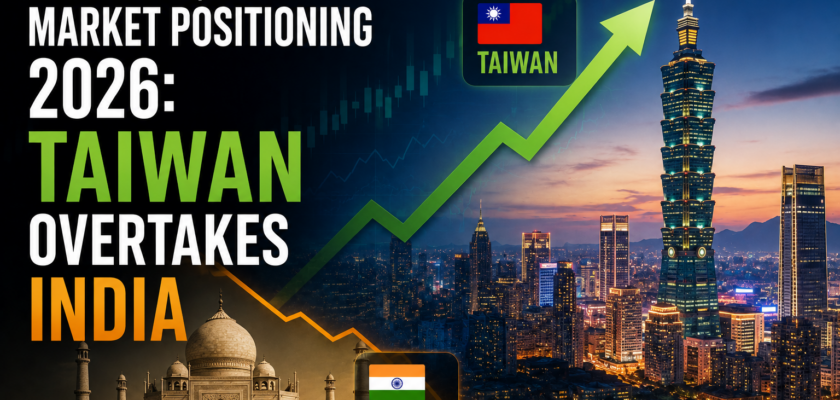
Trading Places: How Taiwan Overcame India in the Global Equity and Prime Real Estate Inflow Ranks.
The operational architecture dictating global institutional capital allocation has faced a historic, structural realignment. For nearly two years, India proudly maintained its undisputed standing as the world’s fifth-largest equity market, fueled by an expanding domestic consumer base, record-setting monthly mutual fund inflows, and robust gross domestic product (GDP) expansion numbers. This prolonged economic bull run created a highly profitable secondary boom across the nation’s prime commercial real estate markets. Multinational corporations and sovereign wealth funds aggressively poured capital into acquiring Grade-A office parks, luxury residential high-rises, and industrial logistics corridors in major metros, viewing Indian real estate as an unshakeable asset shield.
However, a massive global rotation of capital has completely inverted that investment matrix.
The latest data tracking global equity market positioning 2026 trends confirms an extraordinary milestone in international finance.
Driven by an unprecedented, breakneck rally in advanced artificial intelligence and hardware manufacturing stocks, Taiwan has officially overtaken India to claim the position of the world’s fifth-largest stock market.
According to Bloomberg market data, Taiwan’s aggregate market capitalization has scaled to an astronomical $4.95 trillion, nudging India down to the sixth spot at $4.92 trillion. This major transition is triggering a profound “domino effect” across alternative asset classes, fundamentally shifting where international funds deploy their multi-billion-dollar commercial real estate and infrastructure investments.
1. The Silicon Pivot: Why Institutional Capital is Fleeing Saturated Metros
The primary catalyst driving this sudden shift in foreign direct investments centers on a clear structural gap in what modern international capital is actively chasing. Investors are no longer evaluating emerging markets solely through broad demographic growth charts.
Instead, maximum valuation premiums are being awarded to economies that directly control the physical hardware infrastructure powering the global artificial intelligence cycle.
                     [ India's Partisan Capital Drain ]
     (Surging Energy Costs ──► Weakening Domestic Rupee ──► $24 Billion Equity Exodus)
                                      │
                                      ▼
                  [ Taiwan's Hardware Monopoly Loop ]
     (TSMC AI Chip Supercycle ──► Relaxed Single-Stock Laws ──► $4.95 Trillion Capital Peak)
This stark contrast in tech exposure has triggered a perfect storm for traditional, consumer-heavy portfolios:
- The Massive Capital Flight: Global fund managers have sold off nearly $24 billion in Indian equities so far this year. This intense sell-off has pushed India’s core stock indices down by 8% to 10%, putting the market on track for its first annual decline after a decade of uninterrupted gains.
- The Currency Headwind: This foreign capital exit has been further accelerated by a weakening domestic currency, with the Indian rupee slipping from 85 to approximately 95 against the US dollar. This depreciation directly erodes net dollar returns for international funds.
- The Taiwan Surge: Conversely, Taiwan’s benchmark TAIEX index has staged an absolute super-rally, surging nearly 50%. This breakneck growth is anchored by Taiwan Semiconductor Manufacturing Company (TSMC), which has gained over 130% in the past year alone to comprise a massive 42% of the total Taiwanese market value.
2. The Commercial Property Shift: The Rise of Specialized Silicon Real Estate
As billions of dollars in equity profits consolidate within Taipei, this massive accumulation of wealth is rapidly transforming commercial property destination shifts across the Asian tech corridor. Institutional investors are actively rotating capital away from standard office spaces in saturated metros to back highly specialized “Silicon Real Estate” layouts.
A. The High-Tech Fab Logistics Expansion
The monumental physical footprint required to build advanced semiconductor foundries is triggering unprecedented demand for specialized industrial land.
Because manufacturing next-generation 2nm and 3nm processor microchips requires specialized, vibration-proof construction grids and hyper-scale cleanrooms, land values surrounding Taiwan’s primary technology corridors have skyrocketed.
International real estate funds are aggressively reallocating capital away from standard metropolitan office portfolios to directly fund the construction of high-tech manufacturing parks and advanced logic test facilities.
B. Relaxed Investment Limits Fuel the Inflow
Furthermore, recent policy updates from Taiwan’s financial regulators have significantly accelerated this real estate and equity buying momentum:
  [ Regulator Alters Limits ] ───► [ Domestic Funds Can Hold 25% in Top Stocks ]
                                                    │
                                                    ▼
                                     [ Mass Institutional Capital Unlocked ]
                                "JPMorgan Projects Fresh $6 Billion Inflow"
                                                    │
                                                    ▼
                                     [ Real Estate Wealth Consolidation ]
                                "Drives Premium Luxury & Commercial Asset Demands"
The island’s financial regulator recently increased single-stock investment limits for domestic funds. Under the relaxed guidelines, funds focused solely on Taiwanese equities can hold up to 25% of their net assets in a single listed firm whose market weight crosses 10%.
Because TSMC is currently the only enterprise meeting this high threshold, the rule change has unlocked an immense wave of domestic liquidity.
According to research notes from JPMorgan Chase & Co., this regulatory shift is poised to lure in more than $6 billion in fresh institutional inflows.
This massive influx of capital is directly driving premium office leasing rates to record highs across Taipei’s central business districts, transforming the island into a magnet for corporate real estate investment.
3. Strategic Matrix: India’s Consumer-Led Assets vs. Taiwan’s Tech-Hardware Real Estate
| Property Allocation Vector | India’s Consumer-Led Core Assets | Taiwan’s Tech-Hardware Infrastructure |
| Primary Economic Engine | Domestic retail spend, infrastructure, and services | Global AI chip supercycle & advanced foundries |
| Foreign Flow Trajectory | Negative; nearly $24 Billion net outflows recorded | Positive; massive global capital rotation inflows |
| Core Real Estate Format | Grade-A corporate offices & urban retail hubs | Specialized cleanrooms & advanced logic facilities |
| Regulatory Policy Stance | Rigid tax structures on international property funds | Supportive guidelines; single-stock caps relaxed |
| Risk Characterization | Impacted near-term by inflation and rising crude | Sustained Risk; exposed heavily to cross-strait tail risks |
4. Portfolio Realignment: Balances for Long-Term Global Investors
The long-term takeaway of this historic market swap delivers an essential wake-up call to globally minded property and equity investors. It highlights a clear structural message: the global economy is systematically shifting rewards away from purely volume-driven consumer hubs toward highly specialized, tech-heavy hardware nodes.
However, financial advisers caution that this market rotation does not mean India’s foundational economic engine is permanently broken.
  [ Recognize Structural Tech Shift ] ───► [ Balance Overpriced Consumer Portfolios ]
                                                        │
                                                        ▼
                                         [ Deploy Globally Diversified Capital ]
                                 "Allocate Line Items to Sovereign Hardware Hubs"
                                                        │
                                                        ▼
                                         [ Insulate Long-Term Portfolio Wealth ]
                                "Maintains Growth Across Diverse Market Cycles"
India’s domestic fundamentals remain highly resilient, with robust GDP growth holding steady at 7.8% and national GST collections crossing the historic ₹2 trillion mark for the first time. The country’s infrastructure push, long-term demographic dividend, and massive financialization of domestic household savings are completely real and durable.
Therefore, instead of completely abandoning consumer-centric markets, institutional fund managers are executing a smart, defensive architectural rebalancing.
By keeping core investments in India’s stable domestic growth sectors while adding specialized line items in Taiwan’s AI hardware clusters, globally minded investors build a resilient portfolio. This balanced approach protects capital across shifting international trade trends, ensuring sustained wealth growth regardless of temporary market cycles.
Conclusion
The dramatic market rotation defining the global equity market positioning 2026 landscape delivers a powerful lesson to contemporary asset managers: true financial dominance in the digital age requires a strong, physical foothold in advanced technology hardware. The old abacus maze of allocating capital based purely on gross population scale or past real estate cycles has run into an unyielding wall of silicon-driven innovation.
By merging structural AI dominance with relaxed investment guidelines and hyper-scale industrial real estate development, Taiwan has successfully climbed the global financial rankings.
These impressive achievements do not erase the long-term potential of consumer-led economies. Rather, they highlight the absolute necessity of building a balanced, globally diversified investment approach. As these high-tech industrial hubs continue to expand their global footprint, they deliver a brilliant truth for modern lifestyle and wealth design: the ultimate way to secure your financial future is to stay nimble, look beyond traditional borders, and plant your capital where the machinery of tomorrow is actively being built.


