
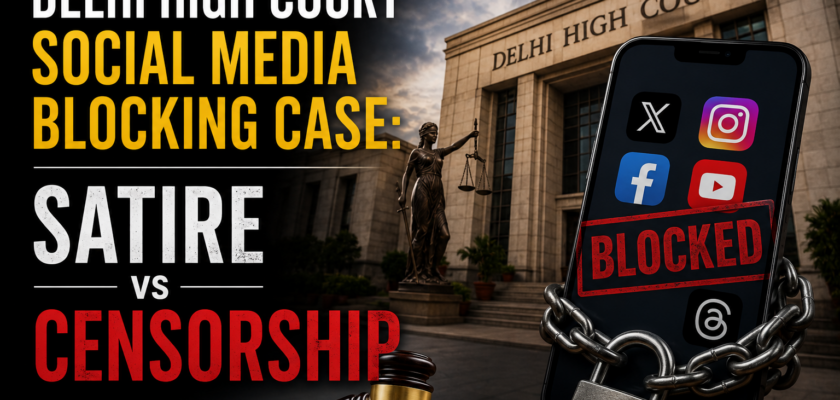
The Freedom of Speech Fight: Why a Popular Satirical Free-Speech Account Moved High Court After Social Block.
The structural boundary separating online political satire from administrative censorship in India has faced an unprecedented legal challenge. For several years, the explosive growth of meme-driven commentary transformed mainstream social media networks into highly decentralized public squares. Younger generations, particularly millennials and Gen Z users, actively turned away from traditional op-eds to consume quick, sarcastic digital campaigns addressing governance, public policy, and institutional behavior. To the fast-paced digital public, these satirical spaces functioned as a crucial emotional outlet to highlight structural grievances, mock societal issues, and challenge administrative overreach in real time.
However, a sudden wave of sweeping account suspensions has triggered an intense national debate regarding digital speech liberties.
The newest updates surrounding the Delhi High Court social media blocking case confirm a high-stakes legal battle between a viral internet movement and the State.
Abhijeet Dipke, the founder of the massively popular satirical online profile “Cockroach Janta Party” (CJP), has formally filed a writ petition before the High Court.
The urgent petition directly challenges the Central Government’s administrative order to withhold the movement’s primary communication accounts under national security grounds. This major development forces a critical examination of Section 69(A) of the Information Technology Act, bringing the core principles of digital expression back into the spotlight of the country’s highest legal venues.
1. The Genesis: How an Oral Courtroom Exchange Triggered a Viral Movement
The unique origins of this digital speech clash trace back to an intense, multi-layered internet reaction following a high-level judicial proceeding. Unlike traditional political platforms built over years of physical grassroots organizing, the CJP movement erupted almost overnight from a single spark of digital outrage.
                     [ The Viral Crackdown Loop ]
    (Courtroom Exchange ──► Sarcastic CJP Meme Surge ──► 1.9 Crore Followers Secured)
                                     │
                                     ▼
                  [ The Total Administrative Takedown ]
    (Section 69(A) Applied ──► Primary Handles Blocked ──► Deep Legal Challenges Initiated)
The unexpected digital movement grew rapidly across the country’s online landscape by channeling user frustrations through sharp satire:
- The Courtroom Observation: The initial online trend exploded following a specific, highly controversial courtroom exchange during a senior advocate designation hearing in mid-May.
- The Satirical Membership Matrix: Capitalizing on the viral momentum, the movement launched a satirical platform where candidates could apply for membership. The humorous registration guidelines required users to be “unemployed, lazy, chronically online” and possess the “ability to rant professionally”.
- The Rapid Growth Influx: This relatable, sarcastic approach resonated deeply with younger users, helping the movement quickly attract over 10 lakh digital members and secure an astronomical 1.9 crore followers on Instagram before facing sudden censorship.
2. Deconstructing the Crackdown: The Invocation of Section 69(A)
The core legal conflict driving the current High Court petition centers on a sweeping, multi-platform block that completely removed the movement’s digital footprint from the public eye.
A. The Total Digital Takedown
The petitioner alleges that the administrative action functioned as an un-checked, coordinated digital wipeout.
Within a brief window, the group’s primary account on X (formerly Twitter) was withheld under directives citing national security concerns.
Concurrently, the movement’s official Instagram handles, personal creator accounts, backup communication feeds, and central website were either compromised or completely taken offline.
This comprehensive shutdown left the platform completely locked out of its massive audience network, prompting the leadership team to warn followers that any new posts appearing under their name could not be treated as official communication.
B. Shifting from Satire to Hard Accountability
Furthermore, the government’s swift censorship order came immediately after the movement shifted its focus from simple memes to direct, organized political action:
  [ Meme Movement Goes Viral ] ───► [ Launch High-Profile National Petition ]
                                                   │
                                                   ▼
                                    [ Demand Union Minister Resignation ]
                              "6 Lakh Signatures Collected Over Paper Leaks"
                                                   │
                                                   ▼
                                    [ Total Digital Shutter Order ]
                              "Section 69(A) Applied Citing Security Risks"
The CJP platform rapidly scaled up its digital advocacy by launching a formal petition demanding the immediate resignation of the Union Education Minister.
The online campaign focused heavily on alleged structural failures within the national education system, drawing intense public focus to the NEET-UG 2026 paper leak controversy.
By successfully gathering over 6 lakh verified electronic signatures from students and parents within days, the satirical platform transitioned into a powerful tool for civic pressure.
Consequently, the legal defense team argues that the subsequent blocking orders were not driven by real threats to public safety, but were instead deployed to suppress legitimate political criticism under the convenient cover of national security.
3. Strategic Matrix: Arbitrary Account Shuttering vs. Established Legal Protections
| Legal Evaluation Axis | Arbitrary Blanket Blocking Orders | Established Shreya Singhal Safeguards |
| Primary Target Scope | Disproportionate; deletes entire profiles and feeds | Targeted; isolates specific offending text lines |
| Transparency Mandate | Minimal; text orders kept hidden from creators | Strict; requires written, fully recorded justifications |
| Pre-Hearing Protection | Non-existent; accounts removed before reviews | Mandatory; ensures creators get a fair opportunity |
| Satirical Speech Stance | Aggressive; treats parody as an existential threat | Protected; shields humor under basic free speech rights |
| Risk Characterization | High risk of systemic speech chilling effects | Withdrawn Risk; tech-backed system balance |
4. Precedents of Balance: The Path for Parody Accounts
The upcoming legal battle, scheduled for a high-profile hearing on Friday, May 29, 2026, before Justice Purushaindra Kumar Kaurav, will serve as a vital test for online speech protections in India.
Fortunately, the High Court has established clear, protective boundaries for digital humor in recent landmark cases.
  [ Government Demands Full Ban ] ───► [ High Court Intervenes to Guard Satire ]
                                                      │
                                                      ▼
                                       [ Account Restorations Ordered ]
                                "Dr Nimo Yadav & Nehr Who Back Online"
                                                      │
                                                      ▼
                                       [ Proportionality Doctrine Locked ]
                                "Isolate Single Content Lines, Keep Pages Live"
Just weeks prior, Justice Kaurav intervened to defend digital expression, ordering the immediate restoration of popular parody accounts like @DrNimoYadav and @Nehr_who, which had been entirely withheld under Section 69(A).
- The Proportionality Shield: The court firmly established that wiping out entire digital profiles is a disproportionate response to specific objectionable remarks.
- Isolating Content over Pages: The judiciary held that while specific, verified instances of misinformation or defamation can be temporarily hidden, the main account must remain active to protect the creator’s livelihood and free speech liberties.
- The Institutional Impact: Thus, by directing creators to present their arguments before a dedicated Ministry review committee rather than enforcing permanent bans, the court protects public discourse. This balanced approach ensures humor remains protected from heavy-handed administrative actions.
Conclusion
The high-stakes legal battle defining the Delhi High Court social media blocking case outlines a permanent truth for the digital age: a society’s maturity is measured by its capacity to tolerate, understand, and protect uncomfortable humor. The old abacus maze of assuming the state can use national security laws to instantly silence online satire has run into a firm wall of constitutional defense.
By bringing this digital crackdown before the high court, creators are establishing a vital legal boundary for online expression.
These crucial legal challenges do not seek to protect harmful misinformation. Instead, they defend the essential right of the internet generation to comment on public issues using the vibrant language of memes and satire. As the court begins its review of these blocking orders, the core issue is clear: true constitutional strength isn’t demonstrated by silencing public criticism, but by protecting the fair, diverse, and open spaces that allow our democracy to thrive.


