
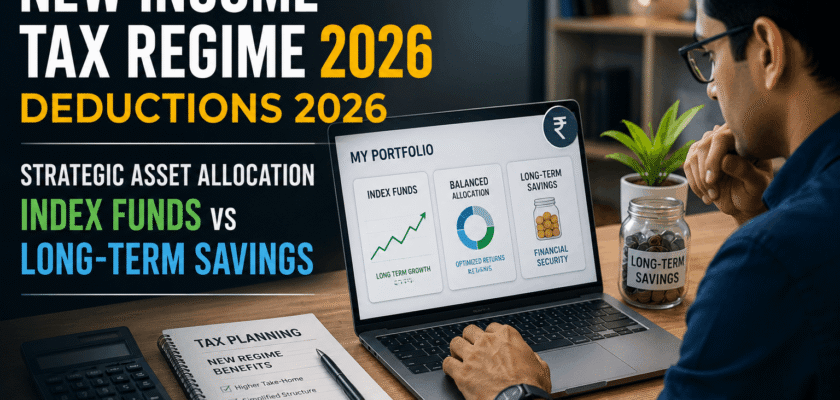
New Income Tax Regime Deductions 2026: Why Your Investment Plan Must Change
New income tax regime deductions 2026 are changing the way Indian taxpayers think about saving and investing. Earlier, many people invested only to save tax under old rules. Now, under the new regime, investors need a smarter plan that focuses on real returns, risk balance, liquidity, and long-term wealth.
This shift matters because the new tax regime gives lower tax rates but allows fewer deductions than the old regime. Therefore, investors should not choose products only because they offer tax benefits. Instead, they should ask one simple question: which option can grow money safely and meaningfully over time?
That is where the debate begins: high-yield index funds or traditional long-term savings?
What Are New Income Tax Regime Deductions 2026?
New income tax regime deductions 2026 are limited compared to the old tax regime. However, some useful deductions still exist.
For salaried taxpayers, the standard deduction is available under the new regime. Also, employer contribution to the National Pension System can qualify for deduction under Section 80CCD(2). In addition, home loan interest on a let-out property may qualify under Section 24(b), subject to rules.
So, the new tax regime does not fully remove every deduction. But it reduces the need to force investments only for tax saving.
New Income Tax Regime Deductions 2026 and Tax Slabs
For FY 2025-26, the new tax regime uses updated slabs. Income up to ₹4 lakh falls under the nil tax slab, and higher slabs rise step by step up to 30% for income above ₹24 lakh.
Also, Section 87A rebate under the new regime can give major relief to eligible resident individuals with taxable income up to ₹12 lakh. For salaried taxpayers, the ₹75,000 standard deduction can make the effective no-tax salary level higher, subject to conditions and special-income rules.
Because of this, many taxpayers may find the new regime simpler. However, simplicity does not mean you should stop investing.
Why Investment Planning Matters More Under the New Regime
Under the old regime, many people invested in tax-saving products like ELSS, PPF, insurance, and tax-saving FDs mainly to claim deductions. However, the new regime changes this habit.
Now, investors must choose products because they match their goals, not only because they save tax. This is actually a good change for disciplined investors.
For example, a young earner with a 15-year goal may prefer index funds. On the other hand, a conservative investor may prefer fixed deposits, PPF, or debt instruments. Both can be right, depending on risk comfort and time horizon.
Therefore, the best plan is not the same for everyone.
High-Yield Index Funds: What They Offer
Index funds are mutual funds that follow a market index like Nifty 50, Nifty Next 50, Sensex, or other broad indices. They do not try to beat the market through active stock picking. Instead, they try to match the index return.
This makes index funds simple, low-cost, and useful for long-term investors.
Index funds may offer:
- Low expense ratio
- Broad market exposure
- Long-term growth potential
- Simple investment style
- No need to select individual stocks
- SIP-friendly structure
- Better transparency
However, index funds carry market risk. Their value can fall during market corrections. So, investors should use them mainly for long-term goals.
Traditional Long-Term Savings: Why They Still Matter
Traditional long-term savings include fixed deposits, PPF, recurring deposits, post office schemes, government-backed options, insurance savings plans, and conservative debt products.
These options may not grow as fast as equity index funds. Still, they provide stability and peace of mind.
Traditional savings may offer:
- Capital safety
- Predictable returns
- Lower volatility
- Easy planning
- Useful emergency support
- Better comfort for low-risk investors
For many families, these options create the base of financial security. Therefore, they should not be ignored.
Index Funds vs Traditional Savings Under New Income Tax Regime Deductions 2026
New income tax regime deductions 2026 make this comparison more important. Since many old-style deductions are not available in the same way, investors should compare products by goal, risk, and return.
Here is a simple view:
| Factor | Index Funds | Traditional Savings |
|---|---|---|
| Risk | Medium to high | Low to medium |
| Return potential | Higher over long term | Stable but usually lower |
| Best for | 7+ year goals | Safety and short/medium goals |
| Liquidity | Usually high | Depends on product |
| Tax benefit | Limited under new regime | Limited under new regime |
| Volatility | High in short term | Low |
| Suitable for | Growth-focused investors | Safety-focused investors |
As a result, the better choice depends on your goal.
When Index Funds May Be Better
Index funds may work better if your goal is far away. For example, retirement, child education after 10 years, wealth creation, or long-term financial freedom may need growth assets.
If you invest through SIPs, market ups and downs can become easier to manage. Moreover, index funds reduce the need to pick the “best stock” or “best active fund.”
Index funds may suit you if:
- Your goal is 7 years or more away
- You can handle market ups and downs
- You want low-cost investing
- You prefer simple wealth creation
- You do not need money immediately
However, do not invest emergency money in equity funds.
When Traditional Savings May Be Better
Traditional savings may work better if you cannot take high risk. They also make sense when your goal is near.
For example, if you need money for a home down payment within 1 to 3 years, an equity index fund may be risky. A market fall near your withdrawal date can hurt your plan.
Traditional savings may suit you if:
- Your goal is short term
- You want stable returns
- You cannot handle market loss
- You need predictable income
- You are building an emergency fund
- You are close to retirement
Therefore, traditional options still have a strong role in every portfolio.
NPS Under the New Tax Regime
NPS deserves special attention because employer contribution to NPS under Section 80CCD(2) remains useful under the new regime. NPS Trust states that employer contributions can qualify up to 14% of salary for employees under the new regime, subject to rules.
This can help salaried employees reduce taxable income while also building retirement money.
However, NPS has long lock-in rules. So, it works best for retirement planning, not short-term goals.
How to Build a Balanced Portfolio in 2026
A good portfolio should not depend on one product. It should mix safety, growth, and liquidity.
A simple structure can look like this:
1. Emergency Fund
Keep 6 to 12 months of expenses in savings, FD, or liquid options. This protects you during job loss, medical needs, or urgent family expenses.
2. Insurance
Buy term insurance if your family depends on your income. Also, keep health insurance because one medical bill can damage your savings.
3. Traditional Savings
Use safe options for short-term goals and peace of mind. This can include FD, RD, PPF, or post office schemes.
4. Index Funds
Use index funds for long-term wealth creation. A monthly SIP can help you stay disciplined.
5. NPS
Use NPS if your employer offers contribution benefits or if you want a retirement-focused product.
Maximizing Tax Savings Without Making Poor Investments
Maximizing tax savings should not mean buying the wrong product. Many people buy insurance plans, locked savings products, or low-return options only because someone says they save tax.
Under the new regime, this habit needs to change.
Before investing, ask these questions:
- What is my goal?
- When do I need this money?
- Can I handle risk?
- What is the lock-in period?
- What is the real return after tax?
- Is this product simple to understand?
- Am I investing for tax saving or wealth creation?
If you cannot explain the product in simple words, avoid rushing into it.
Strategic Asset Allocation: A Simple Example
Let’s take a simple example.
A 28-year-old salaried person with stable income and no big debt may use a growth-heavy portfolio. They can keep emergency money in safe options and invest more in index funds for long-term goals.
However, a 50-year-old person near retirement may prefer more traditional savings and less equity exposure.
A possible structure for a young investor can be:
- 20% emergency and safe savings
- 60% index funds and equity funds
- 10% NPS
- 10% short-term goal savings
For a conservative investor, the structure may change:
- 40% safe savings
- 30% index funds
- 20% debt or post office products
- 10% NPS
This is only a simple example. Your actual plan should depend on income, family needs, debt, age, and risk comfort.
Common Mistakes Investors Should Avoid
Investors should avoid these mistakes in 2026:
- Investing only for tax benefits
- Ignoring emergency funds
- Putting short-term money in equity
- Buying complex insurance-cum-investment plans without understanding them
- Stopping SIPs during market falls
- Keeping all money in low-return products
- Ignoring inflation
- Copying someone else’s portfolio
Moreover, do not chase “high-yield” blindly. High return often comes with higher risk.
Final Verdict
New income tax regime deductions 2026 have changed how Indians should think about saving and investing. Since the new regime gives fewer deduction-based incentives, investors must focus more on real financial planning.
Index funds can be powerful for long-term wealth creation. Traditional savings can protect your money and support short-term goals. NPS can help with retirement planning and may offer useful employer contribution benefits.
The best strategy is not index funds vs savings. The best strategy is index funds plus savings, used in the right balance.
In simple words, use traditional savings for safety, index funds for growth, and NPS for retirement. That balanced approach can help you manage tax, risk, and wealth together in 2026.


