
Metro CNG Price Hike: Why Your Commute Budget Needs a Fresh Look
Metro CNG price hike has changed the daily travel budget for many car owners, auto drivers, cab users, and office commuters. CNG still remains cheaper than petrol in most cases, but the latest price rise means you should recalculate your real per-kilometre cost.
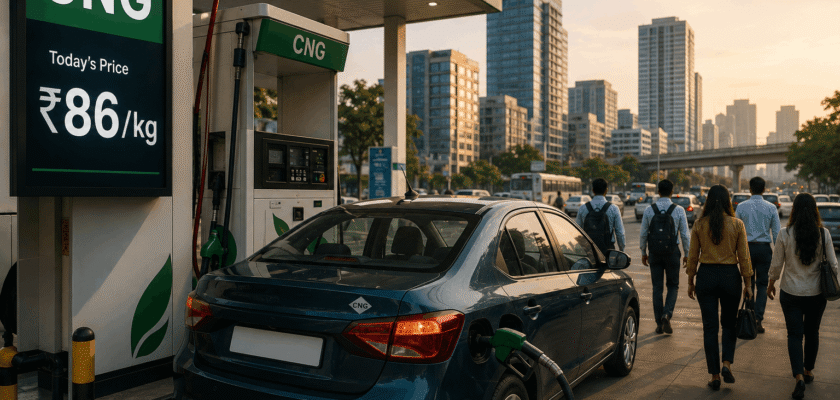
In Mumbai and nearby MMR areas, CNG has moved to ₹86 per kg after a ₹2 per kg hike. Other metro cities also show different CNG rates, so your running cost now depends more on city, mileage, route, and daily distance.
Therefore, this is the right time to check your monthly fuel math before small daily costs become a bigger budget problem.
Why Metro CNG Price Hike Matters in 2026
Metro CNG price hike matters because daily commuting is already expensive. People pay for fuel, tolls, parking, servicing, insurance, tyre wear, and traffic delays.
A ₹2 per kg hike may look small at first. However, when you drive every day, the monthly total can increase. The impact becomes bigger for people who drive 40 km to 100 km daily.
Also, auto-rickshaw drivers, taxi operators, delivery workers, and fleet owners feel the pressure faster because their vehicles run much more than private cars.
Latest Metro CNG Price Hike: What Changed?
The latest metro CNG price hike became visible after Mahanagar Gas increased CNG by ₹2 per kg in Mumbai/MMR. The new retail price reached ₹86 per kg.
Delhi also saw quick CNG price increases in May 2026, including a ₹2 per kg hike reported on May 26.
On May 30, 2026, reported CNG prices across major cities were:
| City | CNG Price |
|---|---|
| Delhi | ₹83.09/kg |
| Mumbai | ₹86/kg |
| Bengaluru | ₹90/kg |
| Hyderabad | ₹97/kg |
| Chennai | ₹91.50/kg |
| Kolkata | ₹93.50/kg |
These rates show one clear point: CNG is no longer equally cheap everywhere. Your city now plays a big role in your daily running cost.
How to Calculate Your Real CNG Cost Per Kilometre
You can calculate your real CNG cost per kilometre with a simple formula:
CNG price per kg ÷ real mileage per kg = cost per km
For example, if CNG costs ₹86 per kg and your car gives 26 km/kg, then:
₹86 ÷ 26 = ₹3.30 per km
This is your fuel-only running cost. It does not include maintenance, tyre wear, insurance, parking, tolls, or loan EMI.
Still, this number helps you compare CNG with petrol, diesel, hybrid, and EV options.
Metro CNG Price Hike Cost Table for Daily Drivers
Here is a simple cost table based on ₹86/kg CNG price:
| Real CNG Mileage | Cost Per Km |
| 22 km/kg | ₹3.91/km |
| 24 km/kg | ₹3.58/km |
| 26 km/kg | ₹3.31/km |
| 28 km/kg | ₹3.07/km |
| 30 km/kg | ₹2.87/km |
| 32 km/kg | ₹2.69/km |
This table shows why mileage matters. The same fuel price can feel expensive in a low-mileage car and affordable in a high-mileage car.
Monthly Commute Cost After Metro CNG Price Hike
Let’s take a simple example.
If you drive 40 km daily for 26 days a month, your monthly running is 1,040 km.
At 26 km/kg mileage, your car will use around 40 kg of CNG.
At ₹86/kg, your monthly CNG cost will be:
40 kg × ₹86 = ₹3,440
Now compare this with the earlier ₹84/kg price:
40 kg × ₹84 = ₹3,360
So, your monthly cost increases by around ₹80.
For a normal private car owner, this may look manageable. However, for a cab or fleet driver running 3,000 km to 5,000 km monthly, the extra burden becomes much larger.
Daily Distance Makes the Biggest Difference
The metro CNG price hike affects every driver differently. The biggest factor is not only fuel price. It is daily distance.
Here is a simple monthly estimate at ₹86/kg and 26 km/kg mileage:
| Daily Distance | Monthly Distance | Approx. Monthly CNG Cost |
| 20 km/day | 520 km | ₹1,720 |
| 40 km/day | 1,040 km | ₹3,440 |
| 60 km/day | 1,560 km | ₹5,160 |
| 80 km/day | 2,080 km | ₹6,880 |
| 100 km/day | 2,600 km | ₹8,600 |
This is why people with long office routes should track fuel spending every month.
Is CNG Still Cheaper Than Petrol?
Yes, CNG is still cheaper than petrol for most daily users. A petrol car in city traffic may cost around ₹6 to ₹9 per km, depending on mileage and petrol price.
On the other hand, many CNG cars can still run around ₹2.70 to ₹4 per km, depending on city rate and real mileage.
However, the saving gap becomes smaller when CNG prices rise again and again. Therefore, buyers should not assume that every CNG car automatically saves a lot of money.
You must calculate based on your own city and daily driving.
Why Real Mileage Matters More Than Company Claim
Company-claimed mileage is useful, but real-world mileage is more important. In city traffic, actual CNG mileage can drop due to:
- Heavy traffic
- Long idling
- Frequent braking
- AC usage
- Low tyre pressure
- Poor servicing
- Overloading
- Aggressive driving
- Bad route planning
- Stop-and-go traffic
So, if your car claims 30 km/kg but gives only 24 km/kg in real use, your cost will rise sharply.
That is why real mileage tracking is necessary after every metro CNG price hike.
How to Track Your CNG Mileage Correctly
You can track your mileage in a simple way.
First, fill CNG completely. Then reset your trip meter. After driving normally, fill CNG again and note how many kg were filled. Finally, divide kilometres driven by kg filled.
Formula:
Kilometres driven ÷ CNG kg refilled = real km/kg
For example:
260 km driven ÷ 10 kg CNG = 26 km/kg
Do this 3 to 4 times and take the average. This gives a more realistic number.
How to Protect Your Monthly Budget
The metro CNG price hike does not mean you must stop driving. Instead, you should drive smarter and plan better.
You can protect your budget with these simple steps:
- Track monthly fuel spending
- Maintain correct tyre pressure
- Service your car on time
- Avoid sudden acceleration
- Reduce unnecessary idling
- Use AC wisely
- Plan routes before leaving
- Avoid peak traffic when possible
- Remove extra weight from car
- Compare public transport for long routes
Small habits can reduce fuel waste and save money.
Should You Switch to Public Transport?
Public transport can save money if your route is well connected. Metro, local train, bus, and shared mobility may reduce daily fuel cost, parking stress, and traffic fatigue.
However, public transport may not work for everyone. It depends on your office location, timing, last-mile travel, family needs, and comfort.
A smart approach is to compare:
- Monthly CNG cost
- Parking cost
- Toll cost
- Public transport pass
- Time saved or lost
- Last-mile cost
- Comfort and safety
If public transport saves money and time, you can use it a few days a week.
Best Car Types After Metro CNG Price Hike
After a metro CNG price hike, the best car depends on your daily running.
For Low Running Users
If you drive less than 20 km daily, a petrol car may still be fine. The extra cost of a CNG variant may take longer to recover.
For Medium Running Users
If you drive 30 km to 60 km daily, a factory-fitted CNG car can still make sense.
For High Running Users
If you drive 70 km or more daily, CNG, hybrid, or EV options should be compared carefully.
For City Fleets
For taxis, delivery vehicles, and company fleets, running cost tracking is essential. Even small price changes can affect monthly profit.
CNG vs EV: Should You Think About Electric Cars?
EVs can offer low running cost, but they also need charging access, higher upfront cost, battery warranty confidence, and route planning.
CNG is still easier for many users because refuelling is faster than charging and CNG stations are available in many metro areas. However, waiting time at CNG pumps can be a problem.
If you have home charging and daily city driving, an EV may be worth comparing. But if you need long flexible routes and quick refuelling, CNG may still be more practical.
What New Car Buyers Should Check
If you plan to buy a CNG car now, do not look only at showroom price. Check the full ownership cost.
Before buying, check:
- CNG variant price difference
- Real-world mileage
- Boot space loss
- CNG pump availability
- Waiting time at pumps
- Service cost
- Insurance cost
- Resale value
- Safety rating
- Daily distance
This will help you choose a car that actually saves money.
Why Auto and Taxi Fares May Come Under Pressure
Metro CNG price hike affects public transport too. Auto-rickshaw and taxi drivers use CNG heavily in many cities.
When fuel cost rises, driver unions may demand fare revision. This can affect daily passengers who do not own cars.
Therefore, the CNG price hike is not only a car owner issue. It can also affect city transport cost, ride-hailing fares, office travel budgets, and local delivery charges.
Simple Budget Formula for Every Commuter
Use this simple monthly formula:
Daily km × 26 days ÷ real mileage × CNG price = monthly CNG cost
Example:
40 km × 26 ÷ 26 km/kg × ₹86 = ₹3,440
Now add:
- Parking
- Toll
- Maintenance
- EMI
- Insurance
- Tyre cost
This gives you the real monthly commuting cost, not just fuel cost.
Final Verdict
Metro CNG price hike has made daily commuting math more important in 2026. CNG still remains a cheaper option than petrol for many users, but the savings depend on your real mileage, city rate, daily distance, and driving style.
If you drive short distances, the hike may not hurt much. However, if you drive long distances or run a commercial vehicle, the monthly impact can become serious.
The best solution is simple: calculate your real per-kilometre cost, track your monthly fuel use, maintain your vehicle, and compare transport options honestly.
In simple words, fuel prices are not fully in your control. But your commute planning, mileage habits, and monthly budget discipline are still in your hands.


