
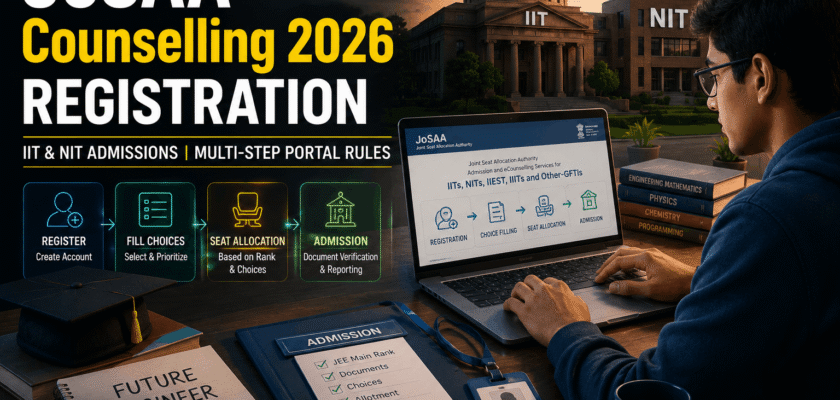
JoSAA Counselling 2026 Registration: Why Aspirants Must Act Carefully
JoSAA Counselling 2026 registration has officially started, and this is the main seat gateway for IIT, NIT, IIIT, and GFTI admissions. For engineering aspirants, this stage is as important as the entrance exam result because one wrong choice, missed deadline, or unlocked preference list can affect seat allotment.
The Joint Seat Allocation Authority has opened registration and choice filling on the official JoSAA portal. Candidates must use the official website only and complete every step before the deadline.
Therefore, students should not treat JoSAA as a simple form. It is a multi-step admission process where choice order, document readiness, fee payment, and reporting rules matter a lot.
Why JoSAA Counselling 2026 Registration Matters
JoSAA Counselling 2026 registration matters because it connects JEE Main and JEE Advanced qualified candidates with India’s top engineering institutes. IITs, NITs, IIITs, and other government-funded technical institutes participate in this centralised counselling process.
Times of India reported that JoSAA 2026 registration and choice filling started on June 2 at 5 PM, and the process is critical for admission to more than 62,000 seats across major technical institutions.
This means students must plan choices carefully instead of filling colleges randomly.
A good counselling strategy can improve the chance of getting a better branch, better institute, or better location.
What Is JoSAA Counselling?
JoSAA counselling is the centralised seat allocation process for admission into IITs, NITs, IIITs, and GFTIs. It uses JEE Main and JEE Advanced ranks to allot seats based on candidate eligibility, category, preferences, and seat availability.
A simple JoSAA flow looks like this:
- Registration
- Choice filling
- Mock seat allocation
- Choice editing
- Choice locking
- Seat allotment round
- Seat acceptance fee
- Document upload
- Online reporting
- Query response
- Final admission process
Each step has a deadline. Missing a deadline can create serious problems.
JoSAA Counselling 2026 Registration Dates
JoSAA Counselling 2026 registration and choice filling started on June 2, 2026 at 5 PM. The official JoSAA site also shows that online registration and choice filling for JoSAA 2026 has started.
Important dates reported in the 2026 schedule include:
| Event | Date / Time |
|---|---|
| Registration and choice filling start | June 2, 2026, 5 PM |
| Pre-payment of seat acceptance fee starts | June 2, 2026, 5 PM |
| Mock seat allocation 1 | June 8, 2026 |
| Mock seat allocation 2 | June 10, 2026 |
| Choice locking starts | June 10, 2026 |
| Registration and choice filling end | June 11, 2026, 5 PM |
| Pre-upload of documents ends | June 11, 2026, 5 PM |
Candidates should still check the official JoSAA portal daily because counselling schedules can have detailed time-based instructions.
Official JoSAA Portal Rules Students Must Follow
Students should use only the official JoSAA website for registration, schedule, choice filling, seat allotment, and updates. The official portal is the safest source for business rules, seat matrix, opening-closing ranks, and schedule documents.
Important portal rules include:
- Do not rely on random Telegram links
- Do not share login details with strangers
- Use only official JoSAA portal
- Check schedule PDF carefully
- Save confirmation pages
- Download filled choice list
- Keep registered mobile active
- Read business rules before locking choices
- Respond to queries on time
- Track every round carefully
Aspirants should remember that counselling errors can cost more than exam mistakes.
Step 1: Register on the JoSAA Portal
The first step is registration. Candidates must sign in using their JEE Main or JEE Advanced credentials as applicable. JoSAA’s registration/login page redirects candidates to new candidate registration and sign-in flow.
During registration, students should check personal details carefully.
Verify:
- Name
- JEE application number
- Category
- Gender
- PwD status
- Nationality
- State of eligibility
- Rank details
- Contact number
- Email ID
If any detail looks wrong, students should follow official correction or support instructions.
Do not ignore mistakes.
Step 2: Understand Eligibility Before Choice Filling
Before filling choices, students must understand which institutes and branches they are eligible for.
Basic eligibility depends on:
- JEE Main rank
- JEE Advanced rank
- Category rank
- Class 12 eligibility rules
- Institute-specific criteria
- Programme-specific requirements
- Gender-neutral or female-only seats
- Home state or other state quota
- PwD status, if applicable
- Preparatory course rules, if applicable
IIT seats mainly depend on JEE Advanced eligibility. NIT, IIIT, and GFTI seats mainly depend on JEE Main rank and other rules.
So, students should not copy someone else’s list blindly.
Step 3: Choice Filling Is the Most Important Step
Choice filling is the heart of JoSAA Counselling 2026 registration. Students must select institutes and branches in the exact order of preference.
The system tries to allot the highest possible choice based on rank, category, seat availability, and eligibility.
This means your first choice should be your most preferred option.
Do not put a less preferred branch above a more preferred branch just because you think it is “safe.” JoSAA checks your list from top to bottom.
A wrong order can create regret later.
How to Build a Smart Choice List
A smart choice list should include dream options, realistic options, and safe options.
Divide your list like this:
Dream Choices
These are top IIT/NIT/branch combinations that may be difficult but possible.
Realistic Choices
These are options where your rank has a reasonable chance based on previous trends.
Safe Choices
These are options where your rank has a stronger chance.
Students should fill enough choices. A short list can reduce allotment chances.
JoSAA 2026 Choice Filling Mistakes to Avoid
Many students make avoidable mistakes during choice filling.
Avoid these mistakes:
- Filling only 10–20 choices
- Copying friends’ preference list
- Ignoring home state quota
- Not checking branch curriculum
- Choosing only institute name over branch fit
- Forgetting newer IIITs or GFTIs
- Not using mock allotment properly
- Leaving choice locking until last minute
- Ignoring category-specific seat matrix
- Not saving the final list
Choice filling should be done slowly and carefully.
Step 4: Use Mock Seat Allocation Properly
Mock seat allocation helps students understand likely allotment based on choices filled before a specific cut-off time. It is not the final allotment, but it gives useful guidance.
JoSAA 2026 mock allocation 1 is scheduled for June 8, and mock allocation 2 is scheduled for June 10.
After mock allotment, students should ask:
- Am I getting a seat too low in my list?
- Did I miss safer options?
- Did I place a branch wrongly?
- Should I add more colleges?
- Should I change my priority order?
- Is my list too risky?
- Did I ignore home state advantage?
- Did I include enough NIT/IIIT/GFTI options?
Mock allotment is a warning system. Use it.
Step 5: Choice Locking Is Final
Choice locking is a serious step. Once choices are locked, students cannot casually change them later unless official rules allow any specific correction window.
Choice locking starts after mock allocation 2 timing, and registration/choice filling ends on June 11 at 5 PM. Reports also mention auto or system locking after the deadline.
So, candidates should not wait until the final minutes.
Before locking, check:
- College order
- Branch order
- Category eligibility
- Seat matrix
- Location preference
- Fee affordability
- Hostel availability
- Career interest
- Family discussion
- Backup options
Lock only after careful review.
Step 6: Pre-Payment and Document Upload
JoSAA 2026 also includes pre-payment of seat acceptance fee and pre-upload of documents starting from June 2 at 5 PM and ending on June 11 at 5 PM.
This step is important because late document preparation can create stress after allotment.
Students should keep scanned copies ready.
Common documents may include:
- Class 10 marksheet or certificate
- Class 12 marksheet
- Category certificate, if applicable
- PwD certificate, if applicable
- JEE Main score details
- JEE Advanced details, if applicable
- Photo ID proof
- Passport-size photo
- Medical certificate, if required
- Seat acceptance-related documents
Always follow the official JoSAA document list.
IIT Aspirants: Special Points to Remember
IIT aspirants must understand that IIT admission usually requires JEE Advanced qualification and meeting performance criteria in Class 12 or equivalent as per rules.
IIT aspirants should check:
- JEE Advanced rank
- IIT branch preference
- Seat matrix
- Opening and closing ranks
- Academic programme details
- Gender-neutral and female-only seats
- Preparatory course rules
- Category rules
- Fee structure
- Reporting instructions
Do not choose an IIT branch only because of the IIT tag. Check whether the branch matches your interest and future plans.
NIT Aspirants: Home State Quota Matters
NIT aspirants must pay close attention to home state and other state quota. This can strongly affect admission chances.
For many students, a home state NIT branch may be a better realistic option than a faraway institute with uncertain branch quality.
NIT aspirants should compare:
- Home state quota
- Other state cutoffs
- Branch demand
- Placement trends
- Location
- Hostel quality
- Faculty strength
- Internship access
- Peer group
- Fees and travel cost
Home state advantage should be used wisely.
IIIT and GFTI Options Should Not Be Ignored
Many students focus only on IIT and NIT options. However, IIITs and GFTIs can also offer strong opportunities, especially in computer science, electronics, IT, and emerging tech branches.
Students should research:
- Institute reputation
- Branch strength
- Placement reports
- Location advantage
- Fees
- Industry access
- Hostel facility
- Faculty profile
- Alumni network
- Student reviews
A good IIIT or GFTI branch can sometimes be a better fit than a weak branch at a bigger-name institute.
Freeze, Float, and Slide: Understand Before Allotment
JoSAA seat acceptance choices are very important. Students should understand Freeze, Float, and Slide properly.
Freeze
You accept the allotted seat and do not want higher options.
Float
You accept the seat but want a better option from higher preferences in later rounds.
Slide
You accept the institute but want a better branch within the same institute.
These options can affect future rounds. Read official business rules before choosing.
Why Opening and Closing Ranks Are Useful
Opening and closing ranks help students understand previous year admission trends. They show the rank range for each institute, branch, category, and quota.
However, cutoffs can change every year.
They depend on:
- Number of candidates
- Difficulty level
- Seat matrix
- Branch popularity
- New programmes
- Category movement
- Candidate preference trends
- Female supernumerary seats
- Institute demand
- Round-wise withdrawals
Use previous ranks as guidance, not guarantee.
How to Decide Between Branch and College
This is one of the biggest counselling questions.
A top college with a less preferred branch may be good for some students. A slightly lower-ranked college with a preferred branch may be better for others.
Ask yourself:
- Do I truly like this branch?
- Can I study it for four years?
- Does it match my career goal?
- Is the college environment strong?
- What are placement opportunities?
- Can I switch fields later?
- Is location important?
- What is the fee burden?
- Is the alumni network useful?
- What do seniors say?
There is no single answer for everyone.
Common Portal Errors and How to Avoid Stress
During high-traffic counselling periods, portals may feel slow. Students should avoid last-minute work.
To reduce stress:
- Use stable internet
- Avoid final-hour submission
- Save choices regularly
- Download PDFs
- Keep screenshots
- Use laptop or desktop if possible
- Keep documents in one folder
- Name files clearly
- Check file size limits
- Log out safely after work
Small discipline can prevent big tension.
Cyber Safety During JoSAA Counselling
Students must stay alert during counselling season. Fake links, paid agents, and phishing messages often target anxious aspirants.
Follow these rules:
- Use only official JoSAA portal
- Do not share password or OTP
- Do not pay through unknown links
- Avoid fake counselling groups
- Do not trust guaranteed seat claims
- Verify every notice officially
- Use secure device
- Avoid cyber cafés for payment if possible
- Keep payment receipt
- Report suspicious messages
No private agent can guarantee a JoSAA seat.
Parent Role During JoSAA Counselling
Parents should support students but avoid pressure-based decisions. Engineering branch and institute choice affects the student’s future, so the student’s interest matters.
Parents can help by:
- Checking deadlines
- Arranging documents
- Discussing fee affordability
- Helping compare locations
- Supporting calm decision-making
- Avoiding social comparison
- Checking hostel and safety
- Helping with internet/payment
- Encouraging realistic choices
- Respecting student interest
A calm family environment helps better decisions.
Last-Minute Checklist Before Choice Locking
Before locking choices, students should check this list:
- Registration completed
- Personal details verified
- Choices arranged in real preference order
- Enough choices added
- IIT/NIT/IIIT/GFTI options checked
- Home state quota considered
- Category rules checked
- Mock allotment reviewed
- Documents uploaded
- Fee payment step reviewed
- Final choice list downloaded
- Deadline confirmed
Do not lock in panic. Lock after review.
What Happens After Seat Allotment?
After seat allotment, students must accept the seat, pay required fee, upload documents, and complete online reporting within the deadline.
If JoSAA raises a query, respond quickly.
Missing online reporting or failing to respond to document queries can affect your seat.
After final JoSAA rounds, candidates may need to follow institute-specific admission, fee, hostel, and physical reporting instructions.
Always read every official message carefully.
Final Verdict
JoSAA Counselling 2026 registration is the real IIT/NIT seat gateway for engineering aspirants. The process has started, and students must complete registration, choice filling, mock allotment review, choice locking, fee steps, and document upload within the official schedule.
The biggest mistake is treating JoSAA as a simple form. It is a strategic process. Your choice order can decide your seat.
In simple words, fill choices based on your real preference, not fear. Use mock allotment wisely. Keep documents ready. Avoid fake links. Follow only the official JoSAA portal.
A careful counselling strategy can make a big difference between a missed opportunity and the right engineering seat.


