
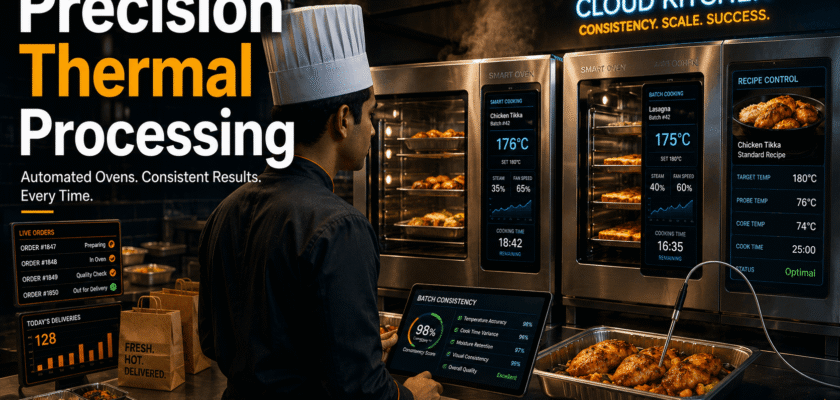
Precision Thermal Processing: Why Cloud Kitchens Need It
Precision thermal processing is becoming a key tool for cloud kitchens. These kitchens often cook the same item many times a day, yet small changes in heat, moisture and timing can change the final taste. Therefore, consistency becomes a business problem, not only a cooking problem.
Cloud kitchens depend on repeat orders, delivery ratings and tight margins. If one batch of biryani rice turns dry, one pizza base burns, or one batch of baked snacks loses texture, the customer may not return. As a result, operators need better control than manual timers alone can offer.
Automated commercial ovens help solve this gap. They can use stored recipes, controlled humidity, temperature probes and connected dashboards. Moreover, smart combi ovens can combine steam and convection, which helps operators manage texture, color and moisture in a more reliable way.
Because food delivery is fast and review-driven, the winner is not always the kitchen with the most creative menu. Often, the winner is the kitchen that can make the same item taste right at 1 PM and again at 10 PM.
| KEY TAKEAWAYPrecision thermal processing gives cloud kitchens a repeatable cooking method. It helps protect taste, texture, yield, training speed and customer ratings across many batches. |
Precision Thermal Processing in Cloud Kitchen Operations
In simple words, precision thermal processing means controlling heat transfer with care. It is not only about setting a temperature. It also includes airflow, humidity, food load, tray position, core temperature and cooking time.
In a cloud kitchen, these details matter because teams work under pressure. Orders arrive in waves. Staff may change shifts. Ingredients may come from different batches. However, the customer still expects the same taste every time.
Therefore, automated ovens act like a process-control system. They reduce guesswork and help staff follow one approved cooking path.
Why Automated Commercial Ovens Are Gaining Attention
Market interest in smart ovens and combi ovens is rising because food-service operators want speed, energy control and better output quality. Persistence Market Research estimates the commercial combi oven market at US$2.7 billion in 2026, with growth projected through 2033.
Food-tech reports also show that AI and IoT tools are changing modern kitchens by reducing waste and improving production. Meanwhile, combi oven makers describe benefits such as steam and convection cooking, flexible cooking modes and better kitchen processes.
This matters for cloud kitchens because their model depends on repeatable output. A dining restaurant can sometimes fix a dish at the table. A delivery kitchen does not get that chance.
The Consistency Vulnerabilities Cloud Kitchens Face
✓ Uneven browning when trays are overloaded or placed poorly.
✓ Dry texture when humidity is not controlled.
✓ Overcooking during order peaks because staff are multitasking.
✓ Food safety risk when core temperature is not checked correctly.
✓ High waste when a batch fails during rush hours.
✓ Slow training when every cook uses a different method.
✓ Customer-rating drops when the same recipe tastes different across outlets.
How Smart Ovens Reduce Batch Variation
1. Stored Cooking Programs
Stored programs help teams repeat a recipe with fewer manual steps. Once the chef approves a setting, staff can follow the same thermal path each time.
Additionally, central teams can update a recipe across locations. This is useful when a brand operates several delivery kitchens.
2. Steam and Convection Control
Combi ovens can use steam, convection or both. This gives kitchens more control over moisture and crust. For example, bread, rice, roasted vegetables and proteins all need different heat behavior.
As a result, the same oven can support many menu items without turning the kitchen into a crowded equipment line.
3. Core Temperature Monitoring
Core temperature probes help teams check whether food is cooked inside, not only browned outside. This is important for food safety and product quality.
Furthermore, clear temperature data gives managers a record that can support audits and training.
4. Connected Dashboards
Connected dashboards can show oven use, error patterns, cleaning cycles and recipe performance. Managers can then find weak points before they become customer complaints.
For cloud kitchens, this data can also support menu planning. If one item fails often, the team can adjust its recipe, batch size or packaging.
| OPERATIONS BOXThe best automated oven setup is not only a machine purchase. It needs standard recipes, staff training, food safety checks, cleaning routines and daily performance review. |
Precision Thermal Processing for Menu Items That Need Control
✓ Pizza bases need steady heat, airflow and browning control.
✓ Baked snacks need even texture and moisture control.
✓ Rice dishes need steam balance to avoid dryness.
✓ Grilled proteins need safe core temperature and surface color.
✓ Roasted vegetables need timing control to avoid sogginess.
✓ Cloud bakery items need repeatable rise, crust and crumb quality.
Business Benefits for Cloud Kitchens
First, consistent food protects repeat orders. Delivery customers often reorder the same dish if the experience is predictable.
Second, automation can reduce staff-training pressure. New team members can follow guided programs instead of learning every recipe from memory.
Third, better process control can reduce waste. Fewer failed batches mean lower ingredient loss and better margin protection.
Finally, ovens with monitoring features can support multi-location control. This helps brands keep similar quality across city zones.
What Owners Should Check Before Buying
✓ Menu fit: The oven must match the items you actually sell.
✓ Capacity: The oven should handle rush-hour batch volume.
✓ Recipe memory: Stored programs should be easy to update.
✓ Humidity control: Steam control is useful for many delivery foods.
✓ Cleaning system: Simple cleaning reduces downtime and odor problems.
✓ Service support: Fast repair support matters more than a flashy feature list.
✓ Energy use: Check energy cost, not only purchase price.
✓ Data access: Multi-outlet brands should ask for useful reports.
Mistakes That Can Waste the Investment
⚠ Buying a premium oven without standardizing recipes.
⚠ Ignoring staff training after installation.
⚠ Using one setting for every batch size.
⚠ Overloading trays and expecting perfect airflow.
⚠ Skipping cleaning cycles during busy days.
⚠ Choosing capacity without checking peak demand.
⚠ Ignoring service availability in the city.
| COST CONTROL WARNINGAutomation can improve consistency, but it cannot fix a weak recipe, poor ingredient quality or bad dispatch timing. Owners should improve the full workflow, not only the cooking step. |
How to Roll Out Automated Ovens Safely
✓ Start with two hero items: Choose the dishes that create the most complaints or the highest sales.
✓ Record the baseline: Track waste, cook time, customer ratings and batch failures before the change.
✓ Build approved programs: Let the chef test settings and lock the best version.
✓ Train every shift: Use simple SOP cards near the oven and repeat training for night teams.
✓ Review data weekly: Check failed batches, temperature misses, cleaning gaps and staff feedback.
✓ Scale slowly: After success with hero items, add more menu items to the oven program.
Food Safety and Quality Control
Food safety should remain the top priority. Automated ovens can help, but managers still need clear checks for storage, preparation, cooking, holding and dispatch.
Core temperature records are helpful because they show whether food reached the required cooking level. In addition, cleaning logs reduce the risk of flavor carryover and contamination.
Therefore, the strongest cloud kitchens combine automation with human inspection. Machines create repeatability, while trained staff protect judgment and hygiene.
The Future of Cloud Kitchen Cooking
Cloud kitchens are moving from chef-dependent output to process-led output. This does not remove chefs. Instead, it lets chefs design a better system that staff can repeat.
In the next phase, ovens may connect with inventory, order forecasting and recipe-cost dashboards. Consequently, kitchen managers may see how cooking performance affects waste, margin and ratings in one view.
For food brands, this shift is powerful. It turns cooking consistency into a measurable business advantage.
Conclusion
Precision thermal processing is becoming important because cloud kitchens cannot afford random batch results. Delivery customers expect the same taste, texture and portion quality every time.
Automated commercial ovens help by controlling heat, steam, airflow, timing and recipe steps. However, they work best when paired with training, SOPs and daily review.
The organic-search lesson is clear for food-service owners. Smart ovens are not only kitchen equipment. They are consistency infrastructure for the delivery-first restaurant economy.
Frequently Asked Questions
Q. What is precision thermal processing?
Precision thermal processing means controlling heat, airflow, steam, time and core temperature to cook food in a repeatable way.
Q. Why do cloud kitchens need automated ovens?
They need them because delivery kitchens must produce the same item many times with stable taste, texture and safety.
Q. Are combi ovens useful for cloud kitchens?
Yes. Combi ovens can combine steam and convection, which helps manage moisture, browning and texture.
Q. Can automated ovens reduce food waste?
They can reduce waste when recipes are standardized, staff are trained and batch sizes are planned correctly.
Q. Should every cloud kitchen buy a smart oven?
No. The decision should depend on menu type, order volume, service support, energy cost and return on investment.


