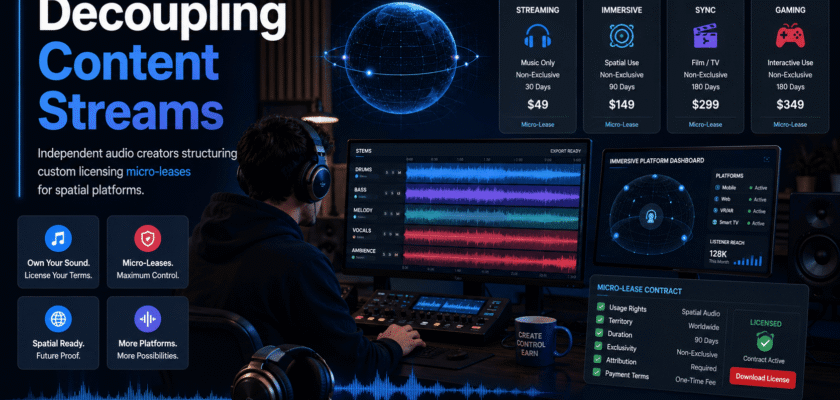
Decoupling Content Streams: Why Audio Creators Are Changing Licensing
Decoupling content streams is becoming a serious strategy for independent audio creators. Earlier, many creators treated one track as one product. Now, the same audio work can be used in podcasts, short videos, spatial apps, virtual events, games and AI-powered remix features.
Because every use case has a different value, creators are separating the rights. A short podcast sting is not the same as a six-month spatial audio placement. A binaural ambience loop is not the same as a full commercial sync.
This is where custom licensing micro-leases enter the picture. Instead of selling broad rights forever, creators can license a narrow use for a fixed time, format, region or platform.
Therefore, decoupling content streams helps creators protect ownership while still making their catalog more useful for modern platforms.
| KEY TAKEAWAYThe new creator strategy is not only to upload more audio. It is to split one catalog into controlled rights packages that match how platforms actually use sound. |
Decoupling Content Streams for Spatial Platforms
Spatial platforms need different licensing logic because sound becomes part of a 3D experience. A creator may license a voice layer, an ambience bed, a localized sound cue or a full immersive mix.
Research on spatial audio shows that creating immersive audio can be expensive and can require specialized skills. New AI-assisted tools can reduce the barrier, but they also make rights tracking more important.
As a result, audio creators need contracts that say exactly where the sound can live. For example, a license may cover one AR store, one virtual concert lobby or one 360-degree travel experience.
Why Micro-Leases Fit the New Audio Economy
✓ They limit usage by time, platform, territory or format.
✓ They let creators keep ownership of the master work.
✓ They make small commercial uses easier to price.
✓ They reduce confusion between streaming royalties and sync rights.
✓ They help platforms clear rights faster for immersive features.
✓ They support repeat income from one reusable audio asset.
What a Custom Licensing Micro-Lease Can Include
A micro-lease should be simple, but it must not be vague. The strongest agreement describes the exact audio file, permitted platform, usage window, territory, exclusivity and credit line.
Creators should also define whether the buyer can edit, loop, spatialize, remix or combine the sound with AI tools. Without this clarity, a small license can become a broad rights leak.
Moreover, the license should explain payment terms. A flat fee may work for a small placement. A higher fee or revenue share may fit a larger branded experience.
Micro-Lease Checklist
✓ Track title and file version.
✓ Exact permitted use.
✓ Platform and format covered.
✓ Start date and end date.
✓ Territory or global permission.
✓ Exclusivity or non-exclusivity.
✓ Editing, looping and spatialization rights.
✓ AI remix or voice-use restrictions.
✓ Credit and reporting requirements.
✓ Renewal price and takedown terms.
Why Streaming Royalties Are Not Enough
Streaming royalties are useful, but they are not always enough for independent creators. A track may earn small amounts from passive streams while also having high value in a branded spatial experience.
That is why creators are exploring direct licenses, custom quotes and project-specific terms. Musicbed, for example, publicly describes custom licensing options with tailored pricing for individual projects or subscription plans.
At the same time, major platforms are experimenting with licensed AI remix features. The Guardian reported in May 2026 that Spotify and Universal Music agreed on a deal for AI-created covers and remixes, with the feature framed around consent, credit and compensation.
| RIGHTS CLARITY BOXA stream pays for listening. A license pays for permission. Independent creators should not treat these as the same income stream. |
How Independent Creators Can Price Micro-Leases
Pricing should start with use, not ego. A small creator can still charge more for a high-value use if the audio becomes part of a paid product, brand campaign or immersive experience.
First, identify the buyer type. Next, define the audience size and length of use. Then check whether the audio will be exclusive, modified or connected to AI tools.
Finally, set renewal terms. If the platform continues using the sound after the first term, the creator should earn again.
Risks Creators Should Avoid
⚠ Giving worldwide rights forever for a small fee.
⚠ Allowing edits without defining what edits mean.
⚠ Ignoring AI remix or voice-cloning restrictions.
⚠ Using unclear language around exclusive rights.
⚠ Forgetting to name the exact platform or format.
⚠ Not tracking license expiry dates.
⚠ Failing to keep proof of ownership and source files.
How Spatial Audio Changes Creative Packaging
Spatial audio can turn a simple sound into a location-based experience. A rain loop can sit behind a meditation app. A city ambience track can move around a 360-degree travel scene. A voice cue can guide a listener inside an AR space.
Because of this, creators should package stems, loops and alternate versions carefully. One master track may become several licensed products.
However, each version should have its own name and rights notes. That makes reporting cleaner and reduces disputes later.
What Platforms Need From Creators
✓ Clear ownership documents.
✓ Clean stems and high-quality files.
✓ Short preview clips for review.
✓ Defined usage terms and renewal options.
✓ Metadata with mood, tempo, genre and spatial format notes.
✓ AI-use permissions or restrictions.
✓ Fast approval process for urgent campaigns.
The AI Remix Factor
AI remix tools make licensing more complex. A platform may want to let users create versions of existing songs or use creator sounds inside generative audio features.
That can open new income. However, it also raises consent and attribution questions. A creator should decide whether the audio can train a model, generate derivatives or be used inside user-generated remixes.
Because of this, micro-leases should include AI clauses. A missing clause can create confusion when a platform adds a new feature after the license is signed.
Organic Search Summary for Creators
Decoupling content streams helps independent audio creators earn from different uses of the same catalog. Instead of giving one broad permission, creators can offer focused micro-leases.
Spatial platforms make this more important because audio may be used as ambience, voice cues, immersive layers or interactive sound objects.
The safest strategy is clear rights language. Define the use, platform, term, territory, edit rights, AI rights and renewal terms before delivery.
Conclusion
Decoupling content streams is becoming a smart move for independent audio creators. The same sound can hold different value across streaming, sync, spatial media and AI remix platforms.
Custom licensing micro-leases give creators more control. They also help buyers get legal clarity without paying for rights they do not need.
As spatial platforms grow, the creators who organize their catalogs, define terms and price usage clearly will be better positioned to earn from the next phase of immersive audio.
Frequently Asked Questions
Q. What does decoupling content streams mean?
It means separating one audio catalog into different rights packages for streaming, sync, spatial use, clips, remixes and platform-specific licensing.
Q. What is a custom licensing micro-lease?
It is a small, focused license that gives permission for a specific use, time period, platform or format.
Q. Why do spatial platforms need special audio licenses?
Spatial platforms may use sound as 3D ambience, positional cues, interactive layers or immersive scenes, so rights need clearer boundaries.
Q. Can creators still keep ownership?
Yes. A micro-lease can allow limited use while the creator keeps ownership of the original work.
Q. Should AI remix rights be included?
Yes. Creators should clearly state whether AI remixing, model training or derivative generation is allowed.


