
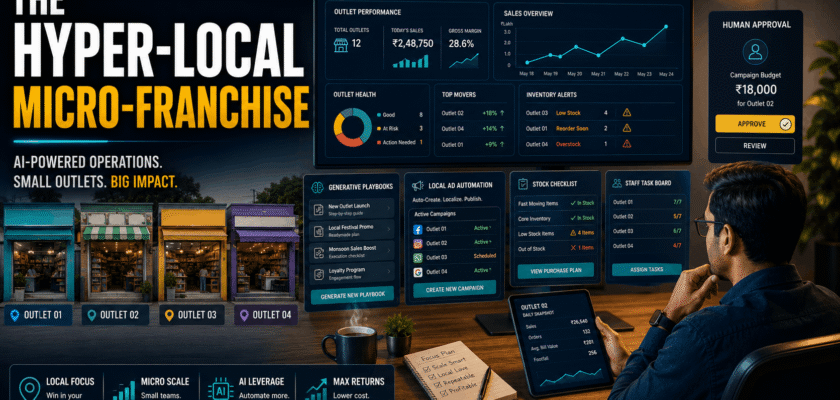
AI automated retail franchise models are changing small retail plans in 2026.
Now, one investor can run a sharper launch plan.
Still, speed needs control, not blind automation.
Why AI automated retail franchise models are rising
First, franchise growth is still strong.
The IFA expects more franchised units in 2026.
Also, many owners now want leaner operations.
So, AI tools fit the moment well.
They can guide ads, staffing, stock and local offers.
What a hyper-local micro-franchise means
A hyper-local micro-franchise is a small outlet system.
It focuses on one tight market area.
For example, it may serve one block or society.
Next, it uses one tested playbook.
Then, AI adjusts that playbook for local demand.
How generative playbooks speed up launch
Generative playbooks turn plans into ready tasks.
They can write a store checklist.
They can draft staff scripts.
They can build a local ad plan.
They can also suggest opening stock.
Therefore, the owner saves many planning hours.
The 48-hour retail setup map
Hour 1 to 6: pick the local angle
The owner studies footfall, rent and buyer habits.
Then, AI turns that data into a simple plan.
Hour 7 to 18: prepare the outlet kit
Next, the playbook creates shelves, offers and roles.
It also makes opening-day social posts.
Hour 19 to 36: test the sales loop
After that, the owner checks pricing and supply.
Small tests catch mistakes before launch.
Hour 37 to 48: open with human checks
Finally, the outlet opens with clear guardrails.
The owner reviews every key decision first.
Where automation helps the most
AI works best on repeat tasks.
- Local offer planning
- Basic stock ordering
- Daily sales summaries
- Staff task reminders
- Customer reply templates
However, it should not replace owner judgment.
Why solo investors like this model
Solo investors often lack a large team.
So, a guided system reduces daily confusion.
Also, it keeps each outlet more consistent.
This can help one person manage more locations.
Still, the model needs clean data and discipline.
Main risks to watch
Fast scaling can create hidden problems.
For example, bad data can create poor stock plans.
Also, weak training can hurt service quality.
In addition, copied prompts can expose business data.
Therefore, each system needs clear access rules.
Smart guardrails for franchise owners
A safe rollout starts with human approval.
Also, the owner should track every AI decision.
Next, each outlet should use the same rule book.
Finally, the business should review results weekly.
This keeps growth fast, but still practical.
Final take on AI automated retail franchise models
AI automated retail franchise models can help small investors move faster.
They make launch work easier and cheaper.
However, they do not remove business risk.
The winning model uses AI for speed.
But it keeps humans in charge of trust.


