
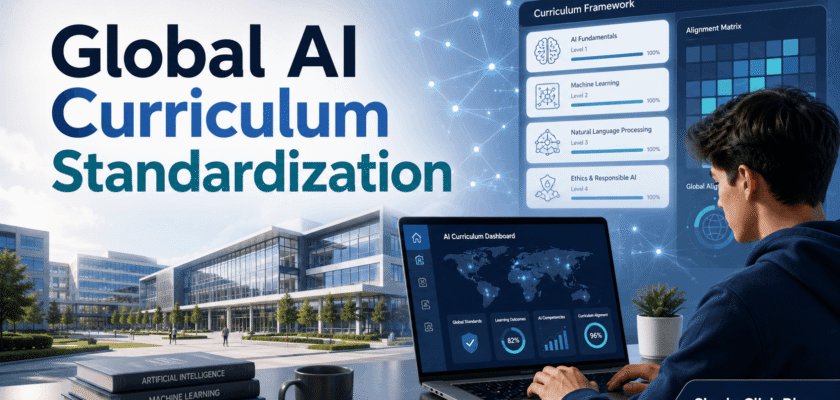
The best engineering curriculum specialized AI 2026 is no longer just about coding. It is about building useful, safe, and real-world AI systems.
Across global engineering schools, the degree map is changing fast. Students still need algorithms, math, and software basics. However, they also need model testing, data judgment, AI ethics, and product thinking.
This shift is not a single global rule. Instead, it is a shared direction. Top universities are moving toward common AI learning blocks. That is why the phrase global AI curriculum standardization now matters.
| ⚡ Quick Takeaway✓ AI is becoming a core engineering skill, not only an elective.✓ Universities are mixing theory with labs, projects, and ethics.✓ Students need proof of skill through portfolios and certifications. |
Why AI curriculum reform is accelerating in 2026
Companies now expect graduates to work with AI tools from day one. Yet they also want clear thinking, strong fundamentals, and responsible judgment.
That is the gap universities are trying to close. A student cannot only learn prompt writing. A student also needs probability, linear algebra, algorithms, data handling, evaluation, and security basics.
The latest CS2023 guidance from ACM, IEEE-CS, and AAAI gives a shared curriculum direction for undergraduate computer science and related fields. It focuses on knowledge and competencies students should gain before graduation.
So, the best engineering curriculum specialized AI 2026 is becoming a layered model. It starts with computing fundamentals. Then it adds machine learning. After that, it adds safe deployment, domain projects, and human impact.
What top universities are already signaling
MIT lists Artificial Intelligence and Decision Making as a Bachelor of Science path inside Electrical Engineering and Computer Science. Its structure includes programming, algorithms, linear algebra, probability, data-centric subjects, and machine learning areas.
Carnegie Mellon offers a B.S. in Artificial Intelligence. Its curriculum includes computer science, math, statistics, computational modeling, machine learning, and symbolic computation. It also includes ethics and social responsibility.
UC Berkeley Engineering is testing AI inside core engineering courses. One funded 2026 project integrates AI into Industrial Engineering and Operations Research classes, so students can use AI as a thinking partner inside real modeling work.
Imperial College London’s Computing with Artificial Intelligence and Machine Learning MEng shows another pattern. The course keeps computing fundamentals while adding AI, knowledge engineering, machine learning, applied computing, projects, and industrial placement experience.
These examples do not copy one identical syllabus. Still, they show a common blueprint. AI degrees are becoming deeper, more practical, and more cross-disciplinary.
| ✅ Common global AI degree blocks✓ Strong math: linear algebra, probability, statistics, and optimization.✓ Core CS: programming, algorithms, databases, systems, and networks.✓ AI layer: machine learning, deep learning, NLP, vision, and reasoning.✓ Responsible AI: ethics, bias, privacy, safety, and social impact.✓ Portfolio proof: labs, capstones, internships, and real deployment work. |
How standardization changes technical degrees
Earlier, many students studied AI as one optional subject. Now the structure is wider. AI touches software, electronics, robotics, healthcare, finance, manufacturing, and climate systems.
That means engineering departments cannot keep AI locked inside one semester. They need AI across several years of learning.
In year one, students can learn Python, data basics, and responsible tool use. In year two, they can add algorithms, probability, and machine learning. In year three, they can test models, build applications, and learn MLOps. In the final year, they can complete domain capstones with industry partners.
This is where industry ready computer science certifications become useful. A degree gives depth. A certificate can show current tool skill. Together, they give employers more confidence.
The new degree framework students should look for
A strong AI-focused engineering program in 2026 should not look like a random list of trendy subjects. It should follow a clear learning path.
1. Foundation first
• Programming
• Data structures
• Algorithms
• Discrete math
• Linear algebra
• Probability and statistics
2. AI core next
• Machine learning
• Deep learning
• Natural language processing
• Computer vision
• AI reasoning
• Model evaluation
3. Engineering practice
• Software engineering
• Cloud basics
• MLOps
• Testing
• Cybersecurity
• Data pipelines
4. Human and legal context
• AI ethics
• Data privacy
• Bias checks
• Explainability
• Responsible deployment
• Society impact
5. Proof through work
• Capstone projects
• Hackathons
• Internships
• Open-source work
• Research projects
• Case studies
| �� Student tip✓ Do not choose an AI program only because it has a trendy name.✓ Check the course map, labs, projects, internships, and faculty work.✓ A practical portfolio can matter as much as the degree title. |
Why certifications are becoming part of the AI degree story
AI tools change faster than university handbooks. This is why many students now combine degree learning with short certifications.
Certifications can cover cloud AI, data analytics, cybersecurity, prompt workflows, model monitoring, and responsible AI practices.
However, certificates cannot replace fundamentals. A student who only learns tools may struggle when tools change. A student with strong math and CS basics can adapt faster.
So the best engineering curriculum specialized AI 2026 model should blend both. It should teach deep basics and also allow flexible upskilling.
What this means for Indian engineering students
Indian students should read course structures carefully before choosing a college or specialization. A title like AI and ML is not enough.
They should check whether the program includes real coding labs, data projects, statistics, cloud deployment, and AI ethics. They should also check placement links and internship support.
For students in core branches like mechanical, civil, electrical, or manufacturing, AI can still be valuable. The better path may be domain plus AI. For example, mechanical plus predictive maintenance, civil plus smart infrastructure, or electrical plus edge AI.
This makes the future of tech education programs more flexible. The winning graduate may not be only a coder. The winning graduate may be an engineer who can use AI inside a real industry problem.
Simple checklist before joining an AI-focused course
✓ Does the course teach math and algorithms properly?
✓ Does it include machine learning and model evaluation?
✓ Does it include hands-on labs every year?
✓ Does it teach responsible AI and data privacy?
✓ Does it include capstone or industry projects?
✓ Does it allow useful certifications or electives?
✓ Does it help students build a public portfolio?
Final view: AI degree standardization is about trust
The global AI curriculum standardization trend is not about making every university identical. It is about building trust in what an AI graduate can actually do.
By 2026, strong programs will likely share a clear pattern. They will keep fundamentals strong. They will add AI systems. They will test students through projects. They will teach ethics. And they will connect learning to real industry needs.
That is the real value of the best engineering curriculum specialized AI 2026 movement. It makes AI education less noisy and more useful.


