
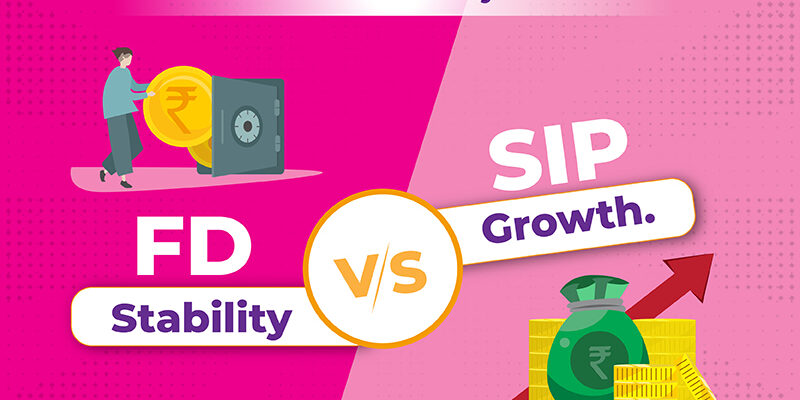
FD vs SIP: Which One Should You Choose in 2026?
If you have some extra savings, the first question that pops up is: “Should I put it in a safe FD or start a monthly SIP?” While Fixed Deposits (FD) have been a traditional favorite in Indian households, Systematic Investment Plans (SIP) in mutual funds are rapidly gaining ground due to their high growth potential.
In 2026, the choice depends entirely on your Risk Appetite and Investment Horizon. Let’s break down the facts.
1. Understanding the Core Difference
- Fixed Deposit (FD): You deposit a lump sum for a fixed period at a guaranteed interest rate. It’s like a “set it and forget it” safety box.
- Systematic Investment Plan (SIP): You invest a fixed amount regularly (monthly/quarterly) into mutual funds. It is a “market-linked” journey where your money grows with the economy.
2. Returns: Guaranteed vs. Potential
- FD Returns (2026): Currently, major banks are offering interest rates between 6.5% and 7.5%, with senior citizens getting up to 8.0%. These are guaranteed, meaning they won’t change even if the market crashes.
- SIP Returns (2026): SIPs in equity mutual funds historically deliver 12% to 15% over the long term (5+ years). However, these are not guaranteed and depend on market performance.
3. The Impact of Taxation
This is where SIPs often win for high-income earners.
- FD Taxation: The interest you earn is added to your total income and taxed according to your Income Tax Slab. If you are in the 30% bracket, your 7% FD effectively gives you only 4.9% after tax.
- SIP Taxation: For equity SIPs, if you hold for more than a year, gains up to ₹1.25 Lakh per year are tax-free. Gains above that are taxed at a flat 12.5% (LTCG). This makes SIPs far more tax-efficient.
4. Risk and Safety
- FD Safety: Your capital is highly secure. In India, deposits up to ₹5 Lakh are insured by the DICGC (an RBI subsidiary).
- SIP Risk: Since SIPs are linked to the stock market, your investment value can go down in the short term. However, over 5-10 years, the “Rupee Cost Averaging” usually smooths out the risk.
Quick Comparison: FD vs. SIP (2026)
| Feature | Fixed Deposit (FD) | SIP (Mutual Funds) |
| Returns | 6.5% – 7.5% (Fixed) | 12% – 15% (Estimated) |
| Risk Level | Extremely Low | Moderate to High |
| Flexibility | Rigid (Penalty on early exit) | High (Pause/Stop anytime) |
| Taxation | As per your tax slab | 12.5% on gains >₹1.25L |
| Ideal For | Short-term / Emergency fund | Long-term Wealth Creation |
5. Which One Is Better for You?
- Choose FD if: You need the money within 1 to 3 years, you are a retiree looking for stable income, or you absolutely cannot afford to lose a single rupee of your principal.
- Choose SIP if: You are planning for a goal 5+ years away (like a child’s education or your own retirement) and you want your money to beat inflation significantly.
Conclusion
In 2026, the smartest strategy is often Diversification. Don’t put all your eggs in one basket. Keep your emergency fund in an FD for instant access and safety, while starting an SIP for your long-term dreams. This way, you enjoy both peace of mind and the power of compounding.
Are you a “Safety First” investor or a “Growth Seeker”? Share your investment strategy for 2026 in the comments!


