

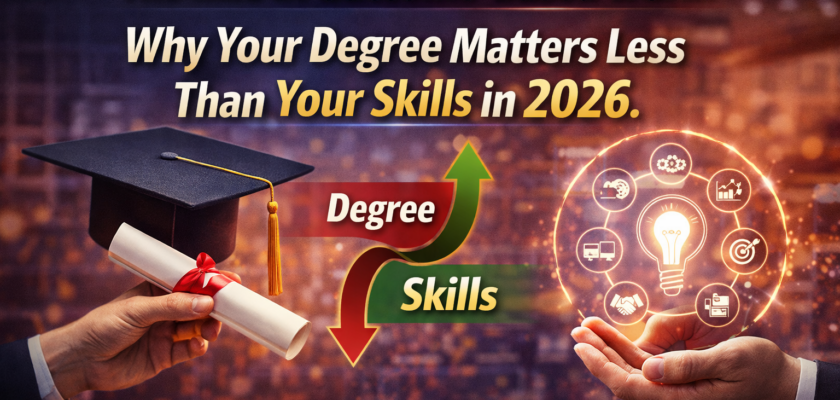
The Rise of Outcome-Based Work: Why Your Degree Matters Less Than Your Skills in 2026.
The defining workplace shift of March 2026 is not about remote work or the four-day week; it is about a fundamental change in how performance is defined, measured, and rewarded. The decade-long debate between academic credentials and functional capability is officially over. We have entered the era of Outcome-Based Work.
For decades, the standard entry ticket to the B2B workforce was a university degree. It served as a proxy for intelligence, discipline, and generalized capability. The hiring process was built around validating these proxies: checking credentials, analyzing GPAs, and interpreting slow, linear growth patterns in experience.
But this old system, which valued a static document over a dynamic ability to deliver results, is now collapsing. It is too slow, too indirect, and too disconnected from the immediate demands of an Agentic AI-driven economy.
In 2026, your degree is no longer your definitive asset. Your verified skills are. Here is why the credentials-first model is dying and how the Outcome-Based Work economy is being constructed.
The Collapse of the Degree-Based Maze: SLOWNESS & LIABILITY
The traditional hiring model is slow and error-prone. It typically creates a 30-45 day manual collection maze of paper trails, multi-departmental approvals, and back-and-forth communication. For companies, this wait is a significant operational liability:
- Delayed Execution: Critical projects are stalled while companies search for the “perfect” certified candidate.
- Mismatched Talent: A degree does not guarantee performance. The mismatch between credential and capability creates substantial compliant and operational risks.
- Uncertain Return: The old system often yields an UNCERTAIN RETURN (Slow Growth) on talent investment, especially in fast-evolving fields like cybersecurity or data science.
The Rise of the Outcome-Based Skills Economy: INSTANT & COMPLIANT
By March 2026, the system is being automated. We are moving from manual, localized recruitment to a Global Outcome Network where performance, not pedigree, is the primary currency. The new model delivers:
- Instant, Compliant Matches: Agentic AI matching systems can instantly scan a global talent pool. When a specific goal is defined—e.g., “Deploy a highly robust, compliant zero-trust network by June 15”—the AI identifies individuals with verified histories of delivering exactly that outcome.
- Minimized Risk: The new workflow is fully compliant. By prioritizing verified skill assets, companies minimize the risk of a high-stakes failure due to a credential-capability gap.
- Record-Breaking Efficiency: Instead of a 45-day wait, the match and contract are finalized within hours, leading to rapid project execution and efficient capital deployment.
Strategic B2B Matrix: Degree vs. Outcome-Based Work (2026)
| Metric | Traditional Model: Degrees | 2026 Model: Outcome-Based Work | Business Vibe |
| Philosophy | General Capability, Proxy | Verified Capability, Specific Delivery | Credentials vs. Proof |
| Data Source | Linear Growth (Abacus-Driven) | Decentralized Skill Assets (Global Network) | Static vs. Dynamic Data |
| Speed (Match to Hire) | Weeks to Months (30-45 Day Wait) | Instant to Hours (Agentic Precision) | Slow & Manual vs. Fast & Auto |
| Measurement | Output (Time Spent) | Outcome (Deliverable & Impact) | Time vs. Results |
| Liability & Risk | UNCERTAIN RETURN (Slow Growth), Liability | MINIMIZED SKILL RISK (Compliant, Stable) | Risk-Prone vs. Risk-Minimized |
| Primary Driver | Degrees, Linear Experience | Verified Skills, e-Skill ID | Credentials vs. Performance |
Conclusion
We are witnessing the definitive modernization of the human resource sector. The era where a paper degree, which can be easily faked or become irrelevant, provided lifelong security is gone. In 2026, companies demand autonomous precision and verified performance.
The rise of Outcome-Based Work is not just about adopting new AI tools; it is a fundamental shift in corporate trust. B2B leaders are moving away from trusting static credentials and instead betting on agentic ecosystems where verified individual skill assets (e-Skill ID) are tracked, analyzed, and deployed with zero-error precision. The old system is slow and manual; the new is fast and automated. The choice is clear: prioritize skills or face obsolescence.
How is your organization adapting to the skills economy? Is your hiring process still entangled in the 30-45 day manual degree maze, or have you integrated Agentic AI for outcome-based hiring? Share your workforce transformation journey in the comments below!


