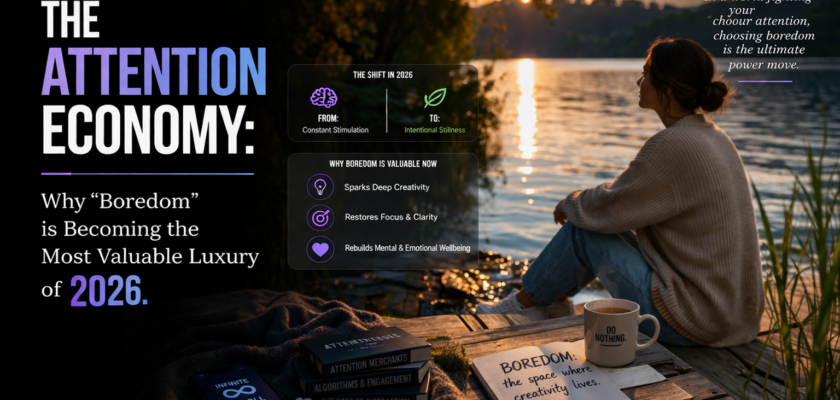
The Attention Economy: Why “Boredom” is Becoming the Most Valuable Luxury of 2026.
In the hyper-connected world of March 2026, we have reached “Peak Content.” With AI agents generating millions of videos, blogs, and social posts every second, the Attention Economy 2026 has become so crowded that “Information” is now free, but “Silence” is priceless.
This year, the most successful individuals aren’t those who consume the most; they are those who can afford to be bored. Boredom is no longer a state to be avoided—it is the ultimate luxury of the elite.
1. The Saturation of the Attention Economy 2026
For the past decade, tech giants fought for every second of your gaze. In Attention Economy 2026, that fight has been won by AI. Because Agentic AI can now create hyper-personalized, addictive content in real-time (as seen in the Dhurandhar movie marketing), our brains are constantly flooded with dopamine.
The result? Attention Bankruptcy. When everything is interesting, nothing is. This is the “Slowness & Liability” of the modern mind—we are moving too fast to actually think.
[Image showing a person overwhelmed by floating digital notifications vs. a person sitting in a quiet, minimalist garden]
2. Why “Boredom” is a Strategic Asset
In the Attention Economy 2026, boredom is the “Circadian Reset” (see our previous blog) for the brain. It is the only state where true Deep Creativity can occur. High-performers are now paying thousands of dollars for:
- Digital Fasting Retreats: Locations with zero connectivity where “Doing Nothing” is the scheduled activity.
- Analog Productivity: A return to paper journals and abacus-style thinking to escape the digital current.
- Monastic Focus Blocks: Using AI agents to “Ghost” their entire digital presence for weeks so they can focus on a single Outcome-Based goal.
3. Strategic Matrix: Noise vs. The Luxury of Silence
| Feature | The Masses (Noise) | The Elite (Luxury Boredom) |
| Consumption | Infinite / AI-Generated | Curated / Analog / Minimal |
| State of Mind | Fragmented / Hyper-Stimulated | Deep Focus / Reflective |
| Value Perception | Chasing “The Next Big Thing” | Value in “The Present Moment” |
| Work Style | Always-On / Busy-ness | Sprints / Long Periods of Rest |
| Risk | High Burnout / Attention Deficit | Minimized Risk of Mental Fatigue |
4. The “Boredom” Economy: New Business Models
As of 2026, a new sector is thriving by selling “Un-plugged” experiences.
- “No-AI” Zones: Premium cafes and workspaces where all digital devices are banned.
- Mindfulness AI: Ironically, we are using AI Tutors (as discussed before) to teach us how to disconnect and embrace boredom.
- Sovereign Time: A movement where employees are paid based on “Thinking Outcomes” rather than “Availability,” encouraging them to spend time away from screens.
Conclusion
The Attention Economy 2026 has taught us that while AI can give us all the answers, it cannot give us the space to ask the right questions. As we navigate this high-speed, automated era, the ability to sit quietly in a room and be “bored” is the ultimate sign of status.
Boredom is where the ₹16,700 Crore ideas are born. It is the “Ghost Agency” for your mind—clearing out the noise so the Architect can finally work. In 2026, don’t just chase the trend; chase the silence.


