


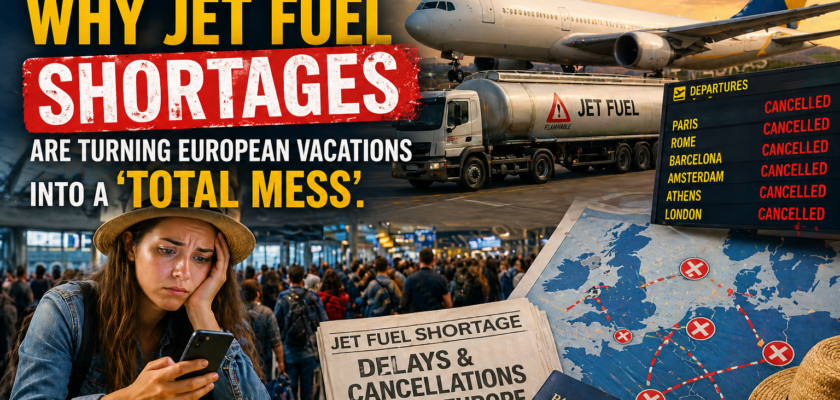
Summer Travel 2026: Why Jet Fuel Shortages are Turning European Vacations into a ‘Total Mess’.
As of April 25, 2026, the dream of a smooth Mediterranean getaway has hit a massive turbulence. The airline industry is currently grappling with what experts call the “largest energy crisis in history,” turning Summer Travel 2026 into a logistical nightmare. In just the last week, major carriers like Lufthansa and KLM have collectively axed over 20,000 flights, leaving millions of passengers stranded and vacations in jeopardy.
The “Abacus Maze” of global aviation fuel supply has collapsed under the weight of the ongoing Strait of Hormuz blockade, making Summer Travel 2026 a test of patience and pocketbooks.
1. The Six-Week Countdown: Why Europe is Running Dry
The primary driver behind the Summer Travel 2026 chaos is a critical physical shortage of aviation kerosene.
- The “Six-Week” Warning: On April 16, International Energy Agency (IEA) Director Fatih Birol issued a stark warning: Europe has “maybe six weeks” of jet fuel supplies left if oil doesn’t start flowing through the Strait of Hormuz immediately.
- Depleted Reserves: In major hubs like London Heathrow and Amsterdam Schiphol, fuel stocks have sunk to their lowest levels since 2020. Major importers are surviving on less than 20 days of cover, a record low for the Summer Travel 2026 season.
- The Hormuz Chokepoint: Since the strait accounts for roughly 40% of Europe’s jet fuel imports, its effective closure has created a deep structural imbalance that Agentic AI systems are currently struggling to optimize.
2. The Impact: Cancellations, Rationing, and Plan B
For the average tourist, Summer Travel 2026 is becoming a game of “Plan B and Plan C.”
- Lufthansa’s 20,000 Flight Cut: The German giant has already announced a reduction of 20,000 short-haul flights through October to save 40,000 metric tons of fuel.
- Rationing in June: Experts warn that by June, long-haul flights will be strictly rationed for fuel, while short-haul routes may be replaced by “motor it” or rail alternatives.
- The Price Spike: Jet fuel prices have doubled since late February, reaching multi-year highs of $120/barrel. This cost is being passed directly to you through skyrocketing surcharges and hidden baggage fees.
3. Strategic Matrix: 2025 vs. Summer Travel 2026
| Metric | Summer Travel 2025 (Normal) | Summer Travel 2026 (Crisis) |
| Fuel Availability | Abundant / High Inventory | Critical Shortage (Under 20 Days) |
| Average Airfare | Competitive / Stable | Record-High (Fuel Surcharges) |
| Flight Status | 98% On-Time / Reliable | Mass Cancellations (25,000+ Axe) |
| Risk Management | Minimal (Standard Insurance) | Minimized Risk (Plan B/C Required) |
| Primary Route | Direct / Efficient | Rationed / Multi-Stop Diversions |
4. How to Navigate the 2026 Aviation Crisis
If you are committed to your Summer Travel 2026 plans, you must shift your strategy from “Passive Booking” to Autonomous Precision.
- Check Your Insurance: Ensure your travel insurance explicitly covers “Fuel Supply Disruptions,” as standard “Mechanical Failure” clauses may not apply.
- Fly the “Big Boys”: Larger airlines with deeper pockets are better equipped to secure scarce fuel at high prices compared to budget carriers.
- Prepare for the “Quick Return”: Carry essential documents and medications on your person; experts advise being ready to return home with just a few days’ notice if your return leg is rationed.
Conclusion
Summer Travel 2026 is no longer about the destination; it’s about the availability of the kerosene needed to get there. The shift from the fast, automated global current to a world of rationing and fuel anxiety is a harsh reminder of our energy dependencies.
While the ₹16,700 Crore travel economy is resilient, the current jet fuel crunch is a “Total Mess” that requires every traveler to have a digital shield of flexibility. The old abacus maze is gone, but the new high-speed future is temporarily grounded. Stay informed, stay flexible, and always have a Plan B.


