


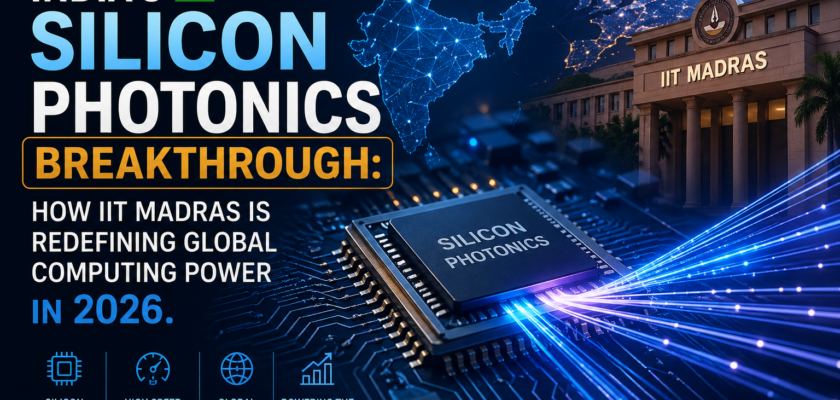
India’s Silicon Photonics Breakthrough: How IIT Madras is Redefining Global Computing Power in 2026.
As of April 25, 2026, India has officially entered the elite tier of global semiconductor innovation. In a landmark event yesterday at Chennai, the Ministry of Electronics and Information Technology (MeitY) launched two indigenously developed solutions that mark the IIT Madras Silicon Photonics 2026 breakthrough. By shifting from electrons to photons, this technology is set to solve the “Slowness & Liability” of traditional copper-based chips, offering a path to Autonomous Precision in high-performance computing.
The launch of the Silicon Photonics Process Design Kit (PDK) and the Universal PPIC Test Engine signals the dawn of India’s “Technology Sovereignty” in a field traditionally dominated by a handful of global players.
1. What is Silicon Photonics? (Light-Speed Computing)
To understand the IIT Madras Silicon Photonics 2026 impact, one must understand the bottleneck of modern electronics. Traditional chips use electrons to move data, which generates heat and limits speed. Silicon Photonics uses Photons (Light).
- Speed of Light Data: Information travels significantly faster through optical waveguides than through copper wires.
- Low Power Consumption: Photonic systems minimize heat generation, a critical factor for the Record-Breaking Heatwave 2026 challenges we face.
- CMOS Compatibility: The breakthrough at IIT Madras uses standard silicon manufacturing processes, making it ready for mass production in existing foundries.
2. The Two Pillars of the 2026 Breakthrough
The IIT Madras Silicon Photonics 2026 milestone is built on two core innovations developed at the Centre of Excellence (CoE-CPPICS):
A. The Silicon Photonics Process Design Kit (PDK)
This is a comprehensive library of over 50 verified components. It allows Indian startups, defense labs, and academic institutions to design advanced Photonic Integrated Circuits (PICs) without relying on expensive, foreign proprietary tools. It is the “Instruction Manual” that provides Minimized Risk for domestic chip designers.
B. Universal PPIC Test Engine
Testing photonic chips is notoriously difficult. The newly launched Universal Programmable Photonic Integrated Circuit (PPIC) Test Engine is an automated, state-of-the-art platform that characterizes these chips with Autonomous Precision. It ensures that every chip meets global performance benchmarks before it hits the market.
3. Strategic Matrix: Electronic vs. Photonic Computing (2026)
| Feature | Traditional Electronic Chips | IIT Madras Silicon Photonics 2026 |
| Data Carrier | Electrons | Photons (Light) |
| Transmission Speed | Limited by Resistance/Heat | Near Light-Speed |
| Energy Efficiency | High Heat / High Power | Low Heat / Ultra-Efficient |
| Sovereignty | Import-Dependent | Indigenous (Self-Reliant) |
| Applications | General Computing | AI Data Centers / Quantum / 6G |
| Global Status | Standard | Global State-of-the-Art |
4. Impact on the ₹16,700 Crore AI Economy
The IIT Madras Silicon Photonics 2026 breakthrough is the missing piece of India’s ₹16,700 Crore AI current. Large-scale AI models (like the Mythos AI we discussed) require massive data bandwidth.
- AI Data Centers: Photonic chips can reduce the energy consumption of data centers by up to 40%.
- Quantum Readiness: These circuits are essential for the “Quantum Regime,” where light is used to carry quantum bits (qubits).
- Defense Sovereignty: Secure, indigenous communication systems for the Indian defense sector are now a reality, removing the UNCERTAIN RETURN of foreign-sourced chips.
Conclusion
The IIT Madras Silicon Photonics 2026 breakthrough is India’s answer to the global semiconductor race. By moving from the old “Abacus Maze” of electronic limitations to a streamlined, digital Photonic current, India is redefining what it means to be a global computing power.
As Secretary MeitY S. Krishnan noted, India is now matching the global state-of-the-art. The next step? Establishing a dedicated Silicon Photonics Fab under the India Semiconductor Mission (ISM) to turn these designs into the hardware that will power the world. The future of computing is bright—and it’s moving at the speed of light from Chennai.


