


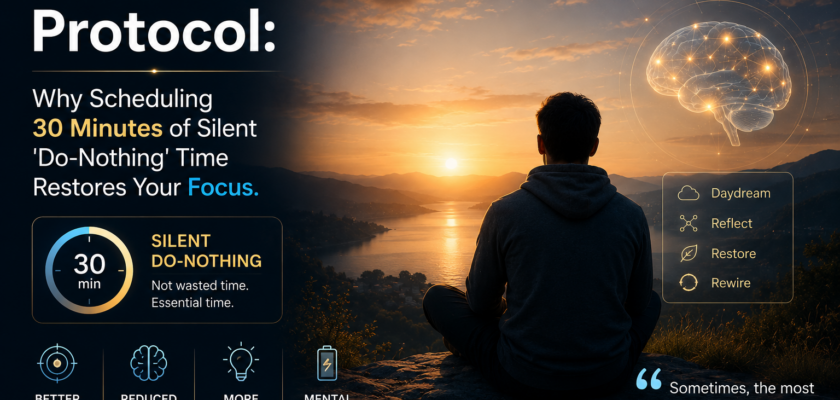
The DMN Protocol: Why Scheduling 30 Minutes of Silent ‘Do-Nothing’ Time Restores Your Focus.
We are living in an era of absolute Attention Bankruptcy. In 2026, our brains are continuously targeted by a hyper-optimized digital current—from standalone instant messaging apps to AI-driven, continuous feedback loops. We push our minds into a perpetual state of “Active Focus,” believing that constant processing equals maximum productivity.
But the human brain isn’t built to run like a machine with a 98% continuous uptime. When you force uninterrupted task execution, your cognitive efficiency suffers from a deep “slowness and liability.” The solution isn’t another productivity app or a new time-blocking template. It is a biological reset mechanism known as the DMN Protocol Focus 2026.
By deliberately scheduling 30 minutes of absolute, silent “Do-Nothing” time every single day, you don’t turn your brain off. Instead, you activate a powerhouse neural network that restores deep focus, solves complex creative bottlenecks, and protects your mental capital.
1. What is the Default Mode Network (DMN)?
To execute the DMN Protocol Focus 2026, we must first look at the underlying neuroscience. For decades, cognitive scientists believed that the brain was only working when engaged in a specific task. However, neuroimaging studies debunked this by identifying a massive web of interconnected brain regions that ignite only when a person is daydreaming, idling, or completely unengaged from the external world. This is the Default Mode Network (DMN).
The brain operates on a toggle switch between two opposing systems:
- The Task-Positive Network (TPN): Activates when you are actively typing, processing data, or solving a visible problem. It is highly analytical, short-sighted, and consumes massive metabolic energy.
- The Default Mode Network (DMN): Activates when you drop external tasks. It is the brain’s internal processing engine, responsible for autobiographical memory, deep synthesis, and high-level creative connections.
When you continuously force the TPN to run without giving the DMN its turn, your brain loses its structural agility. You experience brain fog, decision fatigue, and an inability to maintain deep focus.
2. The Protocol: How to Correctly “Do Nothing”
The DMN Protocol Focus 2026 is not about taking a casual scroll through social media or listening to an engaging podcast. Those activities keep your TPN firing because they require external information processing. True DMN activation demands a strict, low-friction framework.
The 3 Core Rules of the Protocol:
- Zero Input: No screens, no books, no music, and no active conversations. You must eliminate external stimuli to cut off the information current.
- Zero Output: Do not try to solve a specific problem, write notes, or organize your day. It is a space of zero structural goals.
- Passive Observation: Sit in a comfortable chair, look out a window, or take a slow walk without a destination. Let your thoughts drift without trying to control or anchor them.
3. Strategic Matrix: Task-Positive Network vs. The DMN Protocol
| Cognitive Dimension | Task-Positive Network (Active Work) | DMN Protocol Focus 2026 (Idle Reset) |
| Primary Trigger | External deadlines, typing, analyzing | Deliberate goal-free silence & daydreaming |
| Mental State | Highly focused, rigid, short-sighted | Expansive, associative, deeply creative |
| Energy Consumption | Rapid metabolic drain (High fatigue) | Consolidation phase (Restores active focus) |
| Problem Solving | Linear, trial-and-error mechanics | Sudden “Aha!” moments & intuitive synthesis |
| Risk Factor | Attention bankruptcy and burnout | Minimized Risk (Emotional & cognitive balance) |
4. Why Doing Nothing Generates Unfair Advantages
Implementing the DMN Protocol Focus 2026 delivers three distinct operational upgrades to your daily workflow:
A. The “Circadian Reset” for Attention
Just as a high-performance computer requires temporary cooling cycles to avoid thermal throttling during intense processing, your prefrontal cortex needs periods of low cognitive load. A 30-minute DMN break flushes out metabolic waste, acting as a functional reset that restores your ability to execute subsequent complex tasks with absolute precision.
B. Incubation and Memory Consolidation
The brain does not store new skills or process complex project parameters while you are actively working. It does so during rest. When you step back into the DMN, your brain automatically begins sorting through fragmented information, building strong neural pathways, and turning raw data into an organized asset library.
C. Overcoming the Creative Block
Have you ever noticed that your best ideas never happen while you are staring blankly at an empty Google Doc, but rather when you are standing in the shower or walking to a car? That is the DMN at work. By disconnecting your linear focus, you allow different regions of the brain to share data freely, yielding unique solutions that standard analytical thinking could never calculate.
Conclusion
In our modern, high-speed ecosystem, scheduling time to do absolutely nothing feels counterintuitive. It triggers a profound fear of missing out or falling behind. But cognitive science proves that constant hyper-focus is a losing strategy that leads straight to burnout.
The DMN Protocol Focus 2026 shifts your perspective: silence is no longer an empty void; it is a premium resource. By stepping away from the chaotic abacus maze of constant notifications, you give your mind the breathing room it needs to rebuild its focus. To achieve true mastery in an overstimulated world, your most powerful performance hack is learning how to sit quietly in a room and clear the field for your brain’s default genius to take over.


