


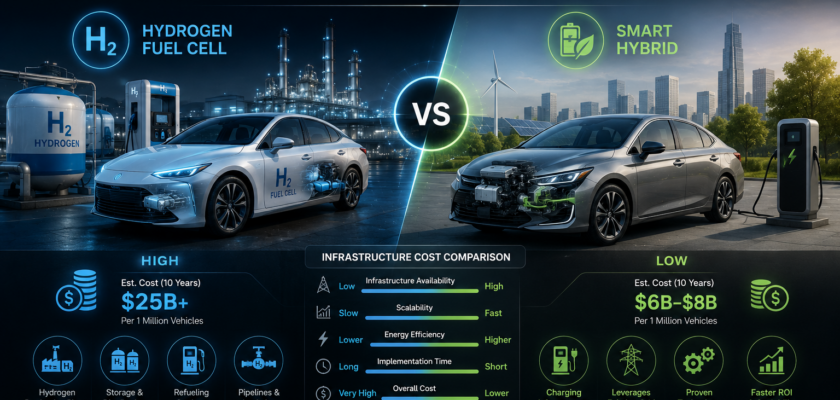
Hydrogen Fuel Cell vs. Smart Hybrid: The Real Infrastructure Cost for Next-Gen Vehicles.
The final week of May 2026 is witnessing the most decisive turning point in India’s alternative mobility strategy. For years, policymakers have engaged in a fierce technical debate over the long-term successor to traditional internal combustion engines. Today, the choice isn’t just about the technology under the hood; it is about the monumental architecture required to keep those wheels turning.
The debate of Hydrogen Fuel Cell vs. Smart Hybrid 2026 has moved beyond theoretical efficiency and entered the territory of hard economic infrastructure. As the global economy navigates the persistent Strait of Hormuz energy blockade, the cost of energy security—and how it is delivered to the vehicle—is the only metric that matters.
While Hydrogen Fuel Cell (HFC) technology offers the alluring promise of zero emissions and fast refueling, the cost of establishing a nationwide H2 ecosystem is staggering. The modern Smart Hybrid system, in contrast, leverages a sophisticated convergence of an optimized engine and highly efficient battery systems to operate on a low-friction, high-utility current.
1. The Hydrogen Pipeline Dream: A Capital Nightmare
In 2026, the biggest “Operational Liability” for Hydrogen vehicles is not the car itself, but the pump. Building a national hydrogen refueling infrastructure is a monumental undertaking with no established shortcut.
- Refueling Station Economics: As discussed in our Fuel Crisis Survival analysis, a single, high-capacity 700-bar Hydrogen fueling station in May 2026 costs an estimated ₹12 Crore ($1.4 Million). Compare this to the ₹60 Lakh needed to upgrade an existing petrol pump or install a fast EV charger.
- Storage and Logistics: Hydrogen (H2) must be stored under extreme pressure. Compressing, transporting, and maintaining the temperature of massive H2 tanks across the Rajasthan desert heat is an inefficient, energy-intensive process with an Uncertain Return.
- The Scale Block: To make HFC vehicles viable, India would need thousands of these ultra-expensive stations. Current projections suggest that even with optimized government funding, achieving 10% coverage for key National Highways would take until at least 2038. This is a classic “Abacus Maze” problem of scaling high-capital current.
2. The Smart Hybrid: Leveraging the Low-Friction Grid
The Smart Hybrid strategy is a “Outcome-Based” solution that relies on Autonomous Precision rather than high-capital buildouts. In 2026, we are not talking about basic mild hybrids; we are seeing advanced Strong Hybrid Electric Vehicles (SHEVs) that act as an un-bottlenecked digital current.
- Low Infrastructure Friction: The most critical advantage of a Smart Hybrid is Zero New Public Infrastructure. It operates on the existing petrol station network for refueling and the national 220V power grid for home charging (if it’s a Plug-in Hybrid, or PHEV).
- The “Wait Time” Solution: For city commuters in Jaipur or Jodhpur, a Smart Hybrid offers the fastest operational workflow. It relies on the optimized engine for most driving but instantly toggles to Agentic AI-driven electric power during slow, stop-and-go traffic, resulting in real-world fuel economy exceeding 28 kmpl. This effectively acts as a Minimized Risk shield against record petrol prices.
- Energy Security: The ongoing Strait of Hormuz energy crisis has highlighted the weakness of relying on a singular import. A Smart Hybrid provides security: it can optimize fuel usage today, and with PHEVs, it has the capacity to rely heavily on the domestic electric current tomorrow, effectively hedging against geopolitical shocks.
3. Strategic Matrix: Hydrogen HFC vs. Smart Hybrid Infrastructure
| Feature | Hydrogen Fuel Cell (HFC) Ecosystem | Smart Hybrid Ecosystem (2026 SHEV/PHEV) |
| New Refueling Network | Mandatory & High-Risk (Est. ₹12 Crore/Station) | Zero (Uses existing petrol network) |
| Energy Grid Reliability | Independent (Requires dedicated renewables/Fabs) | Dependent (Optimizes domestic electric current) |
| Storage Technology | High-Pressure (700 bar) cryogenic required | Low-Friction (Standard gasoline tank + battery) |
| Scaling Timeline | Decadal (Needs massive capital current to viable) | Instantaneous (Grid-ready today) |
| Operational Workflow | High-CapEx / Decadal Wait Time | Zero-CapEx / Autonomous Precision Today |
Conclusion
The Hydrogen Fuel Cell vs. Smart Hybrid 2026 debate is a classic battle between an innovative product and a necessary system. As we track the current global market bloodbath, the “SLOWNESS & LIABILITY” of Hydrogen’s decadal scaling timeline is a risk that few developing economies can afford. Smart Hybrids, with their Autonomous Precision and frictionless integration into our existing environment, are the undeniable Record-Breaking operational success of 2026. By utilizing the low-capital current already at our feet, Smart Hybrids don’t just reduce emissions; they ensure we keep moving through the crises of today while establishing a stable bridge for the electric future.


