


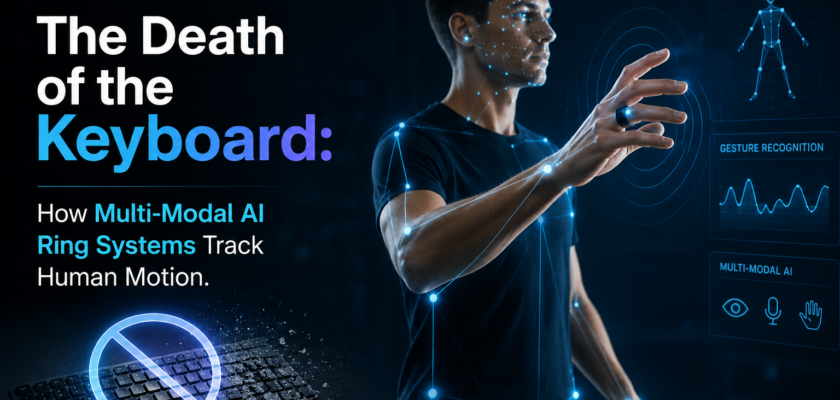
The Death of the Keyboard: How Multi-Modal AI Ring Systems Track Human Motion.
For over a century, the QWERTY keyboard has been the undisputed gatekeeper between human thought and digital execution. But as we move deeper into 2026, a silent hardware revolution is taking place on our fingertips. The rapid rise of wearable form factors—evidenced by the fierce market battle between devices like the Apple Neural Ring and the Apple Watch Series 11—signals a massive shift in how we interact with machines.
We are entering the era of Multi-Modal AI Ring Systems. These tiny, screen-free devices bypass physical buttons entirely, using sophisticated spatial computing to turn natural human hand movements into precise digital commands. Here is an in-depth breakdown of the physics, sensors, and machine learning models that make “typing on thin air” a reality today.
1. The Core Sensor Stack: Capturing the Micro-Movements
To eliminate input lag and achieve Autonomous Precision, a smart ring cannot rely on basic step-counting hardware. Packing a comprehensive, multi-modal sensor stack into a chassis weighing less than 5 grams requires microscopic engineering.
The magic relies on three primary hardware layers working in absolute sync:
- The High-Hz IMU (Inertial Measurement Unit): The backbone of gesture tracking is a custom 6-axis or 9-axis IMU combining an ultra-low-power accelerometer and gyroscope. Operating at refresh rates upwards of 500Hz, this sensor captures the slightest velocity changes, tilt angles, and spatial acceleration of the finger.
- PPG Optical Array (Photoplethysmography): While primarily used for tracking heart rate and sleep metrics, advanced rings utilize high-frequency PPG sensors to detect micro-vibrations in blood flow and tissue density that occur right as your tendons flex to make a gesture.
- Skin-to-Skin Bio-Impedance Sensors: By running a microscopic, undetectable electrical current across the surface of the ring, the system measures subtle shifts in skin contact and moisture. This acts as a secondary verification layer to confirm whether your fingers are touching each other or clicking against a hard surface.
2. The AI Translation Engine: From Raw Data to Intent
Raw sensor data is incredibly noisy; a shaky hand or a casual wave could easily be misinterpreted as a command. This is where local Agentic AI models running on localized, ultra-efficient edge processors come into play.
A. Spatial Mapping Models
The ring maps your hand in a continuous 3D coordinate system. When you move your finger, the AI filters out “environmental noise” (like walking or drinking water) and focuses strictly on the relative intentional path of the digit.
B. Gesture Kinematics
Instead of matching your movement against a rigid library of pre-set templates—an outdated approach that limits flexibility—the device utilizes Predictive Models trained on millions of human hand mechanics. The AI understands the context of your movement: a quick downward snap becomes a “click,” a horizontal swipe in mid-air scrolls a webpage, and typing on a blank desk translates instantly into text.
3. Strategic Matrix: Traditional Keyboards vs. Multi-Modal AI Rings
| Feature | The Mechanical Keyboard (QWERTY) | Multi-Modal AI Ring Systems (2026) |
| Physical Footprint | Large, rigid desktop space required | Invisible, 5-gram wearable footprint |
| Input Philosophy | Active, tactile, high-friction typing | Passive, gesture-based spatial computing |
| Ergonomic Strain | High risk of carpal tunnel syndrome | Minimized Risk (Natural hand ergonomics) |
| Context Awareness | Zero (Only registers direct key presses) | High (Tracks speed, force, and air position) |
| Ecosystem Role | Tethered to a single PC or laptop hub | Universal Controller (Phone, VR, Smart Home) |
4. Overcoming the Hardware Bottlenecks
The transition to Multi-Modal AI Ring Systems hasn’t been without its challenges. Engineering teams have had to solve deep technical hurdles to replace the reliability of a physical keyboard:
- The “Wait Time” Problem: Early spatial rings suffered from noticeable latency between a hand movement and the action on screen. In 2026, low-latency Bluetooth Low Energy (BLE 5.4) coupled with on-chip neural processing has dropped input response times to under 5 milliseconds.
- Haptic Feedback Loop: The biggest downside of typing on thin air is the lack of tactile confirmation. Modern smart rings solve this by embedding micro-linear resonant actuators (LRAs). When your finger triggers an action in mid-air, the ring emits a precise, directional haptic pulse that feels exactly like pressing a physical switch.
- Power Management: Running AI models on a tiny battery can result in an absolute power drain. System architects utilize an “On-Demand Wake” framework: the intensive tracking architecture remains in a low-power state until bio-impedance sensors confirm the hand has entered a designated “workspace position.”
Conclusion
We are witnessing the final chapter of purely mechanical inputs. The emergence of Multi-Modal AI Ring Systems proves that our digital interfaces are evolving to match human anatomy, rather than forcing humans to adapt to plastic hardware layouts.
While heavy text production and programming will likely keep mechanical keyboards alive in professional spaces for a few more years, the general day-to-day navigation of our digital ecosystems is moving to the finger. By trading the heavy clutter of cords and keycaps for the Autonomous Precision of a titanium band, we are finally stepping into a computing era that operates at the fluid speed of human thought. The keyboard isn’t just dying; it’s evaporating into thin air.


