
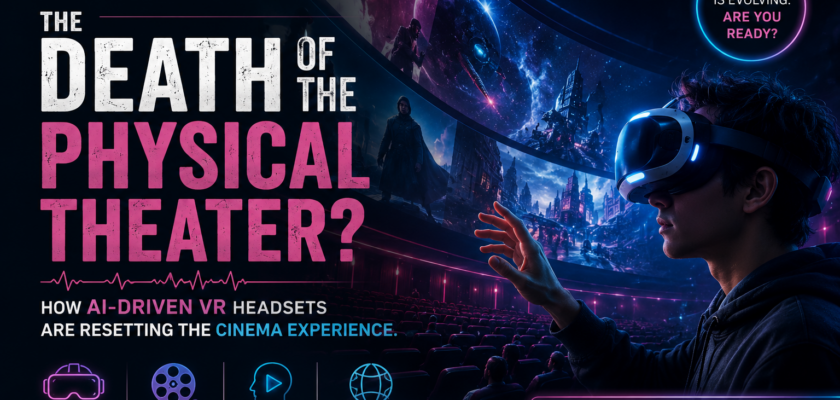
The Death of the Physical Theater? How AI-Driven VR Headsets Are Resetting the Cinema Experience.
For over a century, the physical movie theater has been the uncontested sanctuary of storytelling. The formula was unshakeable: bundle audiences into a darkened room, project a fixed two-dimensional story onto a massive silver screen, and rely on collective acoustics to generate emotional scale. If you wanted a premium, blockbuster experience, you had to leave your house, purchase a ticket, and adapt to a rigid commercial layout.
But as we advance through May 2026, that traditional theatrical paradigm is facing a historic survival crisis.
We are living in the defining era of AI Driven VR Headsets Cinema 2026 trends. Bolstered by a powerful wave of spatial computing hardware—from the highly accessible Meta Quest 3 and 3S to Apple’s high-fidelity M5 Vision Pro—the traditional screen is no longer a boundaries-locked wall; it has transformed into an immersive gateway.
By merging high-resolution displays with real-time Agentic AI engines, wearable spatial setups are decoupling premium cinema from physical buildings. Here is how personalized, adaptive, and virtual architectures are completely resetting how humanity experiences film.
1. The Digital Multiplex: Simulating Perfect Cinematic Physicality
The primary argument for the preservation of physical theaters has always been scale. A standard home television or smartphone panel simply cannot replicate the deep optical awe of an IMAX layout.
Modern AI Driven VR Headsets Cinema 2026 models completely dissolve this hardware deficit through Autonomous Precision in spatial rendering.
                [ The Traditional Cinema Blueprint ]
    (Fixed 2D Screens, Rigid Scheduling, High Ticket Overhead)
                                │
                                ▼
               [ The 2026 Immersive Media Reset ]
    (Infinite Virtual Geometry, Real-Time Pacing, AI Environments)
                                │
         ┌──────────────────────┴──────────────────────┐
         ▼                                             ▼
┌───────────────────────────────┐             ┌───────────────────────────────┐
│   The Physical Multiplex     │             │  The Spatial AI Theater Hub   │
│ ❌ Sticky Floors & Crowds     │             │ ✅ Micro-OLED Simulated IMAX  │
│ ❌ High Distribution Tariffs   │             │ ✅ Real-Time Sound Modeling   │
│ ❌ Static Linear Formats      │             │ ✅ Immersive 360° Volumetrics │
└───────────────────────────────┘             └───────────────────────────────┘
- Micro-OLED Spatial Scale: Utilizing advanced Micro-OLED and pancake optics, modern headsets project massive virtual viewing environments that fool the human eye into perceiving a 100-foot-wide floating theater screen with infinite contrast ratios and deep black levels.
- Real-Time Sound Modeling: Spatial audio algorithms continuously track your precise head orientation. If an explosion occurs on the left side of a film’s composition, the audio engine alters the sound wave’s entry into your ears to match the acoustics of a premium commercial soundstage.
- Eliminating Public Friction: The virtual cinema experience provides an unmatched level of personal comfort. It strips away the long queues, sticky floors, noisy crowds, and rising ticket surcharges of physical complexes, delivering a flawless, high-definition presentation on demand.
2. Interactive Storytelling: The Transition from Watching to Living
The most radical disruption triggered by AI Driven VR Headsets Cinema 2026 platforms isn’t just where we watch movies, but how those movies are constructed. Traditional film is a passive medium; you sit back and watch a predetermined sequence of edited frames.
In 2026, real-time gaming engines like Unreal Engine 5 are fusing with generative AI to birth Immersive Interactive Storytelling.
A. Volumetric Media Exploration
Rather than confining a story to a fixed camera angle selected by a director, modern cinematic files utilize volumetric capture. For example, during select independent pilots showcased at the Cannes Film Festival 2026, viewers could actively step off the default narrative line. If a tense dialogue is happening in a room, you can physically walk around the virtual space, analyzing characters’ micro-expressions from any perspective you choose.
B. AI-Adaptive Environments
Behind the scenes, adaptive AI models are shifting characters from static scripts into dynamic entities. Non-player characters (NPCs) and background elements within virtual environments actively adjust their behaviors, voice responses, and emotional tones based on your spatial positioning and head tracking focus. The narrative stops behaving like a rigid tape track and begins acting like a fluid, living digital ecosystem that adapts natively to your behavior.
3. Strategic Matrix: Brick-and-Mortar Cinema vs. AI Spatial Video
| Experience Parameter | Brick-and-Mortar Commercial Theaters | AI Standalone VR Cinema Ecosystems (2026) |
| Display Geometry | Rigid, physical screen dimensions (IMAX/2D) | Infinite, customizable spatial theater layouts |
| Acoustic Environment | Centralized speaker arrays; fixed seat sweet-spots | Dynamic, real-time spatial head-tracked audio |
| Narrative Framework | Strictly linear; fixed director camera paths | Polycentric, volumetric, user-directed exploration |
| Distribution Model | High overhead; slow regional release delays | Instantaneous cloud rendering & standalone streaming |
| Risk Characterization | Attrition due to declining ticket sales & high bills | Minimized Risk; low infrastructure operating costs |
4. Overcoming the Adoption Obstacles of Immersive Video
While the technical advantages of AI Driven VR Headsets Cinema 2026 frameworks are undeniable, system architects and film executives openly acknowledge that completely replacing the physical theater experience introduces tough real-world challenges.
The primary obstacle is the threat of Social Isolation. Traditional moviegoing is fundamentally built around shared human emotion—laughing together in a packed comedy screening or gasping as a collective crowd during a horror climax. Stripping that communal connection away in favor of isolated solo viewing can feel cold, mechanical, and lonely.
To completely solve this systemic operational liability, spatial platform developers are engineering Social VR Multiplexes.
By utilizing cloud-rendered environments and high-fidelity, expressive digital avatars, viewers can invite friends and family from across the globe into a shared virtual auditorium. You see your friend sitting in the virtual seat beside you, track their real-time facial expressions via your headset’s inward-facing cameras, and share real-time spatial conversations without breaking the illusion of a grand night out. This hybrid structure turns virtual viewing from an isolated activity into a highly connected, boundary-free community asset.
Conclusion
The physical theater isn’t necessarily facing an immediate, total extinction, but it has lost its monopoly on premium immersion. The widespread expansion of AI Driven VR Headsets Cinema 2026 ecosystems proves that spatial computing is moving past tech-demo novelties to become the core architecture of future entertainment.
By trading the rigid, high-friction abacus maze of physical commercial complexes for the un-bottlenecked freedom of micro-OLED virtual dimensions, creators and audiences are co-authoring an exciting media landscape. We are shedding the limitations of the plastic screen frame. As technology continues to grow lighter, smarter, and more socially fluid, the future of film will no longer be defined by the theater buildings we walk into—but by the magnificent, boundless stories we step directly inside.


