


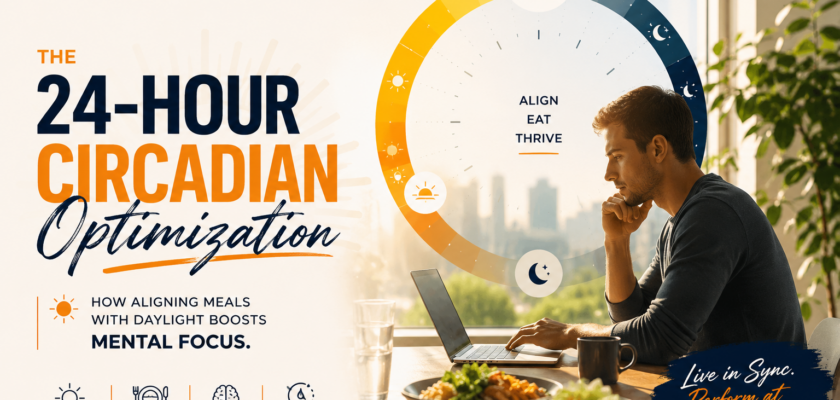
The 24-Hour Circadian Optimization: How Aligning Meals with Daylight Boosts Mental Focus.
In our hyper-connected, always-on work culture, we treat our minds like continuous software engines. When an evening energy crash hits or focus begins to splinter during a complex task, our default response is to lean on external stimulation—reaching for another cup of high-caffeine espresso, popping a sugary snack, or installing another micro-time-blocking productivity application. We try to force our biology to conform to unnatural, 24/7 digital timelines.
But cognitive science and chronobiology prove that true mental stamina cannot be sustained through constant stimulation. When you eat and work out of sync with your internal biological clock, your brain suffers from a compounding state of slow execution and brain fog.
The ultimate operational reset isn’t a new biohack. It is a biological alignment strategy known as Circadian Optimization Focus 2026.
By deliberately aligning your meal windows with natural daylight, you unlock a powerful metabolic lever that stabilizes your blood sugar, optimizes your hormones, and flushes out cognitive fatigue. Here is the data-driven framework to structure your eating habits for absolute, uncompromised mental clarity.
1. The Science of Peripheral Clocks: Beyond the Brain
To successfully execute a Circadian Optimization Focus 2026 routine, we must look at the underlying cellular biology. For decades, it was assumed that our sleep-wake cycle was governed entirely by a single master clock in the brain—the Suprachiasmatic Nucleus (SCN), which responds directly to light entering our eyes.
However, modern chronobiology has revealed a much more complex internal landscape: peripheral circadian clocks exist inside virtually every organ in your body, particularly your liver, pancreas, and gut.
                    ┌──────────────────────────────────────┐
                    │      Daylight Enters the Eyes        │
                    │   Signals the Brain's Master Clock   │
                    └──────────────────┬───────────────────┘
                                       │
                                       ▼
                    ┌──────────────────────────────────────┐
                    │    Daylight-Aligned Meal Ingestion   │
                    │   Activates Organ Peripheral Clocks  │
                    └──────────────────┬───────────────────┘
                                       │
                                       ▼
                    ┌──────────────────────────────────────┐
                    │  Perfect Metabolic-Neural Alignment  │
                    │   • Stable Blood Sugar & Dopamine    │
                    │   • Max Peak Cognitive Processing    │
                    └──────────────────────────────────────┘
While the master clock in your brain is synchronized by light, the peripheral clocks in your digestive organs are synchronized by food intake.
When you consume a heavy meal late at night under artificial blue light, you create a profound state of circadian desynchronization. Your brain thinks it is night, but your liver and pancreas are forced into active daylight mode to process the incoming nutrient load. This internal conflict disrupts your sleep architecture, spikes your morning cortisol, and guarantees a severe focus deficit the next day.
2. The Daylight Eating Protocol: Structuring the Windows
The Circadian Optimization Focus 2026 framework solves this internal friction by enforcing a strict rule: restrict your metabolic workload to the hours when the sun is actively shining. This allows your digestive systems to rest and repair during darkness, freeing up massive metabolic energy for your brain to utilize during your deep work blocks.
The 3 Core Rules of the Protocol:
- The 1-Hour Morning Buffer: Do not eat the moment you wake up. Wait at least 60 minutes to allow your natural morning cortisol spike to clear your system and wake your brain up natively without food-induced insulin interference.
- The High-Noon Capital Peak: Consume your largest, most nutrient-dense meal when the sun is at its highest point (between 12:00 PM and 2:00 PM). This is when your insulin sensitivity is at its peak and your digestive tract is highly efficient, transforming food into immediate cognitive fuel rather than sluggish fat storage.
- The Sunset Hard Stop: Finish your final meal of the day at least 3 to 4 hours before your head hits the pillow, ideally by sunset. Once darkness falls, your body naturally downregulates insulin production and prepares to secrete melatonin, meaning late-night snacks drastically disrupt your brain’s overnight clearing cycles.
3. Strategic Matrix: Chrono-Eating vs. Disrupted Metabolism
| Cognitive & Metabolic Vector | Daylight-Aligned Chrono-Eating | Disrupted Late-Night Eating |
| Blood Sugar Stability | Minimal fluctuations; sustained, linear energy | Sharp spikes & crashes; afternoon brain fog |
| Brain Glymphatic Clearance | Highly efficient; deep detoxification at night | Suppressed; waking up with cognitive fog |
| Dopamine & Focus Output | High baseline focus during daylight hours | Scattered attention; high reliance on caffeine |
| Sleep Architecture | Maximized deep and REM sleep cycles | Fragmented sleep; high nighttime heart rate |
| Systemic Risk Factor | Minimized risk of long-term metabolic burnout | High risk of insulin resistance and fatigue |
4. Driving Executive Yield: The Cognitive Upgrades
Implementing a Circadian Optimization Focus 2026 blueprint delivers three immediate, unfair advantages to your professional workflow:
A. Eradication of the Afternoon Slump
The notorious 3:00 PM energy crash isn’t an inevitable part of the workday; it is an artifact of poor insulin management. By eating a daylight-aligned lunch rich in clean proteins and complex fats, you maintain a completely flat glucose line. Your brain avoids the chaotic neuro-chemical dips that trigger brain fog, allowing you to breeze through late-afternoon tasks with absolute precision.
B. Amplified Nighttime Brain Clearing
While you sleep, your brain activates the glymphatic system—a literal waste-clearance mechanism that flushes out metabolic debris accumulated during the day. If your body is busy digesting a late-night heavy meal, it channels resources away from this vital process. By going to bed with an empty stomach, you optimize your glymphatic flow, ensuring you wake up with a completely clear mental windshield.
C. Natural Dopamine Reset
Your neurotransmitters operate on strict biological rhythms. When your food intake matches natural light cycles, your brain optimizes its dopamine receptor sensitivity. This results in cleaner, sustained internal motivation during the morning, helping you dive into deep, creative problem-solving blocks without constantly searching for quick digital distractions or artificial stimulants.
Conclusion
In our modern world of endless distractions, your biological clock is your most valuable performance asset. High-level focus isn’t about working yourself into exhaustion; it is about respecting the rhythms that have governed human physiology for thousands of years.
The Circadian Optimization Focus 2026 paradigm requires a fundamental shift in perspective: food is not just raw calories; it is a vital data signal that tells your body exactly what time it is. By stepping out of the chaotic, artificial maze of late-night eating and returning to a daylight-driven fuel model, you give your body the clarity it needs to excel. If you want to achieve true mastery over your attention span, stop looking for answers in software apps—look up at the sun, align your plate with the horizon, and let your brain’s natural genius take over.


