


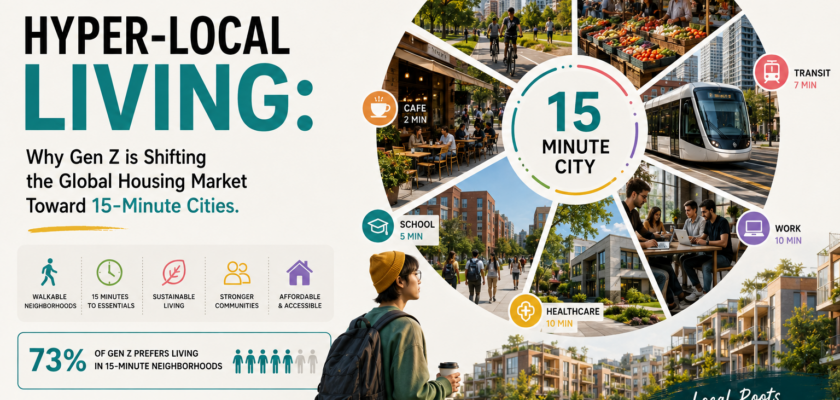
Hyper-Local Living: Why Gen Z is Shifting the Global Housing Market Toward 15-Minute Cities.
The global real estate market is undergoing a profound, structurally permanent generational transition. For decades, the blueprint of property investment followed rigid, car-dependent paths: develop sprawling suburban tracts located miles away from city centers or price-gouge retail buyers for tiny apartments crammed directly inside massive metropolitan commercial cores. Success for previous generations meant tolerating grinding multi-hour commutes in exchange for square footage or corporate proximity.
However, as we cross into May 2026, that conventional layout is experiencing an unprecedented decline. Led by a massive wave of younger buyers entering the homebuying arena, a clean paradigm shift is taking root.
We have entered the defining era of Gen Z 15 Minute Cities Housing 2026 trends.
Driven by an absolute rejection of long car commutes, escalating environmental anxieties, and a native demand for digital-first autonomy, the youngest generation of home buyers is completely abandoning legacy urban sprawl. Instead, they are concentrating their immense economic current into master-planned, polycentric neighborhoods where work, healthcare, nutrition, schooling, and leisure exist within a strict 15-minute walk or bike ride from their front door. Here is how hyper-local living is forcing developers, lenders, and urban planners to fundamentally restructure global housing inventory.
1. The Drivers of the Hyper-Local Pivot
The migration toward a Gen Z 15 Minute Cities Housing 2026 framework is powered by a mixture of intense economic realities and non-negotiable lifestyle upgrades. Younger buyers are not looking at housing through the static lens of past generations; they view real estate as a dynamic asset that must adapt to an optimized daily life.
A. The Eradication of Commuter Friction
Gen Z views mandatory car ownership and multi-hour roadway congestion as an unnecessary operational liability. Fueled by the normalization of remote work and local co-working networks, younger professionals demand a “return to a local way of life”. They prefer a walk to a neighborhood café over sitting in gridlocked traffic, transforming how they evaluate regional property premiums.
B. The “Walkability Premium” Capital Shift
Recent spatial-economic data demonstrates that property values are rising significantly in micro-markets featuring high walkability indices, integrated green zones, and polycentric service hubs. This “diversity premium” is shifting institutional investor money away from monoculture residential blocks toward mixed-use developments that blend micro-apartments directly with retail, public squares, and hyper-local transit nodes.
                  [ Conventional Urban Sprawl ]
    (Car-Dependent, Isolated Zones, Exhausting Commutes)
                                │
                                ▼
               [ The Gen Z Real Estate Disruption ]
   (Demanding Instant Proximity, Micro-Hubs, & Green Spaces)
                                │
         ┌──────────────────────┴──────────────────────┐
         ▼                                             ▼
┌───────────────────────────────┐             ┌───────────────────────────────┐
│     The Legacy Metro Core     │             │   The 15-Minute Urban Hub     │
│  ❌ Commuter Fatigue          │             │  ✅ Walkable Workspaces       │
│  ❌ Volatile Fossil Fuel Costs│             │  ✅ Decentralized Clean Grids │
│  ❌ Sky-High Entry Barriers   │             │  ✅ Hyper-Local Micro-Economy │
└───────────────────────────────┘             └───────────────────────────────┘
2. Tier-II Acceleration and the Digital-First Lending Landscape
A fascinating anomaly of the Gen Z 15 Minute Cities Housing 2026 macro trend is its geographic footprint. Rather than choking out expensive tier-I capital megacities, hyper-local configurations are finding hyper-growth inside secondary tier-II and tier-III regional corridors.
In expanding housing economies like India, smaller, tech-forward cities are emerging as the epicenter of new development. These markets naturally support polycentric planning, offering spacious, affordable ground-up footprints where developers can construct fresh 15-minute communities from scratch.
Furthermore, Gen Z is radically accelerating the speed of home financing. Moving entirely away from slow, manual bureaucratic paper trails, an extraordinary 72% of buyers under the age of 40 demand digital-first lending journeys. Utilizing digital infrastructure stacks and automated paperless verifications, this cohort expects home loan approvals within a lightning-fast 24-to-48-hour window. This rapid transaction speed allows them to snap up high-demand, walkable properties long before traditional buyers can exit the manual underwriting pipeline.
3. Strategic Matrix: Sprawl Real Estate vs. 15-Minute Micro-Hubs
| Market Matrix | Legacy Suburban Sprawl Developments | Gen Z 15-Minute Cities Housing (2026) |
| Mobility Architecture | Car-dependent; isolated residential zones | Human-scale; prioritized for walking & cycling |
| Zoning Framework | Monofunctional; long gaps between amenities | Mixed-use; vibrant, deeply integrated diversity |
| Financing Mechanics | Slow, paper-heavy traditional bank loans | Digital-first paperless setups (24-48 hr approvals) |
| Core Value Driver | Maximum square footage per property unit | Proximity, spatial flexibility, and environmental health |
| Risk Characterization | Volatile fossil fuel exposure & asset isolation | Minimized Risk; autonomous, insulated micro-economies |
4. Overcoming the Structural Obstacles of Density
While the demand for the Gen Z 15 Minute Cities Housing 2026 model is hitting record highs, structural developers and urban planning councils openly recognize that building complete neighborhood autonomy introduces steep execution challenges.
The primary obstacle is the risk of Socioeconomic Displacement. Because highly accessible, walkable neighborhoods are in incredibly high demand, they naturally command premium capital investment currents. Left unregulated, the commodification of these micro-cities can trigger a sharp inflation spike in land values, pricing out essential workers and lower-income demographic brackets.
To completely solve this systemic operational liability, forward-looking cities are deploying the “Just 15-Minute City” framework. Urban planners are actively integrating proactive social protections directly into zoning maps. This includes passing mandatory inclusionary zoning laws that tie high-end developments to affordable housing allocations, setting up free rental pockets near primary public transport hubs, and engineering flexible, community-owned public squares. By enforcing these equity guardrails, municipalities ensure that proximity benefits the whole community rather than fracturing urban zones along class lines.
Conclusion
The era of structural reliance on cars and sprawling, disconnected housing developments is reaching its final destination. The widespread rise of Gen Z 15 Minute Cities Housing 2026 dynamics proves that the future of wealth preservation and urban development rests entirely on human-scale design.
By trading the exhausting, slow abacus maze of long highway commutes for the high-yield, frictionless utility of walkable community rings, younger buyers are building a resilient blueprint for the global real estate economy. They are demonstrating that a truly wealthy life isn’t defined by how much distance you can cover, but by how beautifully, sustainably, and efficiently your world is arranged right outside your front door.


