
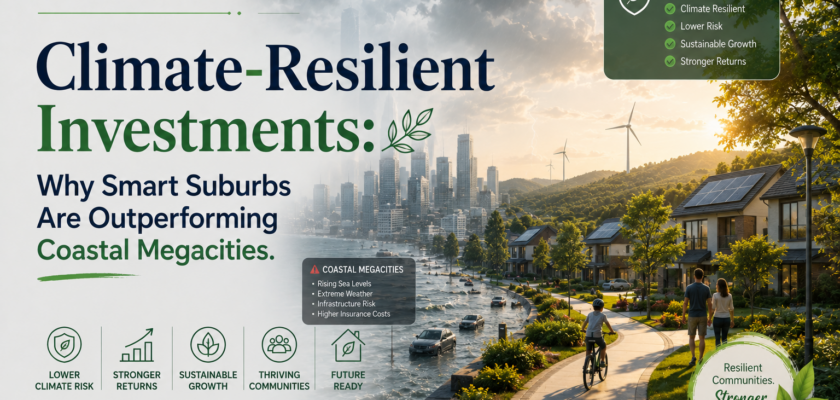
Climate-Resilient Investments: Why Smart Suburbs Are Outperforming Coastal Megacities.
The foundational playbook of global real estate investing is facing an unprecedented, structural asset correction. For decades, institutional capital followed a predictable, high-yield formula: buy premium, high-density residential and commercial real estate across dominant coastal megacities. Proximity to major ocean trade hubs and dense metropolitan centers were the undisputed drivers of long-term property premiums.
However, as we progress through May 2026, that conventional formula is experiencing a massive valuation crisis known as the “Climate Property Bubble”. Driven by repetitive, billion-dollar weather events and structural economic vulnerabilities, a historic capital migration is occurring under the surface.
The clear beneficiary of this flight to safety is Climate Resilient Investments 2026. Master-planned, inland “Smart Suburbs” and secondary tier-II regional hubs are systematically outperforming coastal megacities across global real estate indices. By swapping geographical vulnerability for autonomous infrastructure, decentralized resources, and long-term insurability, these suburban micro-markets are delivering what sinking metros no longer can: uncompromised capital preservation.
1. The Coastal Megacity: Inside the Insurance and Valuation Crisis
The operational decline of the traditional coastal metropolis is no longer a long-term projection; it is a live balance-sheet threat. Densely packed coastal economic engines are grappling with a dual-crisis of physical exposure and financial attrition:
- The Exposure Deficit: Across major global coastlines, rising sea levels and intense storm surges have pulled millions of premium properties out of safe baselines into high-risk annual flood zones.
- The Insurance Desert: The immediate catalyst popping the coastal property bubble is the collapse of the property coverage market. Stranded by accelerating underwriting losses, major commercial insurance carriers are raising premiums by double digits—or choosing to exit high-risk coastal regions entirely.
- Mortgage Constraints: When property insurance becomes structurally unavailable or too expensive to maintain, institutional lenders tighten their mortgage underwriting criteria. This cuts off standard retail buying power, turning prized waterfront real estate into major operational liabilities.
2. The Smart Suburban Framework: Low-Friction and Autonomous Scale
While legacy coastal megacities struggle with decaying drainage systems and high-density grid lockouts, master-planned smart suburbs are capturing institutional capital by designing for Autonomous Precision from the ground up.
In emerging real estate corridors, this shift is accelerated by the strategic development of City Economic Regions (CERs). These are master-planned satellite hubs explicitly engineered to de-congest tier-I metros, routing housing supply and commercial development into climate-sheltered, inland topographies.
                  [ Global Capital Current Migration ]
                                   │
         ┌─────────────────────────┴─────────────────────────┐
         ▼                                                   ▼
┌─────────────────────────────────┐                 ┌─────────────────────────────────┐
│ Legacy Coastal Megacities       │                 │ Smart Suburban CER Hubs         │
│ ❌ Exposure Spikes              │                 │ ✅ Inland Geographies           │
│ ❌ Insurance Non-Renewals       │                 │ ✅ Decentralized Solar Grids     │
│ ❌ Grid Vulnerabilities         │                 │ ✅ Nature-Based Bio-Swales      │
└─────────────────────────────────┘                 └─────────────────────────────────┘
         │                                                   │
         ▼                                                   ▼
[ Asset Valuation Attrition ]                      [ Premium Capital Appreciation ]
A. Blue-Green Infrastructure Systems
Next-gen smart suburbs replace rigid concrete layouts with adaptive, nature-based engineering. They integrate permeable pavements, deep bio-swales, and massive stormwater retention lakes into the landscape. These networks absorb flash flooding instantly, removing the threat of sudden property damage and panic-selling.
B. Passive Cooling and Grid Autonomy
Aligning with real estate benchmarks, modern suburban developments are adopting strict zero-emission building frameworks. By utilizing smart passive cooling technologies—such as solar shading, natural cross-ventilation, and high-reflectivity roofs—these assets natively slash indoor temperatures. This insulates properties from soaring municipal energy costs and rolling blackouts during intense heatwaves.
3. Strategic Matrix: Coastal Megacities vs. Resilient Smart Suburbs
| Investment Variable | Legacy Coastal Megacities | Climate-Resilient Smart Suburbs (2026) |
| Primary Topography | Low-lying coastal zones / High flood risk | Elevated, optimized inland micro-markets |
| Underwriting Status | Escalating insurance deserts & non-renewals | Highly insurable with predictable risk metrics |
| Energy Infrastructure | Centralized grid dependency / Thermal load exposure | Decentralized solar microgrids & storage assets |
| Valuation Trajectory | Structural attrition and climate-risk discounting | Premium capital appreciation & demand growth |
| Development Strategy | Costly reactive retrofitting & sea-wall building | Frictionless, proactive climate adaptation native |
4. Monetizing the Climate Resilient Premium
Allocating capital into Climate Resilient Investments 2026 has shifted from an environmental sentiment into a core fiduciary requirement. Global asset managers are pricing structural efficiency and climate resilience directly into underlying property valuations:
- The Green Valuation Boost: Institutional investment data reveals that implementing verifiable sustainability frameworks and passive energy designs boosts residential asset valuations by 3% to 8%, and commercial assets by an incredible 10% to 20%.
- Lower Default Risks: Macro-banking risk profiles demonstrate an indisputable correlation: properties engineered to withstand extreme climate and energy shocks have a significantly lower statistical probability of entering mortgage delinquency or payment arrears.
- Yield Preservation: Because smart suburbs utilize decentralized energy microgrids and circular water harvesting, their net operating incomes (NOI) remain highly insulated from volatile municipal utility hikes and unexpected disaster repair levies.
Conclusion
The geography of wealth is undergoing a permanent rewrite. The un-bottlenecked digital currents of 2026 mean that corporate networks, institutional builders, and high-yield founders no longer require physical placement inside legacy coastal downtown cores to scale operations.
By redirecting portfolio weights into master-planned, inland smart suburbs, forward-looking real estate investors are securing an undeniable Minimized Risk asset profile. The premium luxury of this decade has pivoted away from volatile oceanfront exposure toward absolute structural permanence, energy autonomy, and resource security in a changing world.


