


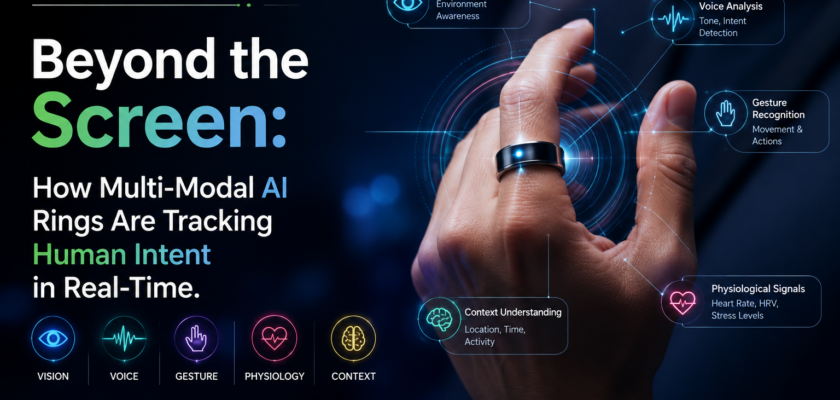
Beyond the Screen: How Multi-Modal AI Rings Are Tracking Human Intent in Real-Time.
The global tech landscape has hit a critical hardware inflection point. As of May 20, 2026, the industry is officially transitioning away from simple, screen-dependent applications. While traditional tech giants fought for dominance via massive smartphone panels, a counter-intuitive breakthrough has quietly occurred right on the human knuckle.
We have entered the era of Multi-Modal AI Ring Systems.
While early smart rings were built to act as passive health monitors—tracking sleep patterns, heart rate variability, and blood oxygen levels—the 2026 hardware track has completely redefined the form factor into an “information catcher” and intent recognition engine. By combining hyper-dense sensor arrays with local, edge-processed Agentic AI, these tiny devices skip physical interfaces entirely. Instead, they capture the subtle physical variables of human movement and translate them into direct digital execution with absolute precision.
1. The Real-Time Translation Breakthrough
The true capability of Multi-Modal AI Ring Systems was highlighted earlier this month in a landmark development by a robotic and engineering team in South Korea. They introduced a system of wireless, flexible smart rings worn right below the finger knuckles that can translate rapid, natural sign language into spoken text in real-time.
┌─────────────────────────────────────────────────────────────────┐
│              Raw Finger Kinematics & Muscle Flex                │
│    Micro-accelerometers capture 3D bending & velocity loops     │
└────────────────────────────────┬────────────────────────────────┘
                                 │
                                 ▼
┌─────────────────────────────────────────────────────────────────┐
│               Edge AI Processing & Text Assembly                │
│    Data streams to host; localized models align gestures        │
└────────────────────────────────┬────────────────────────────────┘
                                 │
                                 ▼
┌─────────────────────────────────────────────────────────────────┐
│            Predictive Intention & Sentence Autocomplete         │
│  Context engines track flow to predict the user's next intent   │
└─────────────────────────────────────────────────────────────────┘
- High-Speed Capturing: Fluent users can communicate at lightning-fast speeds of 100 to 150 signs per minute. To eliminate the traditional lag and liability of old, wired translation systems, these modern rings process and broadcast data streams using edge micro-processors to prevent uncomfortable pauses.
- The “Autocomplete” Layer: The tech doesn’t just match movements against a rigid, static database. It relies on a local Predictive Model that tracks the flow of a conversation, allowing the AI to anticipate and autocomplete phrases instantly. In real-world trials across standard sign lexicons, the setup achieved an accuracy rate exceeding 88% on the very first try.
2. Intent Recognition: How the AI Decodes Action
To step completely beyond screens, these rings must navigate a fundamental technical challenge: separating accidental human fidgeting from definitive intent. To do this, the architecture uses a multi-modal data approach.
A. Micro-Kinematics Tracking
Instead of using heavy, restrictive gloves, these sleek devices deploy high-Hz, low-power micro-accelerometers. Placed right where the finger bends, the sensors track dynamic changes in curling, extension, and deceleration. The AI effortlessly differentiates a quick mid-air swipe to change a song from a simple, idle hand scratch.
B. Intent Recognition Loops
The magic happens when motion tracking is paired with contextual data. When you interact with mixed-reality environments or touchless computer interfaces, the ring cross-references your physical velocity with the layout of surrounding devices. Look at a smart light bulb and pinch your fingers—the ring registers the visual connection, matches the tiny physical flex, and instantly dims the light, executing an autonomous task loop with zero touch intervention.
3. Strategic Matrix: Health Trackers vs. Multi-Modal Intent Rings
| Engineering Attribute | Standard Smart Rings (Oura, basic bands) | Multi-Modal AI Ring Systems (2026) |
| Primary Utility | Passive biometric monitoring (Heart, Sleep) | Active input & real-time intent recognition |
| Data Flow | Periodic, asynchronous app syncs | Continuous, real-time, ultra-low latency streams |
| Core Sensors | Standard PPG optical sensors, basic thermal plates | High-Hz micro-accelerometers & bio-impedance components |
| Interaction Philosophy | Historical data logging and review | Context-aware spatial computing control |
| Operational Workflow | High friction (Requires constant screen checks) | Frictionless (Direct thought-to-device execution) |
4. Overcoming the Limitations of Solo Hardware
Despite their incredible spatial precision, hardware developers openly acknowledge that finger tracking alone cannot decode the full spectrum of human intention.
When we communicate or express intent, a massive portion of the message is non-verbal. Human tone, speed, facial expressions, and body posture carry crucial emotional parameters. Without this broader context, any isolated hardware device faces an inherent risk of misinterpreting a command.
To solve this operational liability, the industry is moving aggressively toward Hardware Hybridization. Multi-modal rings are being engineered to function as parts of a larger personal area network. By linking the ring’s precise finger-tracking data with the computer vision of smart glasses and the voice-transcription engines of smart earphones, the AI gains a comprehensive, multi-dimensional view of the user’s environment. The ring tracks where you point, the glasses identify what you look at, and the earphone listens to what you command—forming a unified digital loop that processes human intent with flawless accuracy.
Conclusion
The era of typing on physical keyboards and tapping on glass surfaces is nearing its expiration date. Multi-Modal AI Ring Systems are proving that the most efficient interface is the one we are born with: our natural body language. By packaging near-invisible form factors with advanced spatial intelligence, these wearable systems turn the human hand into a universal digital controller.
As these tools move out of experimental research labs and merge with our daily hardware networks, we are moving toward a frictionless future. We are shedding the weight of heavy screens and step-by-step app menus, allowing us to interact with the digital world at the fluid speed of natural human movement. The screens are fading away—and the future of computing is resting right on our fingers.


