
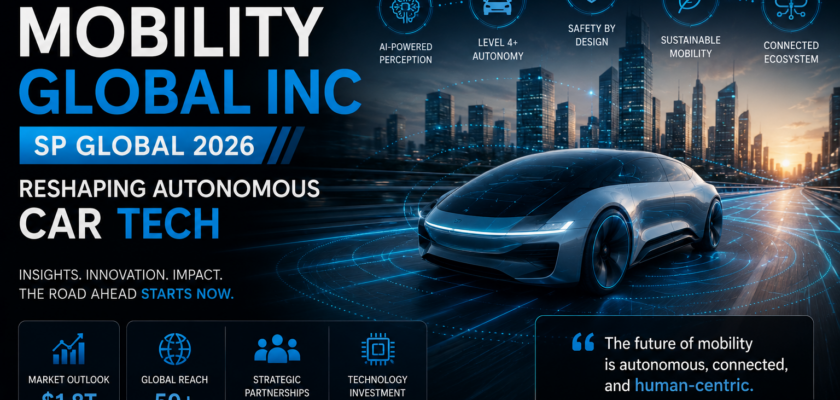
S&P Global’s Mobility Split: How the New ‘Mobility Global Inc’ Will Change Autonomous Car Tech.
The institutional data structure backing the global automotive sector has reached a monumental fork in the road. On May 21, 2026, S&P Global Inc. announced that its Board of Directors officially approved the spin-off of its massive Mobility division into a completely independent, publicly traded entity named Mobility Global Inc..
The corporate split, structured as a pro rata distribution of 100% of Mobility Global’s common stock to existing shareholders, is scheduled to take effect at 12:01 a.m. New York City time on July 1, 2026. Regular-way public trading will commence on the New York Stock Exchange under the definitive ticker symbol “MBGL”.
This is not just a standard corporate shuffling or balance-sheet cleanup. By spinning off massive automotive data engines like CARFAX, Polk Automotive Solutions, automotiveMastermind, and Market Scan into a dedicated standalone company, the restructuring frees a massive “information current”.
Unchained from S&P Global’s core financial rating architectures, Mobility Global Inc. is positioned to run with Autonomous Precision. The new entity will serve as the absolute data framework driving the commercialization, predictive modeling, and safety validation of autonomous vehicle (AV) tech.
1. Bypassing Bureaucracy: Speed and Un-Bottlenecked Capital
Before the 2026 spin-off approval, S&P Global Mobility operated as an internal division within a larger financial matrix. When developing advanced AI pipelines for automotive predictive analytics, the division had to compete internally for corporate capital against highly profitable credit rating and index benchmark wings.
                    [ Legacy S&P Global Structure ]
       (Capital allocation divided between Ratings, Indices, & Mobility)
                                   │
                                   ▼
                 [ The 2026 Spinoff Restructuring ]
   (Mobility Global Inc. stands alone with un-bottlenecked focus)
                                   │
         ┌─────────────────────────┴─────────────────────────┐
         ▼                                                   ▼
┌─────────────────────────────────┐                 ┌─────────────────────────────────┐
│     S&P Global Parent (SPGI)    │                 │   Mobility Global Inc. (MBGL)   │
│  • Focuses on index frameworks   │                 │  • 100% Automotive Intelligence │
│  • Capital data rating modules  │                 │  • Dedicated AV Data Engine     │
│  • Core financial benchmarking   │                 │  • Direct Tech Acquisitions     │
└─────────────────────────────────┘                 └─────────────────────────────────┘
By separating into a pure-play automotive intelligence firm, Mobility Global Inc. gains structural agility. Led by CEO-designate Bill Eager, the company has already completed a massive $2,000,000,000 private offering of senior notes alongside a $500 million credit facility to build a robust operating foundation right out of the gate.
This un-bottlenecked access to capital ensures the company can aggressively pursue targeted AI software acquisitions, rapidly deploy machine learning infrastructure, and partner directly with hardware manufacturers without corporate friction.
2. Structuring the Data Engine for L4 and L5 Autonomy
Autonomous car tech cannot scale in a silo. For a self-driving system to operate with true reliability, its onboard computers must be trained on high-volume, real-world vehicle histories, component lifecycle degradation tracking, and massive behavioral trends.
Mobility Global Inc. holds a massive competitive advantage here, managing an exceptional baseline database: over 30 million lines of monthly forecast data and more than 28 billion unique vehicle history records.
A. Predictive Component Maintenance Telemetry
Leveraging its massive Polk and Market Scan asset lines, Mobility Global Inc. can build continuous predictive simulations tracking how specific vehicle components fail across varying terrains and thermal loads. Autonomous fleet management systems can feed live telemetry directly into the new platform, utilizing real-time data to swap out parts before a critical hardware breakdown occurs mid-route.
B. The “CARFAX for AI”: Mapping Sensor Degradation
As autonomous cars age, their primary hardware arrays—including high-Hz LiDAR sensors, micro-radar units, and multi-angle cameras—suffer from environmental wear and performance decay. By integrating the massive CARFAX data network directly into autonomous fleet registries, the platform can cryptographically verify if a self-driving vehicle’s perception array has maintained its original factory safety calibrations.
3. Strategic Matrix: Internal Corporate Division vs. Standalone Entity
| Operational Vector | S&P Global Mobility (As an Internal Division) | Mobility Global Inc. (Standalone “MBGL” Entity) |
| Capital Architecture | Shared internal budgets; strict parent oversight | Independent public equity; direct $2B cash options |
| Primary Industry Focus | Generic corporate analytics & financial summaries | 100% specialized automotive intelligence workflows |
| Autonomous Car Utility | Static, broad vehicle registration lookups | Real-time API integrations for AV fleet training |
| Strategic Flexibility | Slow, multi-tiered acquisition approval chains | Frictionless M&A execution targeting software firms |
| Risk Dynamic | Operational slowness due to broad corporate goals | Minimized Risk; targeted, high-yield asset focus |
4. Redefining the Autonomous Risk and Insurance Landscape
The most critical bottleneck delaying the widespread deployment of commercial robotaxis and autonomous delivery trucks is the complex issue of liability underwriting. Traditional insurance companies struggle to write policies for autonomous fleets because they lack long-term, specialized actuarial data frameworks to calculate autonomous risk profiles.
Mobility Global Inc. is positioned to solve this systemic bottleneck. By combining comprehensive, localized accident registries with advanced vehicle telemetry analytics, the platform can offer insurers an unparalleled view of AV safety profiles.
The platform’s predictive models can analyze exact vehicle interactions, edge-case structural vulnerabilities, and regional road risk metrics. This shifts autonomous underwriting away from an un-falsifiable guessing game into an exercise in Autonomous Precision. Armed with this clarity, insurance pools can comfortably lower premiums for verified autonomous operations, clearing the path for self-driving fleets to scale across major metropolitan corridors.
Conclusion
The creation of Mobility Global Inc. marks a permanent evolution in the maturity of the alternative transport landscape. The spinoff proves that in the modern digital economy, data cannot simply be treated as a secondary asset hidden inside a massive corporate balance sheet. It must operate as an independent, high-speed engine designed to match the accelerating pace of real-world innovation.
By shaking off the slow bureaucratic processes of the past and establishing a laser-focused corporate structure, Mobility Global Inc. is providing the essential data foundation that the autonomous car market has long missing.
The future of self-driving vehicles won’t just be won by refining camera sensors or tweaking deep learning algorithms; it will be built upon the unshakeable, multibillion-record intelligence networks that monitor vehicles from the factory floor to their final mile. As July 1 approaches, the automotive industry isn’t just watching a stock spin-off—it is witnessing the launch of the core data refinery for the driverless era.


